




Plymouth-based M SUBS Ltd were commissioned to design the 24m ‘Oceanus’
Set to usher in a new era for net zero oceanography and advanced international marine research, Plymouth Marine Laboratory has revealed designs for the world’s first long-range autonomous research vessel.
Supported by seed funding from the Natural Environment Research Council (NERC), the sleek, futuristic-looking and fully unmanned ‘Oceanus’ has been designed as a self-righting, light-weight, mono-hulled autonomous vessel capable of carrying an array of monitoring sensors to collect data for research into critical areas such as climate change, biodiversity, fisheries and biogeochemistry.
Designed primarily to make the transatlantic sampling voyage from the UK to the Falklands, the Oceanus will carry an advanced scientific payload and use the latest AI technology to help navigate the best course to its target location, with real-time input from weather forecasts and other marine data feeds.
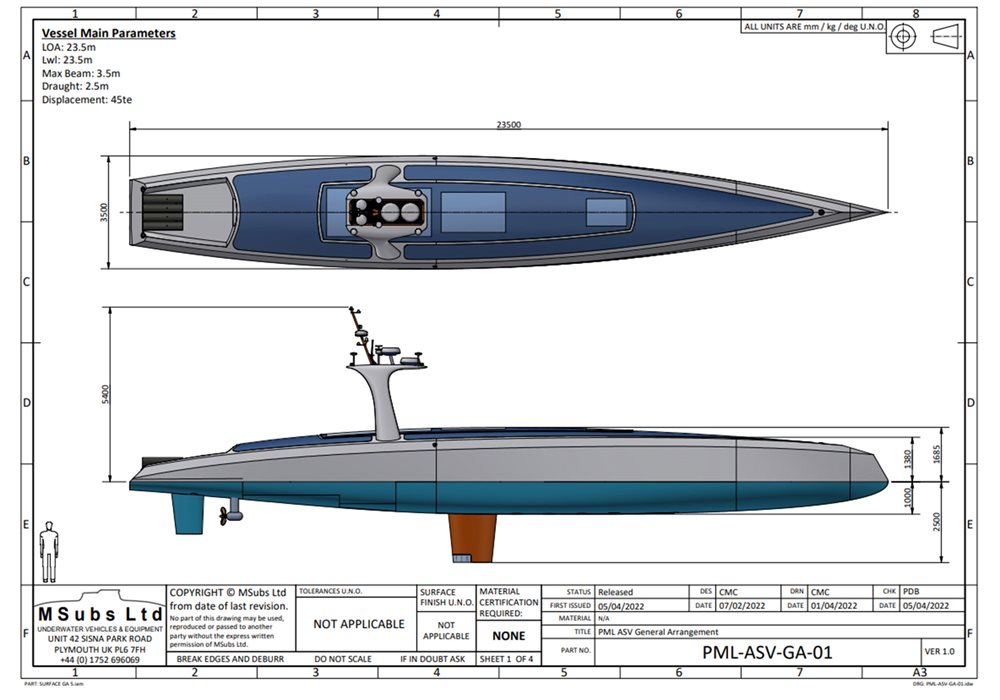 Above: Technical drawing of the Oceanus. Click here to download the technical drawings and specification of the vessel (PDF 2.6MB)
Currently most oceanographic sampling is performed either through fully-manned research trips or via moored data buoys and smaller autonomous devices, such as PML’s recently launched Autonaut and EcoSubs as part of Smart Sound Plymouth.
Although still important for validation purposes and more complex tasks, research trips are costly, logistically challenging and have an environmental footprint while smaller autonomous devices are restricted in their range.
The Oceanus represents a ground-breaking vision of how long-range marine research can be carried out in a more environmentally-benign way. While a fuel-efficient diesel engine will still feature, it will be complemented by on-board micro-energy generation devices and solar panels on the deck. With the weight of people and living facilities also removed this will greatly reduce fuel consumption compared with traditional manned research vessels.
The Command Centre for Oceanus will be hosted at PML and will display oceanographic conditions in near-real time across the ship’s transect, providing scientists and other users with open access to the latest and most robust oceanographic data.
In situ sampling will still be needed at times to validate the autonomously collected data and to perform more complex monitoring and experiments that require proximity to the sample sources. However, autonomy on this scale will allow for radically more responsive and more frequent data collections at a wider range than currently possible, helping to plug any gaps in datasets and greatly improve marine modelling.
The idea for the vessel was borne in the wake of the Mayflower Autonomous Ship, also developed and built in Plymouth by M Subs Ltd and partners including IBM. The vessel’s name Oceanus was the name of the first child to be born on the original Mayflower in 1620.
The RV Oceanus will be an exciting platform for innovation and the team hope that this vessel of the future will eventually enable a remote Atlantic Meridional Transect (AMT), a unique annual marine research expedition along the length of the Atlantic Ocean that embarked on its first voyage in 1995. An autonomous AMT could lead to multiple data collection missions a year to give a much better understanding of the dynamics of the ocean environment.
Icarus Allen, Chief Executive of Plymouth Marine Laboratory, said:
“This is a hugely exciting venture, with the capacity to revolutionize the way we carry out marine research expeditions and support the drive towards net zero. The Oceanus will exploit the very latest in AI technology, enabling us to push the frontiers of marine science and open up new opportunities in how we monitor the ocean environment. Not that long ago this would have been the stuff of science fiction fantasy but through the design and development of the Oceanus we are really unlocking the future of ocean-going marine research.”
Brett A Phaneuf, Managing Director, M Subs Ltd: “It’s a privilege to work with the team at M Subs Ltd and PML and aid in the design, construction and operation of novel, autonomous ships that will add significantly to the corpus of knowledge about our Ocean and the planet in general. The voyages of exploration the RV Oceanus will undertake are matched in intensity by the parallel technological voyage to bring into being a new era in climate science – at lower fiscal and ecological cost.”









, the sleek, futuristic-looking and fully unmanned ‘Oceanus’ has been designed as a self-righting, light-weight, mono-hulled autonomous vessel capable of carrying an array of monitoring sensors to collect data for research into critical areas such as climate change, biodiversity, fisheries and biogeochemistry.)