


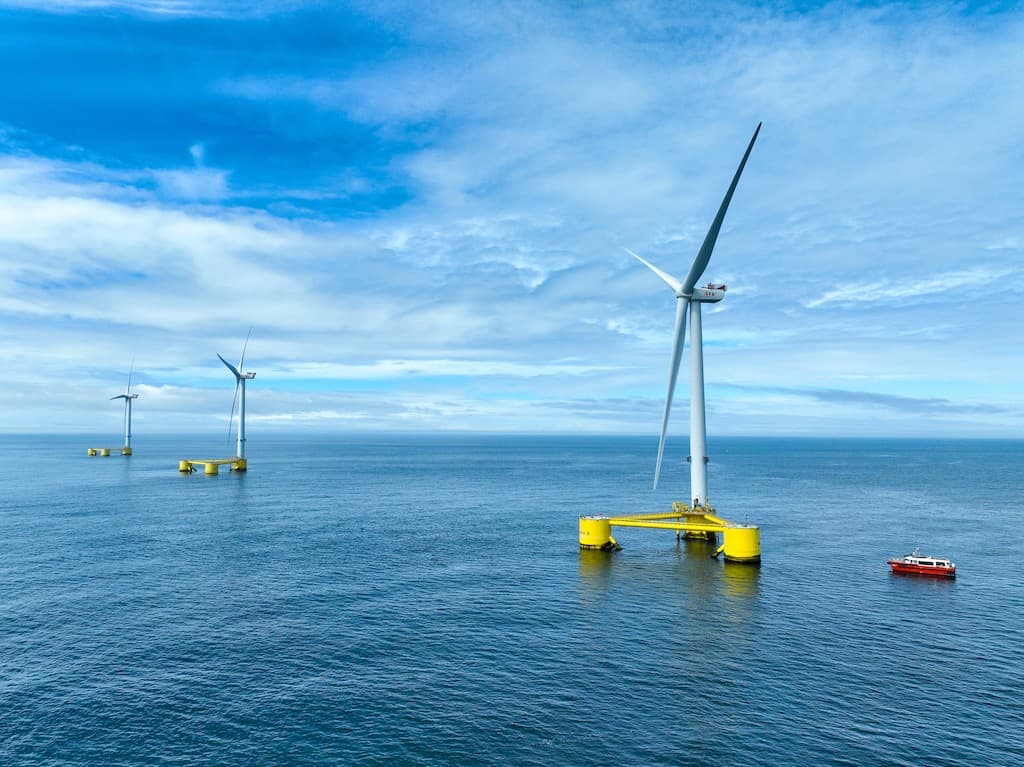
Portugal is accelerating efforts to become a world leader in the rapidly emerging floating wind sector through specially adapted ‘Technological Free Zones’, offering innovation spaces to develop new technology.
Building on a firm foundation for demonstrating novel marine renewable projects, Portugal is now positioning itself as a global frontrunner in the floating wind space, helping underpin ambitious national targets and a surge in global developments.
Earlier this year, five Portuguese institutions – CEiiA, CoLAB+ATLANTIC, Fórum Oceano, INESC TEC, and WavEC Offshore Renewables – formed the OceanACT-Atlantic Lab for Future Technologies. Tasked with managing the Aguçadoura test site and exploring the possibility of being the managing entity of Viana do Castelo pilot zone, on the north coast, specialising in the development, test, demonstration and qualification of marine and offshore renewable technologies.

Speaking at WavEC Offshore Renewables’ Annual Conference in Lisbon, newly appointed WavEC CEO Marco Alves said the establishment of Technological Free Zones will provide a further springboard for floating wind developers, unlocking pre-consented areas with active grid connections and reduced regulatory processes. “This is an exceptionally exciting time for the marine energy space. It was clear from our conference which centred around offshore wind innovations across Iberia, that floating wind in particular will play a significant role in the future energy transition. In recognition of this opportunity, Portugal is now planning specially adapted Technological Free Zones to turbo-charge development.”
Portugal joins a small group of countries which have launched similar regimes including Australia, Canada, India, Singapore and the United Kingdom. With national plans to install 10 GW of offshore wind capacity by 2030, the measures aim to unlock a massive 131 GW offshore wind resource, 90pc of which is located in deep waters and dependent on floating foundations. Meanwhile, Spain’s recently approved Offshore Wind Roadmap aims to install 3 GW by 2030, which is all likely to be floating platforms.
The news comes as project developer BayWa r.e. seeks to secure rights for the world’s first subsidy-free floating wind farm off the coast of Viana do Castelo. Working with the Portuguese Government, the planned 600 MW, 30-turbine development could provide a blueprint for future bidding projects, delivered through a Power Purchase Agreement (PPA) free from public subsidy.
Speaking at the conference Ricardo Rocha, Technical Director Offshore Wind at BayWa r.e. said: “This ground-breaking project is set to be developed in a dedicated zone off the coastline of Viana do Castelo, which forms part of the Portuguese government’s broader marine spatial plan. We believe it can play a vital role stimulating the creation of a global floating offshore wind supply chain here in Portugal, bringing a range of socio-economic benefits for many generations to come and becoming an example which can attract other relevant producers, helping Portugal to reach its ambitious goal of installing 10 GW of offshore power plants and decarbonize its energy sector.”
Portugal has already hosted several innovative ocean energy demonstrations, with the world famous WindFloat Atlantic project now powering 60,000 homes with clean, renewable energy, from Viana do Castelo’s pilot zone. Further plans are afoot with Welsh marine energy developer, Marine Power Systems, to deploy a unique modular floating offshore wind platform, PelaFlex. CorPower Ocean’s flagship HiWave-5 wave energy demonstration project is also preparing to launch at the Aguçadoura test site imminently.
Speaking at the conference, ACCIONA Naval Architect Misael Goicoechea, said: “It’s very positive to see Portugal reinforcing its commitment to delivering world-class testing facilities through the OceanACT initiative, with administrative processes underway to establish a state-of-the-art testing centre in 2023. It comes at an important time as both Spain and Portugal prepare for the first auctions for offshore wind.”
Fellow panellist José Oliveira, Floating Wind Technical Manager at Ørsted, said: “Ambitious floating wind deployment targets are being set by countries worldwide, and while challenges lie ahead to deliver the technology at the pace required, significant progress can be achieved through close collaboration between key actors. This begins at the demonstration phase and extends right across the value chain to final project developers and licensing and consenting authorities. We must be galvanised in our approach.”
Event moderator Luísa Carrilho da Graça, GA_P – Gómez-Acebo & Pombo Abogados, said: “Portugal is firmly positioning itself at the forefront of the floating wind movement through the announcement of an ambitious 10 GW offshore wind auction for 2023. In the interest of the development of the national value chain and the acceleration of industrial scale growth in Portugal, the development of unsubsidized offshore wind projects in suitable areas of the Portuguese maritime space should progress without the need to wait for the auction.”
The ‘Offshore Wind in Iberia: Innovation & Perspectives Conference’ took place on November 10, at Museu do Oriente, in Lisbon, Portugal. The event was organised by WavEC Offshore Renewables, in collaboration with the Embassy of Spain in Portugal.
For more information on WavEC visit www.wavec.org