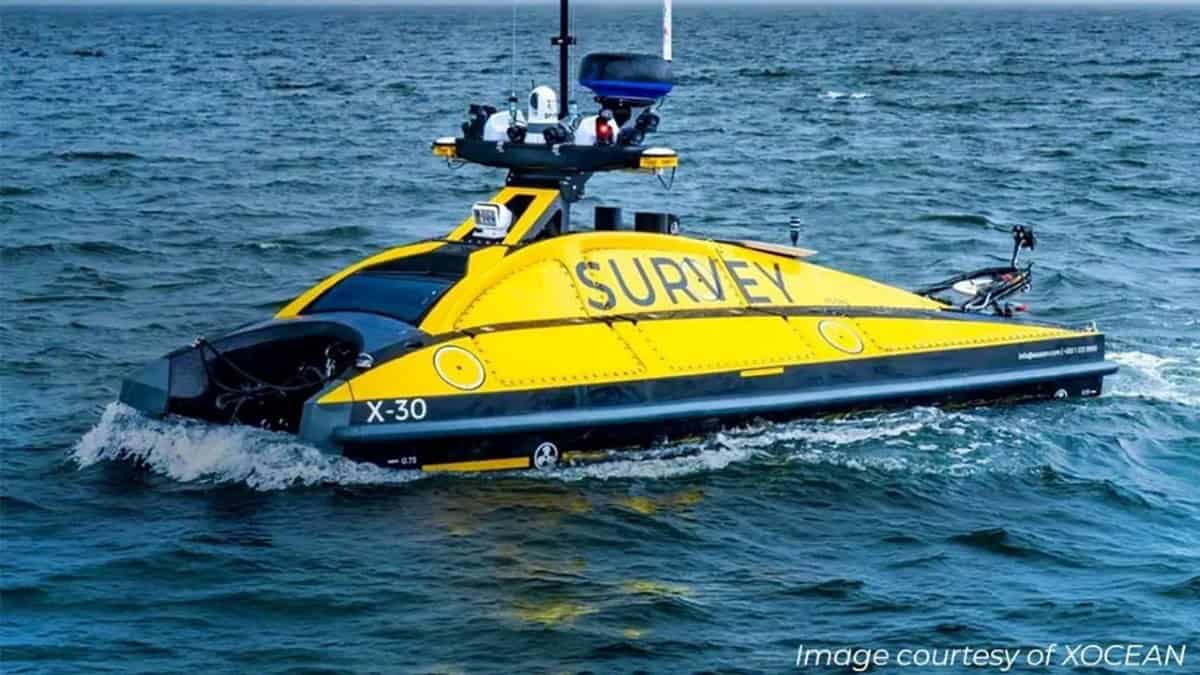
New XO-580 USV builds on operational lessons from the X-450 while maximising the footprint of a standard 20ft ISO container.
Rockabill Marine Design (RMD) has revealed details of its involvement in the development of XOCEAN’s latest autonomous survey platform, the XO-580 uncrewed surface vessel (USV), providing naval architecture and structural engineering services for the next-generation catamaran.
The project began shortly after the establishment of RMD, when XOCEAN approached the company with a clear objective: create a new vessel platform that would build on the operational success of the existing X-450 while maximising the dimensional envelope of a standard 20ft ISO container.
The resulting XO-580 increased the vessel length to 5.8 metres overall and adopted modern composite construction techniques, creating a compact production-ready platform designed specifically for offshore survey operations.
From the outset, the project focused on balancing operational capability, manufacturing efficiency and long-term fleet scalability.
RMD’s involvement began during the concept stage, with multiple hull forms and deck arrangements developed and assessed against the vessel’s operational requirements. Hull efficiency, wetted surface area, pod-drive integration, skeg configuration, stability, equipment packaging and production methodology all formed part of the design process.
The final vessel is a compact twin-hull platform measuring 5.8 metres overall with a beam of 2.25 metres and a draft of approximately 0.5 metres. The arrangement incorporates dedicated spaces for propulsion, generators, fuel systems, sonar deployment equipment, bow thrusters and mission payloads, reflecting the practical realities of offshore survey work.
During development, the introduction of MCA Workboat Code Edition 3 required the evolving design to be reviewed against updated regulatory requirements. The XO-580 was subsequently developed for operation under Workboat Code Edition 3, Category 0.
Alongside naval architecture development, RMD undertook structural engineering and analysis of the composite platform, helping verify the vessel against both global and local loading conditions expected during offshore operations.
What began as a single vessel programme has since grown into a fleet. The second vessel is now complete, with additional vessels in build as XOCEAN continues to scale the platform across its survey operations.
Ruairí Grimes, Founder of Rockabill Marine Design, said: “The XO-580 is a good example of what happens when operators, builders and designers stay closely aligned throughout a project. Every decision was driven by the operational requirements of the platform, from the hull form through to the structural design and production approach. The result is a compact vessel designed to do a very specific job well, while remaining practical to build, certify and scale.”
As autonomous marine operations continue to grow, projects like the XO-580 demonstrate the value of practical naval architecture developed around real operational requirements. For RMD, it reflects the type of work the business increasingly focuses on: specialist commercial vessels where engineering, operation and buildability all need to work together from day one.