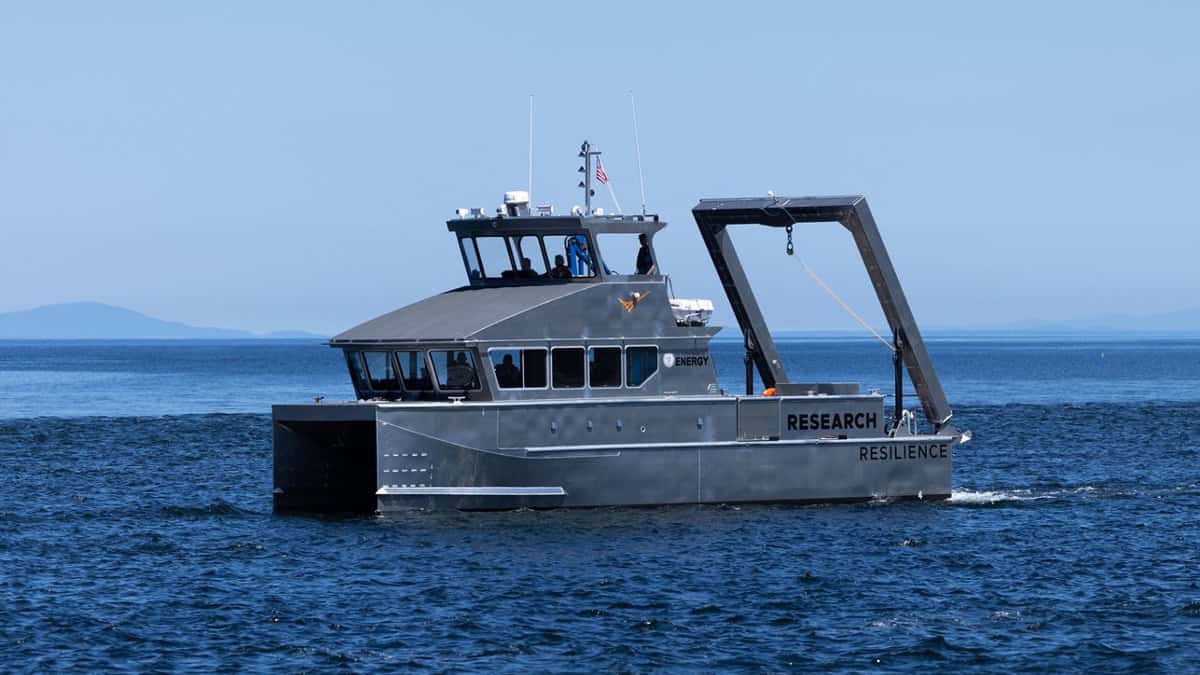
RV Resilience, a new, state-of-the-art hybrid research vessel designed by global digital shipbuilder Incat Crowther and built by Snow & Company has been delivered to the US Department of Energy’s Pacific Northwest National Laboratory (PNNL).
In an important milestone, RV Resilience is the Department of Energy’s very first hybrid electric-diesel research vessel. Ushering in a new era for research for the Department of Energy, the 15-metre hybrid catamaran research vessel will help PNNL sustainably expand its research activities in the Sequim Bay region of Washington state.
Offering exceptional capability for a vessel of its size, RV Resilience’s 28m2 main deck is equipped with an A-Frame, boom crane and movable davit in addition to a foldable swim platform. Designed to support the work of six scientists, RV Resilience also features multiple research workstations and convertible sleeping arrangements for multiday assignments.
Sustainability and operational flexibility have been enhanced via the vessel’s advanced parallel hybrid-electric propulsion system. While RV Resiliencecan travel at speeds of up to 23 knots on its two main diesel engines, it can quickly transition to a silent, all-electric mode capable of speeds of up to 7 knots. This silent, all-electric mode will allow the PNNL researchers to conduct their activities with minimal noise pollution, allowing for enhanced research capabilities when taking sensitive acoustic measurements.
“This first-in-class electric hybrid vessel will greatly expand our R&D and testing capabilities and help us build new partnerships,” said Christian Meinig, Division Director for PNNL’s Coastal Sciences Division. “The large working deck and heavy lift capability will allow us to deploy and recover larger instruments and uncrewed vehicles to rapidly develop technology and deliver impact to our sponsors.”
“RV Resilience opens up a whole new set of research possibilities and potential collaborations that we’re excited to share with the world,” said TJ Heibel, Renewable Energy Lead for Pacific Northwest National Laboratory .
Grant Pecoraro, Incat Crowther’s US Managing Director said, “The successful delivery of RV Resilience adds to Incat Crowther’s growing track record of working with our partners to design, construct and deliver state-of-the-art, low and zero-emission vessels. RV Resilienceis a truly bespoke vessel, designed specifically to the PNNL’s operational requirements and was a true collaboration between our team of digital shipbuilders, our partners at Snow & Company as well as the team at PNNL.”
Propulsion and Performance
- Speed (Electric) – 7.0 knots
- Maximum Speed – 23.0 knots
- Range – 400 nm
- Main Engines – 2 x Volvo Penta D8-510
- Installed Power – 2 x 374 kW @ 2850rpm
- Gearboxes – 2 x Twin Disc MGX-5075 SC
- Propulsion – 2 x Propellers
- Generators – 2 x Danfoss EM-PMI375-T200-2600