



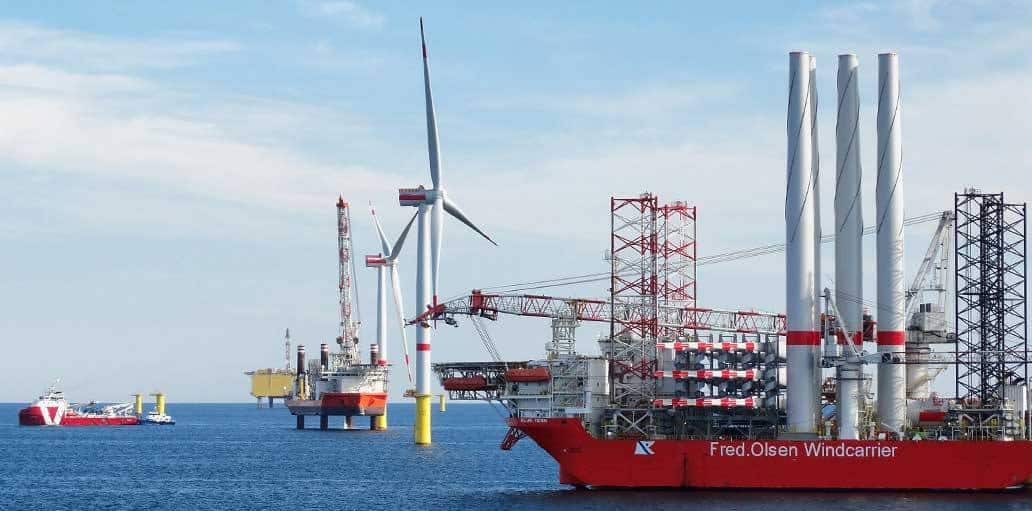
DNV and partners confirm the completion of Phase 1 of a joint industry project (JIP) on Bottom Impact and Partially Submerged Conditions which has resulted in a new framework for optimising the installation process of offshore wind turbines. New partners are encouraged to join Phase 2, which will focus on validating models and establishing common best-practice guidelines to the benefit of the entire industry.
Offshore wind-turbine installation is currently done in very benign weather conditions to limit WTIVs bottom impact of the jack-up legs with the seabed during the set-down phase. This severely restricts their operability and results in high day rates that make delays very costly for operators and charterer. Regions exposed to earthquake risk also require new operation philosophies such as operating the crane with the WTIV in a semi-jacked condition.
“As the industry moves further into new territory with harsher weather, less forgiving seabed conditions and seismic areas, there is an increased urgency to widen the weather window so projects can be completely more efficiently,” says JIP steering committee chairman Andries Hofman of GustoMSC BV.
The absence of guidelines and models to fully understand bottom-impact forces and operations in the semi-jacked condition triggered the initial formation of the JIP in November 2020. The early aim was to investigate operational limits and explore potential new operational practices. Reducing installation costs is key to bringing down the cost of offshore wind energy amid the drive to boost energy security. Pushing the boundaries without compromising on safety needs to be founded on validated knowledge.
“The JIP work will be relevant for a long time to come, as bottom-fixed wind farms that require jack-up installation will remain most cost-attractive way to diversify our energy mix. “ says JIP project manager Antonio Goncalves, Business Lead, Technical Advisory at DNV. “The market is developing quicker than the rules and the only way to make significant leaps is through sharing knowledge. Through better understanding of the forces are at play and their consequences, we can increase performance and safety in worse sea conditions, enabling more efficient and timely turbine installation, which is a great opportunity for the whole industry.”
Phase 1 resulted in a numerical model, developed by DNV and based on the input of all JIP partners, to accurately predict bottom-impact forces and simulate semi-jacked conditions. The JIP is now open to more partners to join the second phase, with the aim of validating the developed models with full-scale measurements and establishing common best-practice guidelines. The project welcomes energy companies, installation contractors, designers and shipyards, crane fabricators or wind turbine manufacturers.
Project partners: DEME Offshore, DNV, EDF Renouvelables, Fred. Olsen Windcarrier, GustoMSC, Huisman Equipment, Jan De Nul, Ocean Winds, Ørsted, RWE Renewables, Seajacks UK, Van Oord Offshore Wind, Yantai CIMC Raffles Offshore






 on Bottom Impact and Partially Submerged Conditions which has resulted in a new framework for optimising the installation process of offshore wind turbines. New partners are encouraged to join Phase 2, which will focus on validating models and establishing common best-practice guidelines to the benefit of the entire industry. Offshore wind-turbine installation is currently done in very benign weather conditions to limit WTIVs bottom impact of the jack-up legs with the seabed during the set-down phase. This severely restricts their operability and results in high day rates that make delays very costly for operators and charterer. Regions exposed to earthquake risk also require new operation philosophies such as operating the crane with the WTIV in a semi-jacked condition. Project partners: DEME Offshore, DNV, EDF Renouvelables, Fred. Olsen Windcarrier, GustoMSC, Huisman Equipment, Jan De Nul, Ocean Winds, Ørsted, RWE Renewables, Seajacks UK, Van Oord Offshore Wind, Yantai CIMC Raffles Offshore)