Ship & Boat BuildingFerriesSea test for Baleària's 'fast ferry Margarita Salas'

Sea test for Baleària’s ‘fast ferry Margarita Salas’

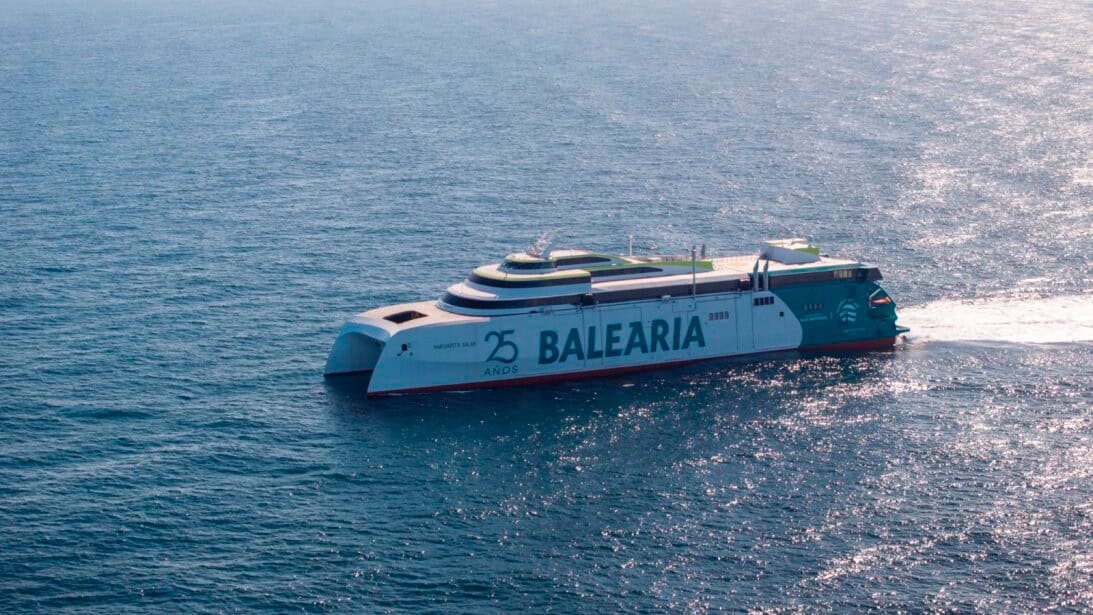
The Margarita Salas of Baleària has carried out the first sea tests, which are part of the final phase of the construction of the fast ferry, which the shipping company expects to receive at the end of June. It is the second fast ferry with dual natural gas engines in the world that is being built at the Armón shipyard in Gijón.

The high-speed ferry Margarita Salas will connect Mallorca , Menorca and Barcelona daily and throughout the year . This investment of 126 million euros, stands out for its sustainability when sailing on natural gas and also for the comfort and features on board.

The Margarita Salas has capacity for 1,200 passengers and 450 vehicles, just like its twin Eleanor Roosevelt , but it adds a second passenger deck with a lounge of seats, so that it gains spaciousness in the interior spaces. In addition, the aft terrace is larger and a more comfortable model of seats is included in the VIP lounge. The interior design and digital services are focused on guaranteeing a unique onboard experience. Passengers will be able to travel in different accommodations and enjoy services such as a cafeteria, shop, children’s area with interactive games, internet access and free instant messaging coverage throughout the journey, digital boarding pass with seat assignment, free entertainment platform or Acclimatised pet area with video surveillance.

A second gas fast ferry with greater power

Inspired by the sustainability and innovation of her counterpart Eleanor Roosevelt , the Margarita Salas has the same dimensions (123 meters long and 28 meters wide) and increases power by 10% thanks to the four dual natural gas engines of 9,600 kW. Like its predecessor, it has two azimuthal propellers to improve manoeuvrability when docking, a stabilisation system that reduces movement and improves comfort, and technological innovations to minimise vibrations and noise.

In addition, it has the OPS (Onshore Power Supply) system for electrical connection to ground during stays in port and measurement equipment to monitor real fuel consumption or calculate engine efficiency, among other functionalities. The ship has two natural gas tanks, which provide a range of approximately 470 miles sailing on gas, and a total range of 1,000 miles.


Latest News

SWITCH Maritime has secured a Design Basis Agreement (DBA) from the United States Coast Guard (USCG) for its SWITCH-150 hydrogen fuel cell-electric ferry, marking a key milestone in the development of the 150-passenger vessel. Designed by naval architecture firm Incat Crowther, the SWITCH-150 combines hydrogen fuel cell-electric propulsion with onboard hydrogen storage to support high-frequency ferry operations without compromising service schedules or requiring shoreside charging infrastructure.

SWITCH Hydrogen Ferry Clears Key US Coast Guard Milestone

The US Coast Guard agreement establishes a regulatory framework to guide construction, commissioning and future commercial operation of the hydrogen-powered ferry SWITCH Maritime has secured...
Norwegian ocean surface measurement specialist Miros has introduced a new 3D vessel view for its WaveSystem wave monitoring platform, giving crews and offshore operators a consolidated view of measured sea conditions around their vessel.

Miros Introduces 3D Vessel View for Real-Time Wave Monitoring

Miros introduces a vessel-specific 3D visualisation to help operators interpret real-time wave measurements at critical offshore working locations Norwegian ocean surface measurement specialist Miros has...
Elegant Exit Company (EEC) has partnered with Conoship International to develop a high-capacity Floating Dry Dock (FDD) concept designed to provide a controlled, environmentally responsible alternative to traditional ship dismantling methods. Ship recycling through beaching remains a major environmental and humanitarian challenge for the maritime industry, exposing coastal ecosystems to potential contamination and workers to hazardous operating conditions.

EEC and Conoship Develop Versatile Floating Dry Dock Concept

The high-capacity floating dry dock concept is designed to support shipbuilding, maintenance and green ship recycling while improving environmental protection and worker safety Elegant Exit...
A liquefied gas carrier originally designed by FKAB Marine Design has completed what Jiangsu Andefu Energy Development describes as the world’s first commercial ship-to-ship bunkering operation using green ammonia.

Ship to Ship Green Ammonia Bunkering Milestone in China

Shenghang Yongle transfers 1,000 tonnes of green ammonia to CMB.TECH’s ammonia-powered Mineral Europa at Zhoushan anchorage, China A liquefied gas carrier originally designed by FKAB...

Related news