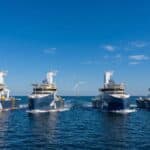
Lloyd’s Register issues AiP for a hybrid propulsion concept enabling integration of Micro Modular Reactors within Seatransport SLV designs.
Lloyd’s Register (LR) has issued Approval in Principle for a next-generation hybrid propulsion concept that prepares commercial landing vessels for the future integration of nuclear Micro Modular Reactors (MMRs). Developed with Australian ship design group Seatransport, the concept enables MMR technology to be combined with conventional diesel-electric systems for 73-metre and 90-metre amphibious stern-landing vessel (SLV) designs.
The AiP follows several years of close collaboration between LR and Seatransport.
Together, they have demonstrated how licensable MMRs can be safely integrated with proven diesel-electric systems to deliver long-range vessels with significantly reduced fuel dependence and emissions.
A recently launched 73m SLV was used as the trial platform. Sea trials of the conventionally powered SLV confirmed the design assumptions used in the MMR concept, providing strong technical assurance that the design is both practical and robust.
Seatransport’s SLV platform is already well established, with more than 25 years of successful operations. By incorporating a hybrid nuclear-ready capability, the vessels gain effectively unlimited operational range, significantly reduced reliance on conventional fuels, and extended endurance for sustained missions. This approach also enhances operational flexibility, delivers low-emission performance, and enables reliable operation in demanding environments, such as landing and logistic support on unprepared or remote beaches.
The MMRs under consideration range from 1.2 MW to 2.6 MW and are undergoing rigorous technical and regulatory assessment. LR is working closely with national authorities to ensure that safety, compliance and operational standards are fully addressed. Wider adoption is anticipated in the early 2030s.
“Achieving Approval in Principle for hybrid nuclear power is an exciting step for LR and the wider maritime industry,” said Jez Sims, Technical Authority for Nuclear, Lloyd’s Register. “We are proud to provide independent technical assurance, drawing on decades of expertise in regulatory compliance, vessel design and nuclear safety. Our role is to help the industry move forward with confidence — turning pioneering ideas into safe, practical solutions.”
Stuart Ballantyne, CEO Seatransport, said: “This AiP marks a pivotal moment for amphibious vessel design. By working closely with LR, we’ve integrated nuclear MMR capability into our proven SLV platform, future-proofing it for extended endurance, operational flexibility and low-emission performance. We do believe that for all shipowners, this is a paradigm shift in marine technology greater than sail to steam.”
Through this collaboration, LR continues to demonstrate global leadership in nuclear marine propulsion, hybrid technologies and next-generation vessel assurance — helping shape a safer, cleaner future for maritime operations.