



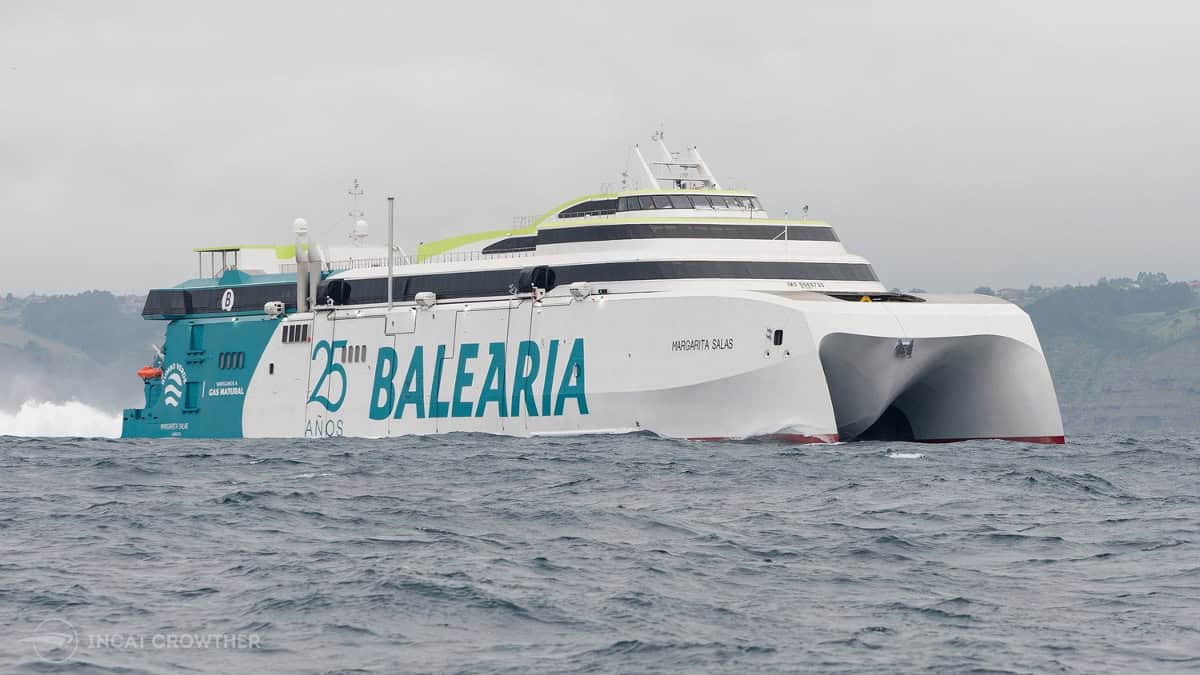
Margarita Salas, an innovative Ro-Pax fast ferry with dual-fuel LNG engines designed by Incat Crowther for Spanish operator Baleària, has successfully completed sea trials.
The new vessel has been delivered to Baleària and will enter service in late July and will provide a daily service between Barcelona and the Balearic Islands of Mallorca and Menorca, providing a vital link for passengers and vehicles.
Named after pioneering biochemist Margarita Salas, the vessel is the second fast ferry with dual-fuel gas engines designed by Incat Crowther and built by Astilleros Armon Gijon S.A. for Baleària. Margarita Salas builds on the innovation and sustainability of its counterpart Eleanor Roosevelt.
Like its predecessor which has been in operation since 2021, Margarita Salas is 123 metres long and 28 metres wide, with capacity for 1,200 passengers and 450 vehicles. However, the new vessel features an additional passenger deck with a spacious lounge area in the bow and an expanded aft terrace with an outdoor bar service, enhancing the onboard experience.
Margarita Salas has been designed to maximise sustainability and to deliver excellent onboard comfort and amenities. The design prioritises passenger comfort with spacious seating areas, a ride control system to minimise vessel motions, and careful design including a resilient mounted superstructure for low vibrations and noise. Passengers will also benefit from several innovative technologies including broadband internet and the ability to access their accommodation via a QR code. They will also have an on-demand digital entertainment platform, while those travelling with pets will be able to monitor them via a video surveillance system.
Powered by four 9,600 kW Wartsila dual-fuel LNG engines, Margarita Salas will cruise at a service speed of 35 knots at 85% MCR. Its propulsion system includes four waterjets and two azimuth bow thrusters, ensuring excellent manoeuvrability when berthing in port. The vessel’s dual-fuel LNG engines provide the ability to operate for approximately 470 miles (approximately 756 kilometres) on gas. It can also consume 100% biomethane and mixtures of up to 25% green hydrogen, making it a versatile and sustainable addition to Baleària’s fleet.
Brett Crowther, CEO of Incat Crowther said: “The successful completion of sea trials means this state-of-the-art fast ferry can now join the Baleària fleet beside her sister ship Eleanor Roosevelt. This project has been a true collaboration between Incat Crowther, operator Baleària and shipbuilder Astilleros Armon and is the second very large aluminium Ro-pax built locally in Europe, close to its operating region.”














