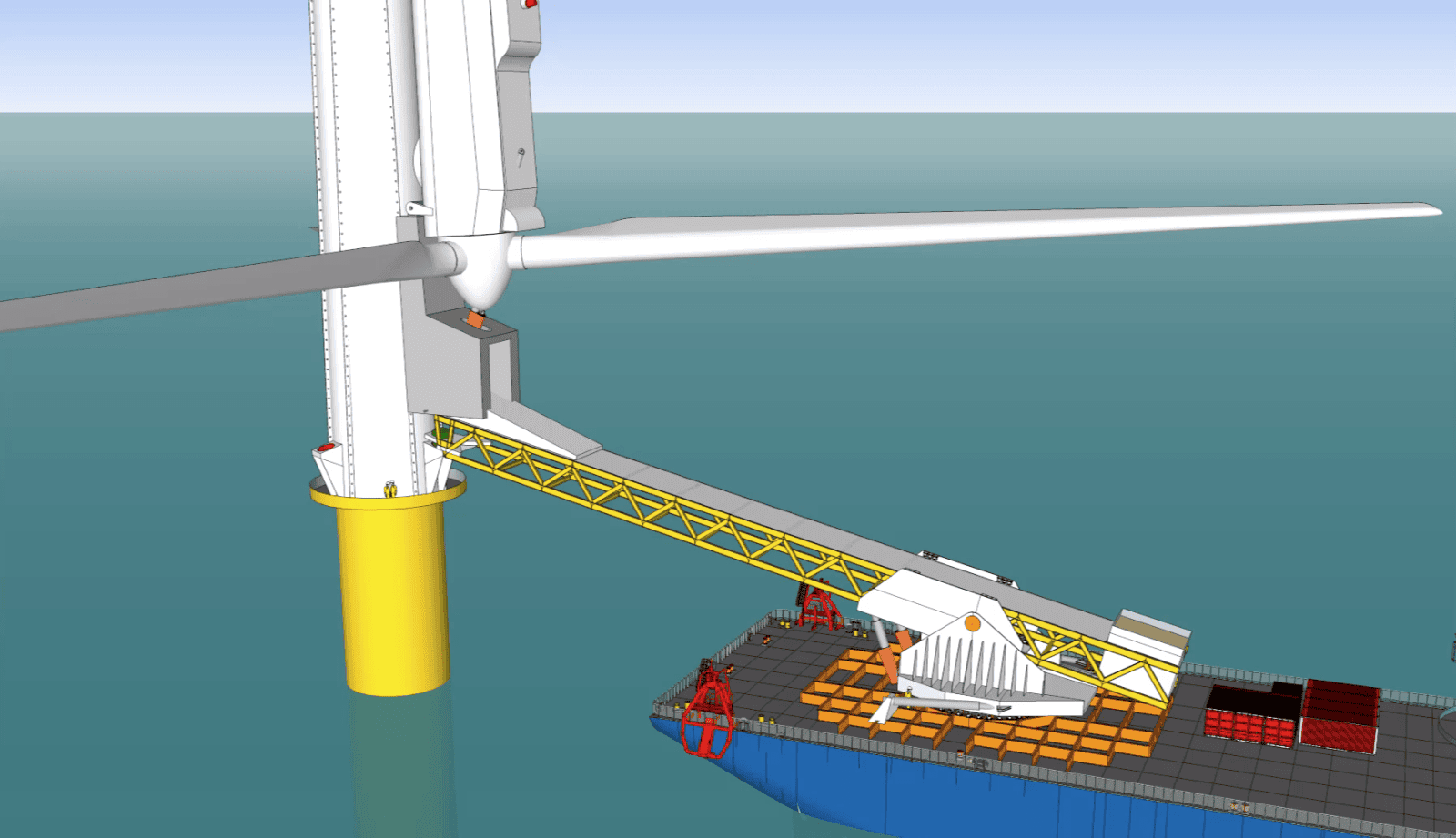
Wind energy technology innovator SENSEWind has successfully completed a demonstration of their SENSE Up-Tower system. The Self Erecting Nacelle and Service System radically transforms how next-generation turbines are installed and serviced making wind energy projects cheaper, quicker and safer.
SENSE up tower demonstration success – video
The predicted growth in demand for wind energy requires the use of super-sized wind turbines and deployment on more challenging sites. Next-generation turbines and more difficult sites make current installation methods uneconomic or impractical. By simplifying operations, the SENSE system reduces costs during development; construction; operations; and increases project revenue through higher availability throughout the life of a project. Independent analysis has shown that the SENSEWind system can cut LCOE by as much as 12%.
The SENSEWind system transforms the installation of wind turbines for both onshore and offshore projects by eliminating the need for large expensive cranes and crane vessels. SENSEWind equipment is modular and only requires standard, readily available cranes and vessels. By automating the heavy lifting and positioning at height, it also improves safety, whilst reducing technical and programme risks.
The system has the added benefit that during operation, it can be used in reverse to allow rapid exchange of major components and complete rotor nacelle assemblies. Inspections, repairs and maintenance of blades and towers are also quicker and easier.
SENSEWind has successfully demonstrated the SENSE system in action, installing a modified Vestas V27 rotor nacelle assembly on a 26m high tower at its test site in Northern Ireland.
SENSEWind CEO Patrick Geraets said: “The team are all extremely pleased with how well the demonstrator performed. We can now finally show the wind industry that SENSE works and has the potential to solve many of the installation and service problems for very large turbines both on and offshore. The tests have also provided us with valuable information as we work to upscale the SENSE system for the growing market.”
Further testing at our assembly and test facilities is planned, to validate design models and further improve functions for the design of a multi-megawatt commercial demonstrator.
The SENSEWind team is now discussing the roll out to a full operational system with several partners, investors and clients.
About SENSEWind:
SENSEWind is leading the development of the SENSE system with industry team partners GEODIS, Xodus, MAATS Tech, and Green Marine. Technology collaborators include PHG Consulting, GBG, BVG Associates, Houlder, Industrial Systems and Control, Tetrace, Creadis, Aerotrope, Anakata, Duncan Plant, and Knowtra.
SENSEWind commenced the development of the SENSE wind turbine installation and service system in 2015.
An Innovate UK funded feasibility study completed in 2017 confirmed the practicality and cost saving potential of the SENSE concept.
Design, manufacture and testing of the SENSE Up Tower Transfer system and further development of the Vessel to Tower Transfer system, supported by an Energy Entrepreneur Award from the UK’s Department for Business, Energy and Industrial Strategy (BEIS), commenced in 2018.
About the Department for Business, Energy, and Industrial Strategy
The Department for Business, Energy, and Industrial Strategy (BEIS) brings together responsibilities for business, industrial strategy, science, research & innovation, energy & clean growth, and climate change. We are building a stronger, greener future by fighting coronavirus, tackling climate change, unleashing innovation and making the UK a great place to work and do business.
This funding forms part of the BEIS Energy Entrepreneurs Fund which supports the development and demonstration of state of the art technologies, products and processes in the areas of energy efficiency, power generation and heat and electricity storage. More details can be found here: https://www.gov.uk/government/collections/energy-entrepeneurs-fund.