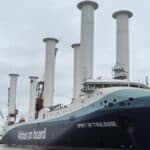
Current trends and developments in the offshore wind industry are shaping the installation fleet of the future. Ever larger offshore wind turbines as well as the expansion to new areas such as Japan, Taiwan, and the USA are challenging the current installation concepts. GustoMSC is widely involved in these developments through the design of ever-increasing Wind Turbine Installation Vessel designs, larger jacking systems and cranes. In parallel, GustoMSC has been developing solutions for feeder options including the latest development of the Steady Top Feeder
This specially designed transport vessel will be able to load WTG components in port and transport them directly to the field. At the site, in dynamic positioning mode, a dedicated WTI Jack-up will be able to lift-off WTG components safely from a motion compensation platform while maximizing workability in the offshore environment. The motion-compensation system is an optimized and integrated solution based on the existing and proven BM-T700 platform by BargeMaster. Via the skidding system, components are transferred from storage position to the motion-compensation platform for lift-off. Optimized main dimensions and hull design offer a high transit speed, improved motion behavior for maximum workability, low air-draft and a small beam for increased port access and a low depth to allow for port loading using multi-wheelers (SPMTs). This fully integrated solution is based completely on proven technology.
Particularly in the case of the USA, where the Jones Act requires US flagged vessels to be used for the transportation of wind turbine components and where there are limited ports which can be accessed by large jack-ups, the STFV provides an attractive alternative or complement to the traditional self-transiting installation jack-up concept.

With the development of the Steady Top Feeder Vessel design and the associated BM-T1500G motion-compensation platform and skidding system GustoMSC has developed a dedicated feeder concept, which offers the flexibility of a floating vessel feeder solution while maximizing workability and minimizing the risk of operations.
The STFV offers an efficient and future proof solution for offshore wind feedering. The solution is an attractive alternative to the self-transiting WTIV particularly when local or project-specific conditions make the use of a self-transiting WTIV less ideal.