


Substantial funding has been won by an impressive group of innovative firms for two projects. The first will see the build of a revolutionary emission-free hydrogen hybrid 1 megawatt inboard powertrain for large ships, and the second will go on to design a ship which integrates this system, in a bid to clean up the maritime industry.
The first project is led by Ecomar Propulsion, alongside partners O.S. Energy and the University of Exeter’s Centre for Future Clean Mobility. The funding is provided by the Clean Maritime Demonstration Competition run by Innovate UK and funded by the Department for Transport.
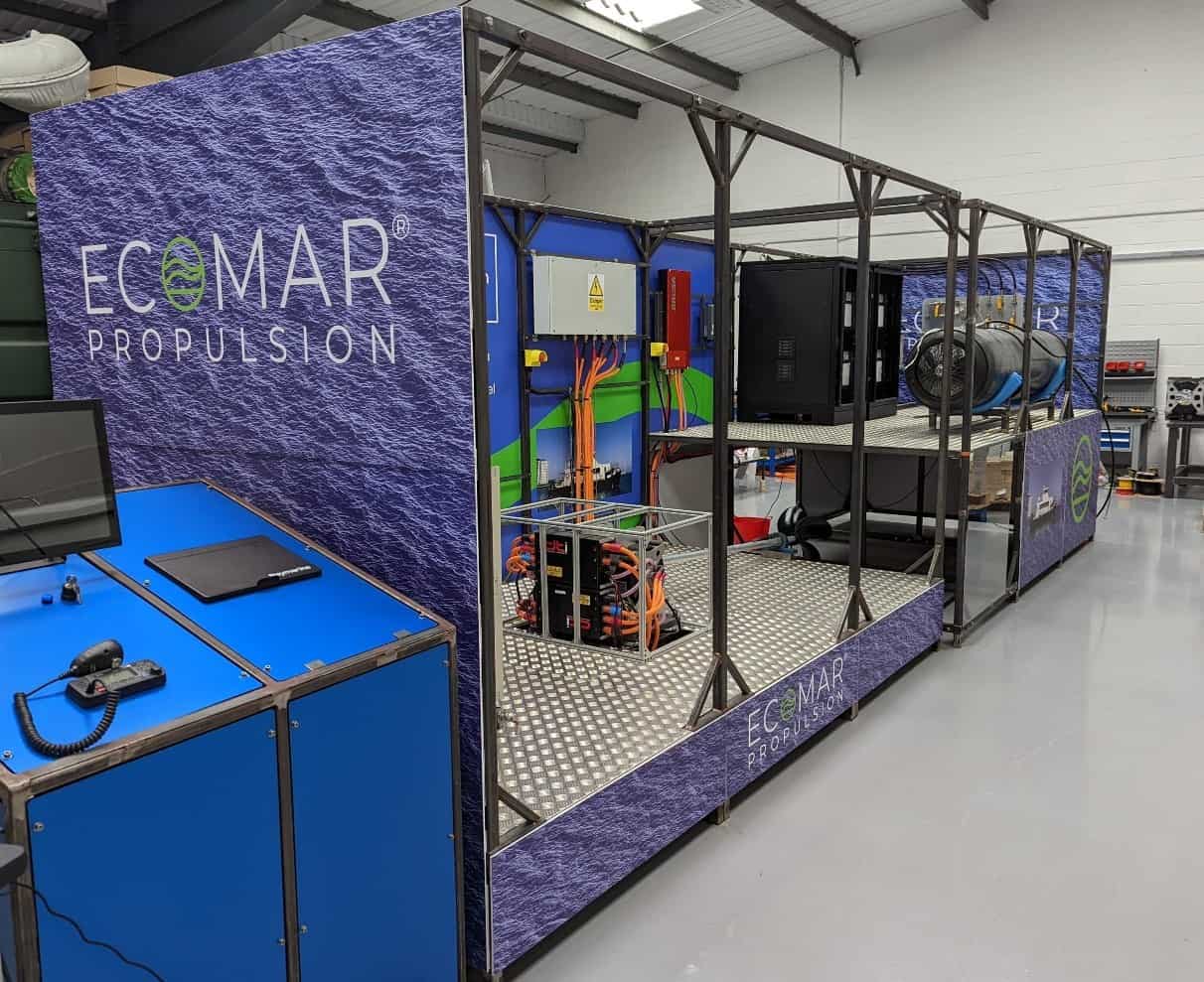
Ecomar Propulsion is a British SME with the ambition and capability to reduce marine greenhouse gases by millions of tonnes. Ecomar Propulsion are tasked with building the innovative hydrogen hybrid 1 megawatt inboard powertrain incorporating electrolysers and bespoke control systems for large ships.
The project aims to accelerate the shift to clean marine shipping by demonstrating a physical model of a clean propulsion system, that can be used by ship builders, operators and legislators to help drive meaningful progress towards emission free shipping in the future. The Maritime sector requires clean propulsion demonstrators to build trust that clean propulsion is possible.
“A megawatt is a huge amount of power but it only a stepping stone to bigger systems that ships require” said CEO and Founder Eugene Bari. “We are confident that we can build this larger demonstrator within the next 10 months. It’s going to be a game changer for the industry.”
The demonstrator will be built in Ecomar Propulsions Hampshire research facility and includes a number of radical designs, but the company are keen to stress that all the technologies are already proven. It is a truly ground-breaking combination joining a whole host of independent innovations into one reliable full propulsion system.
“The plan is not only to provide a big powerplant but to fuel it with hydrogen that is made on the ship itself,” said Bari. “We are doing this with a series of wind turbines that generate hydrogen from on board electrolysers and also trickle charge the batteries. The ship sets off fully charged with full hydrogen tanks but as it does its work the energy systems are constantly replenished which means they can stay out for longer and reduces the cost of operation.”
The second project (Project Zero) is to design a ship which will use Ecomar Propulsion’s system to provide windfarm support operations in UK and European offshore renewable energy projects. This consortium is made up of O.S. Energy, Ecomar Propulsion, Newcastle Marine Services, Solis Marine, Chartwell Marine and Cedar Marine, and with experts from the Strathclyde University, and Exeter University’s Centre for Future Clean Mobility.
The team will design a ship that uses this electric and hydrogen hybrid system with adaptability to also use methanol, ammonia or other alternative fuels with minimal disruption in refit. This project includes all naval architecture, propulsion and operator inputs. It is powered by clean energy with a 10 day range and a 1MW powertrain.
Martin Nuernberg, Director of O.S. Energy said, “O.S. Energy is actively driving the integration of ship energy efficiency optimisation and advanced maritime propulsion systems with the aim of facilitating a step-by-step progression towards zero emission ship operation within UK waters. The combination of a design and demonstration project allows us to accelerate the deployment of innovative UK technology on a purpose built ship and prove the operational capabilities.”
There is already a requirement for thousands of similar vessels just to service the UK’s windfarms. Looking across Europe, there is demand for hundreds more and there is a huge global market.
Thanks to the substantial funding the consortia have received from the UK Government they are ideally placed to take a massive step towards sustainable shipping and a zero carbon future.
About Ecomar Propulsion
Ecomar Propulsion research, design and manufacture high performance, innovative clean marine propulsion systems. With zero emission electric and hybrid hydrogen motors Ecomar Propulsion aim to reduce maritime Greenhouse Gases by 10 million tonnes within 10 years.
Its products are zero emission inboard and outboard propulsion systems, with plans for larger hybrid systems. The outboards are amongst the most efficient and powerful electric green machines available.
Made in the UK, all products are carbon audited, 94% recyclable, high performance and tested to industry standard. They are aimed at the commercial maritime industry (responsible for 6% of the world’s CO2) to make the largest impact.
About CMDC
The project is part of the Clean Maritime Demonstration Competition Round 2 (CMDC2) which was launched in May 2022, funded by the Department for Transport and delivered in partnership with Innovate UK. As part of the CMDC2, the Department allocated over £14m to 31 projects supported by 121 organisations from across the UK to deliver feasibility studies and collaborative R&D projects in clean maritime solutions.
The CMDC2 is part of the UK Shipping Office for Reducing Emission’s (UK SHORE) flagship multi-year CMDC programme. In March 2022, the Department announced the biggest government investment ever in our UK commercial maritime sector, allocating £206m to UK SHORE, a new division within the Department for Transport focused on decarbonising the maritime sector. UK SHORE is delivering a suite of interventions throughout 2022-2025 aimed at accelerating the design, manufacture and operation of UK-made clean maritime technologies and unlocking an industry-led transition to Net Zero.