



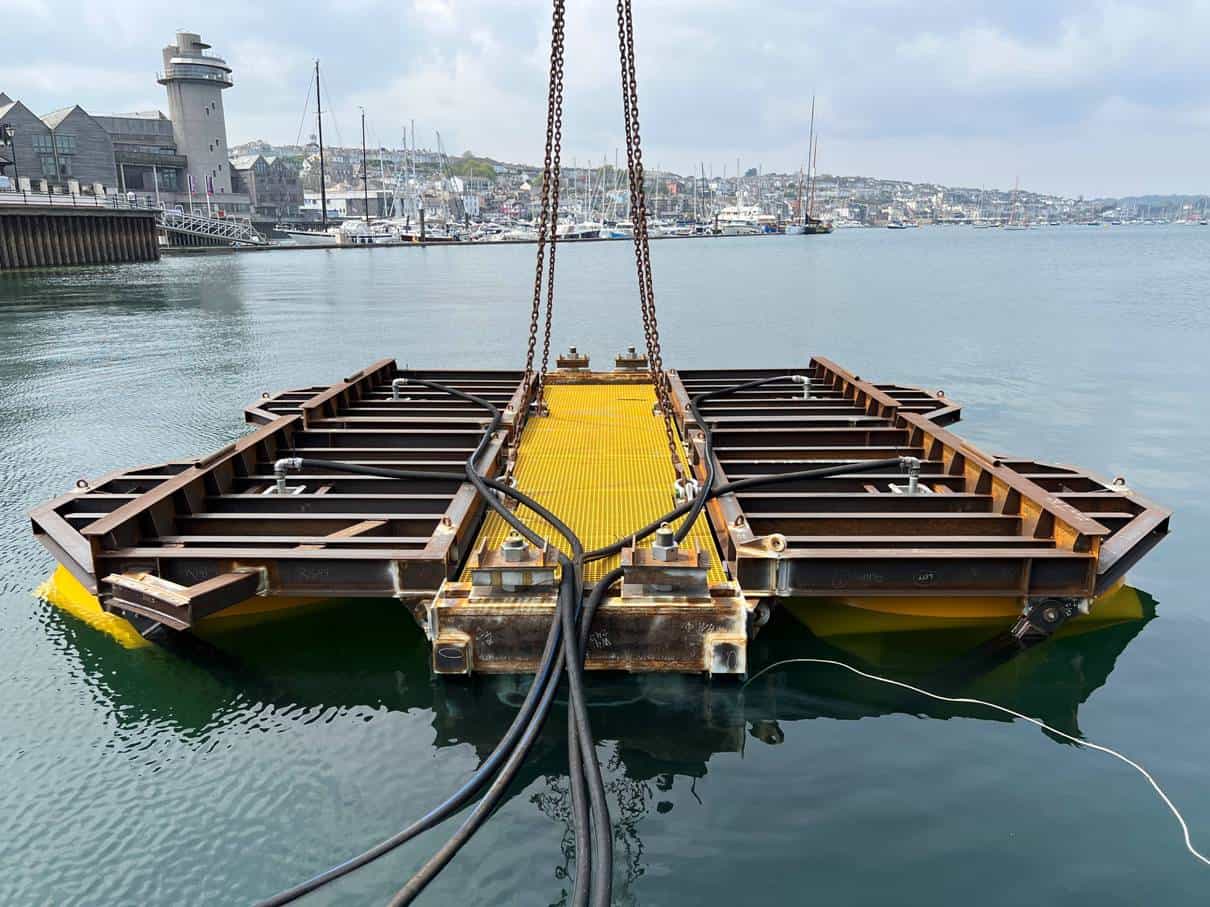
Tugdock, a start-up company based in Cornwall, has been selected to join the 2023 cohort of the National Launch Academy programme, run by the Offshore Renewable Energy (ORE) Catapult.
Launch Academy is ORE Catapult’s national flagship technology accelerator programme, designed to enhance the UK’s offshore wind supply chain and support cost reduction by advancing innovative solutions to real industry problems.
Over the next nine months, Equinor is supporting the 2023 cohort of the Launch Academy, with a focus on developing solutions to challenges facing the emerging floating offshore wind industry in the Celtic Sea.
Floating offshore wind farms are located in deeper waters much further offshore than fixed wind turbines. This gives them access to higher winds which generate more power. The Celtic Sea has been identified as one of the best locations for floating offshore wind in Europe, with 4GW of floating offshore wind capacity targeted by 2035 and 20GW more anticipated by 2045.
Tugdock has been selected to work with Equinor on the pioneering Launch Academy programme, as their patented marine buoyancy bag technology meets a significant infrastructure challenge for the floating offshore wind industry.
Shane Carr, CEO of Tugdock explains: “The floating offshore wind sector is experiencing rapid growth around the world. However, very few of the world’s ports have sufficient water depth and assembly quay space to build the huge turbine floaters required, whilst conventional dry docks are not wide enough as they were originally designed for ships. Tugdock’s patented marine buoyancy bag technology is a solution. It allows floating dry docks to be delivered by road in modular form and assembled at the port to dimensions far wider than most of the world’s existing dry docks.”
Shane continues: “At many ports the large tidal range makes it difficult to loadout the large turbine floaters from the quayside into the water. However, the Tugdock system only needs 5 metres of water depth and the speed of ‘air ballasting’ of the Tugdock system allows the floaters to be quickly and efficiently launched in ports with high tidal range. This saves time and costs.”
Tugdock director Lucas Lowe-Houghton adds: “We are delighted to be asked to work on this programme alongside Equinor and ORE Catapult. It will enable our technology to reach its full potential and help accelerate the growth of the floating offshore wind industry in the Celtic Sea. We are also expecting the programme to be a springboard for our further expansion into new overseas markets, including California in the USA.”











 Catapult. Launch Academy is ORE Catapult’s national flagship technology accelerator programme, designed to enhance the UK’s offshore wind supply chain and support cost reduction by advancing innovative solutions to real industry problems. Over the next nine months, Equinor is supporting the 2023 cohort of the Launch Academy, with a focus on developing solutions to challenges facing the emerging floating offshore wind industry in the Celtic Sea. Floating offshore wind farms are located in deeper waters much further offshore than fixed wind turbines. This gives them access to higher winds which generate more power. The Celtic Sea has been identified as one of the best locations for floating offshore wind in Europe, with 4GW of floating offshore wind capacity targeted by 2035 and 20GW more anticipated by 2045.Tugdock has been selected to work with Equinor on the pioneering Launch Academy programme, as their patented marine buoyancy bag technology meets a significant infrastructure challenge for the floating offshore wind industry.)