



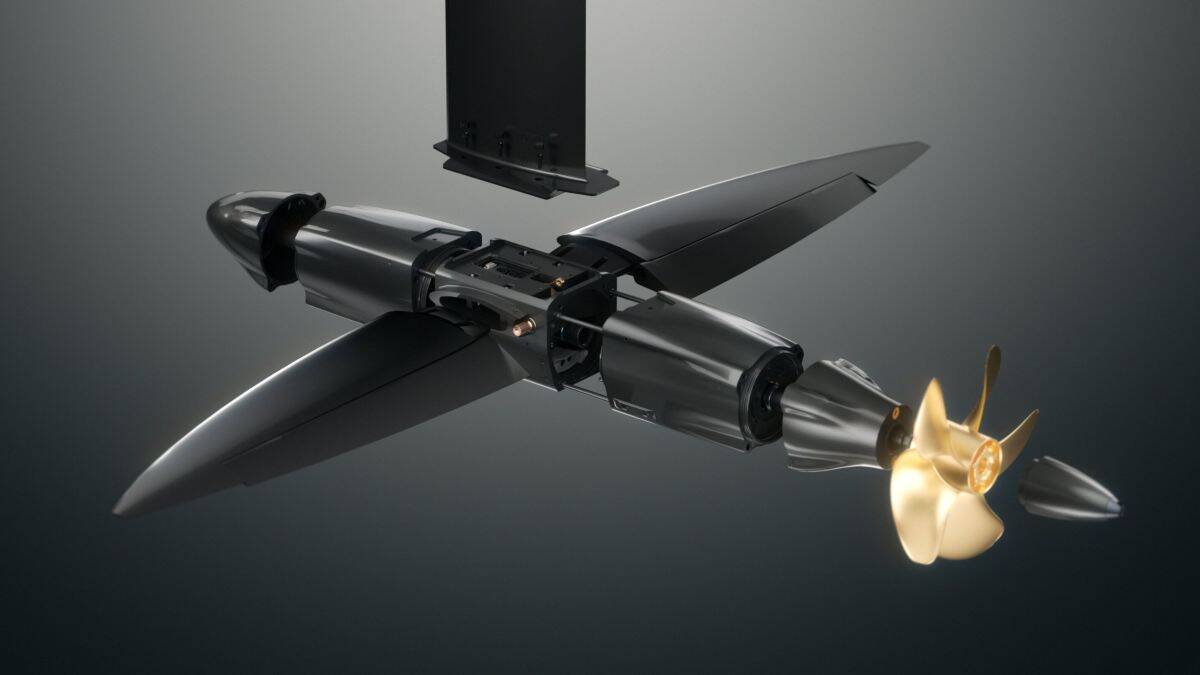
Vessev, a marine technology innovator developing commercial electric hydrofoiling vessels, announce the launch of the VS–Drive, a podded propulsion system designed to transform electric marine performance.
The VS–Drive is a submersible motor system integrates advanced active cooling and custom direct-drive brushless motors within a modular configuration, delivering exceptional efficiency, reliability, and scalability.
The VS–Drive powers the VS–9, Vessev’s nine-metre, battery-electric hydrofoiling catamaran, which delivers smooth, silent and emissions-free journeys. It will scale to other models in development, including 12 and 18-metre hydrofoiling vessels.
Vessev co-founder and Chief Technology Officer Max Olson said VS–Drive’s internal closed-loop cooling system was among its most game-changing features, maintaining motor operating temperatures of below 50°C.
“The VS–Drive began as a clean-sheet design to overcome one of the trickiest challenges in electric marine propulsion: overheating,” Olson said. “The result is sustained high-torque output, and unparalleled performance in tropical climates.”
By connecting the motor directly to the propeller and eliminating gearboxes and long driveshafts, the VS–Drive has fewer moving parts than internal combustion engines, reducing energy loss and enhancing efficiency.
The motor, remarkable for its near-silent operation, has a continuous output of 65 kW (90 horsepower) at 25 knots.
The VS–Drive propulsion system is built to last, with long-life bearings and sensors monitoring the system’s health and performance in real time. The motor’s modular design allows components to be easily disassembled and serviced, offering operators peace of mind.
The VS–Drive’s vectorable rudder mounting also provides superior low-speed maneuverability, which, when combined with Vessev’s fully retractable foiling system, facilitates operation across a broad range of marine environments and marina configurations.
Vessev CEO Eric Laakmann said the VS–Drive will unlock a new level of what’s possible for electric marine transport. “We’re excited to see operators around the world benefit from this propulsion technology across a range of applications.”
The VS–Drive’s development received co-funding from the New Zealand government’s Low Emission Transport Fund, administered by EECA (Energy Efficiency and Conservation Authority).
About the VS–Drive
- Power: 65 kW cruise (90 horsepower), with peak power of 110 kW (150 HP)
- Torque: 400 Nm
- Bearings lifespan: 40,000 miles / 48 months
- Silent, gearless, zero emissions.














