





With its three green “world records” Viking Energy has paved the way for Eidesvik’s success story of climate and environment focused innovation. In May, the vessel passed 20 years in operation and 2.500 roundtrips – all of them for energy company Equinor.
Eidesvik’s Viking Energy is a platform supply vessel (PSV) specially designed to supply offshore oil and gas platforms. The vessel has an impressive record of accomplishment that includes three “world records” in the demonstration of new environmental technologies.
The first record dates back to 2003 when Viking Energy upon delivery became the world’s first LNG-fueled cargo vessel.
The idea was first launched in 2000 by Eidesvik Project Manager Kjell Sandaker and ship owner Lauritz Eidesvik. The inspiration came from the LNG-fuelled ferry MF Glutra.
If it was possible to operate a ferry on LNG, I believed it should be possible to do the same with a PSV. I wrote a short memo to Lauritz and he was very enthusiastic about the idea. Eidesvik wanted to be a future oriented ship owner and what we did on Viking Energy 20 years ago was truly pioneering work, says Sandaker.
Lauritz Eidesvik took the role of introducing gas operations to customers and authorities, and a long story short: Equinor (then Statoil) showed interest in the concept and an extensive development work started with Equinor, Wärtsilä and Eidesvik.
– You can describe it as a long battle to get all the non-existent parts of the value chain in place, in very little time; technology, system integration, regulations and fuel infrastructure. That we succeeded was a great achievement, says Eidesvik’s Business Developer at the time, John Stangeland.
In May2003 Viking Energy was ready for operation for Equinor, equipped with four Wärtsilä dual fuel engines.
Her first Captain, Terje Kallevåg, who was also involved in the construction phase, tells of the milestone with excitement: “Being first with LNG on a cargo vessel was challenging but also very exciting. Employees on both land and sea felt we were an important part of the development towards greener shipping”.
First with “Batter Power”
Viking Energy’s second record dates back to 2016, when she became the world’s first vessel with DNV class notation “Battery Power”. The notation means that in addition to being used during transit for peak shaving, the battery system can also replace one of the main engines as redundant power source, so-called “spinning reserve”, in DP-operations
Measurements show that Eidesvik’s crew has done a great job in using the systems as intended whenever possible.
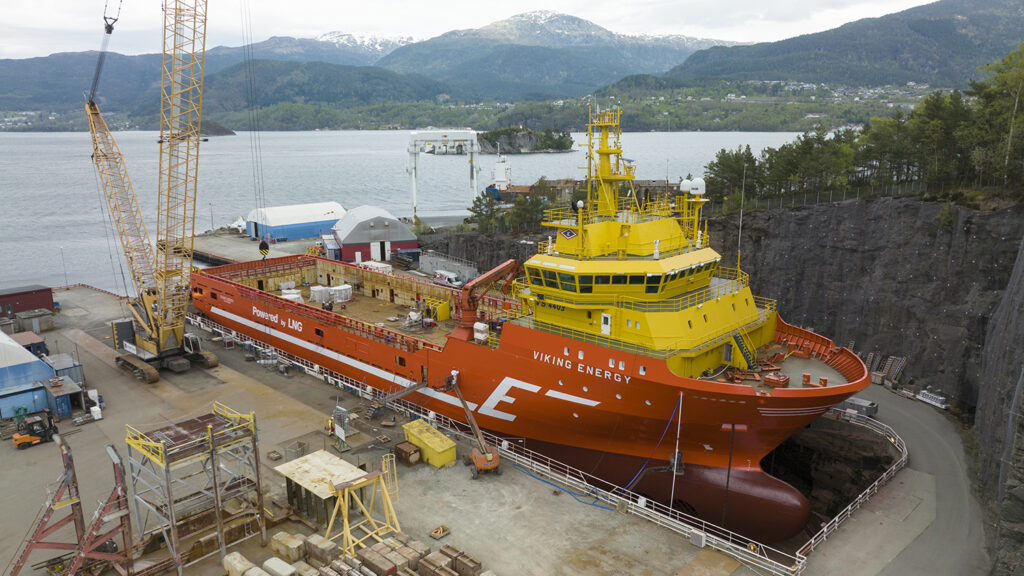
– Whether or not a battery system can be run as spinning reserve is dependent on power needs, which will vary according to operational requirements and weather conditions. Looking back on the last five years the vessel has spent 10.800 hours in DP mode – and half of this time we have been able to run the battery as spinning reserve with only one engine running together with the battery. This shows the important role our seafarers play in our decarbonization efforts, says Eidesvik COO Arve Nilsen.
Viking Energy achieved its third record in 2020, when she became the first offshore vessel to go on contract with zero emission technology. The 5-year contract was awarded in connection with the EU-funded ShipFC project that includes Equinor, Eidesvik and 12 other European partners. The ShipFC project’s goal is to install fuel cell modules running on green ammonia, with a total power of 2MW.
– Viking Energy is an important vessel that has paved the way for Eidesvik’s success story of demonstrating new and cleaner technologies on our vessels. For two decades, our strategy has been to take a leading role in the development towards zero-emission maritime operations. Viking Energy is in many ways a manifestation of this strategy and our step-by-step approach, says Eidesvik CEO, Gitte Gard Talmo.
Viking Energy has been on contract for Equinor ever since delivery. The 20 years in operation equals more than 2.500 roundtrips from Mongstad to installations in the North Sea.
– Equinor contracting Viking Energy for 20 years is a testament to their desire to contribute to development of more environmentally friendly shipping. It is also proof of the vessel and its crew’s high standard of safety and operational performance. This reliable workhorse has many years left in operation, and we look forward to continue our good collaboration with Equinor in the years to come, says Nilsen.








 specially designed to supply offshore oil and gas platforms. The vessel has an impressive record of accomplishment that includes three “world records” in the demonstration of new environmental technologies.The first record dates back to 2003 when Viking Energy upon delivery became the world’s first LNG-fueled cargo vessel. The idea was first launched in 2000 by Eidesvik Project Manager Kjell Sandaker and ship owner Lauritz Eidesvik. The inspiration came from the LNG-fuelled ferry MF Glutra.– If it was possible to operate a ferry on LNG, I believed it should be possible to do the same with a PSV. I wrote a short memo to Lauritz and he was very enthusiastic about the idea. Eidesvik wanted to be a future oriented ship owner and what we did on Viking Energy 20 years ago was truly pioneering work, says Sandaker.Lauritz Eidesvik took the role of introducing gas operations to customers and authorities, and a long story short: Equinor (then Statoil) showed interest in the concept and an extensive development work started with Equinor, Wärtsilä and Eidesvik.)