



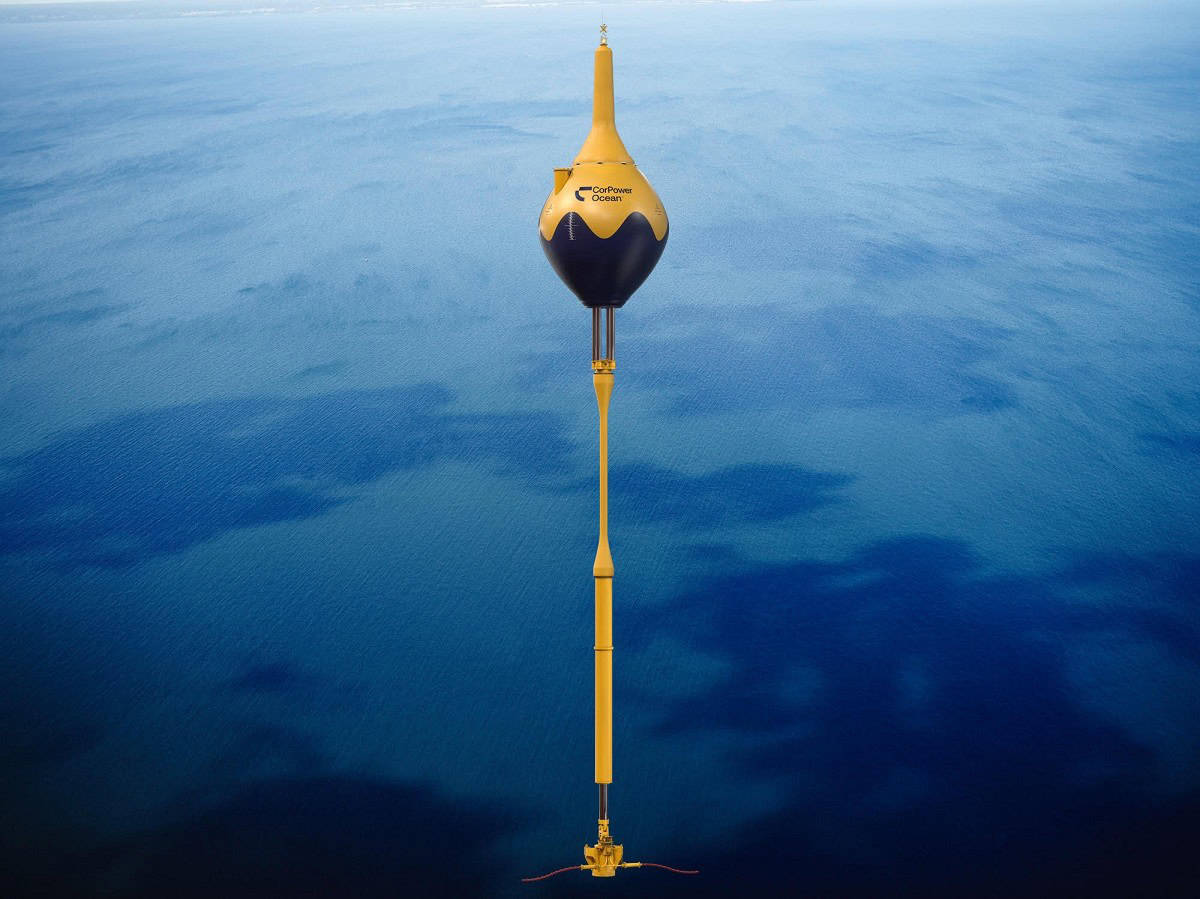
CorPower Ocean and leading energy academics from Edinburgh University have completed a rigorous Life Cycle Assessment (LCA) of a wave energy array, showing its global warming potential to be 20-40 times lower than conventional fossil fuel electricity generation.
A final report, now published on Science Direct, reveals the results of the ‘cradle to grave’ LCA of a 10MW array, consisting of 28 point-absorber Wave Energy Converters (WEC), deployed in Aguçadoura, northern Portugal. Cabling and marine operations at array scale were included in the assumptions.
The analysis – carried out by CorPower Ocean’s wave energy experts and academics within Edinburgh University’s Institute for Energy Systems – covered 19 categories, encompassing human health, ecosystems and resource availability impacts.
Outputs show the WECs perform similarly to other offshore renewable energy technologies, and to consistently outperform fossil-fuelled thermal generation over six impact categories, including those representing embodied carbon and energy.
The resulting global warming potential of the array ranged between 25.1-46.0 gCO2e/kWh, depending on the frequency of marine operations, which can make up to 57% of the total figure. Within materials, steel has the highest impact as the array comprises of 83% steel.
Being the first LCA study ever made on wave energy arrays – previous analyses have focused on single devices – it aims to provide a more realistic view on the real environmental impact of wave energy deployments in the future.
LCA results are particularly meaningful at early-stage technology development, helping inform design considerations and identify hotspots of particular impacts to be designed out of future iterations of the technology.
The report concludes that the results may not be directly comparable for other WEC types, even when deployed in the same location, as wave energy technologies can differ greatly in terms of material composition, marine operation requirements, and generation and failure modes.












 of a wave energy array, showing its global warming potential to be 20-40 times lower than conventional fossil fuel electricity generation. A final report, now published on Science Direct, reveals the results of the ‘cradle to grave’ LCA of a 10MW array, consisting of 28 point-absorber Wave Energy Converters (WEC), deployed in Aguçadoura, northern Portugal. Cabling and marine operations at array scale were included in the assumptions. The analysis – carried out by CorPower Ocean’s wave energy experts and academics within Edinburgh University’s Institute for Energy Systems – covered 19 categories, encompassing human health, ecosystems and resource availability impacts. Outputs show the WECs perform similarly to other offshore renewable energy technologies, and to consistently outperform fossil-fuelled thermal generation over six impact categories, including those representing embodied carbon and energy.)