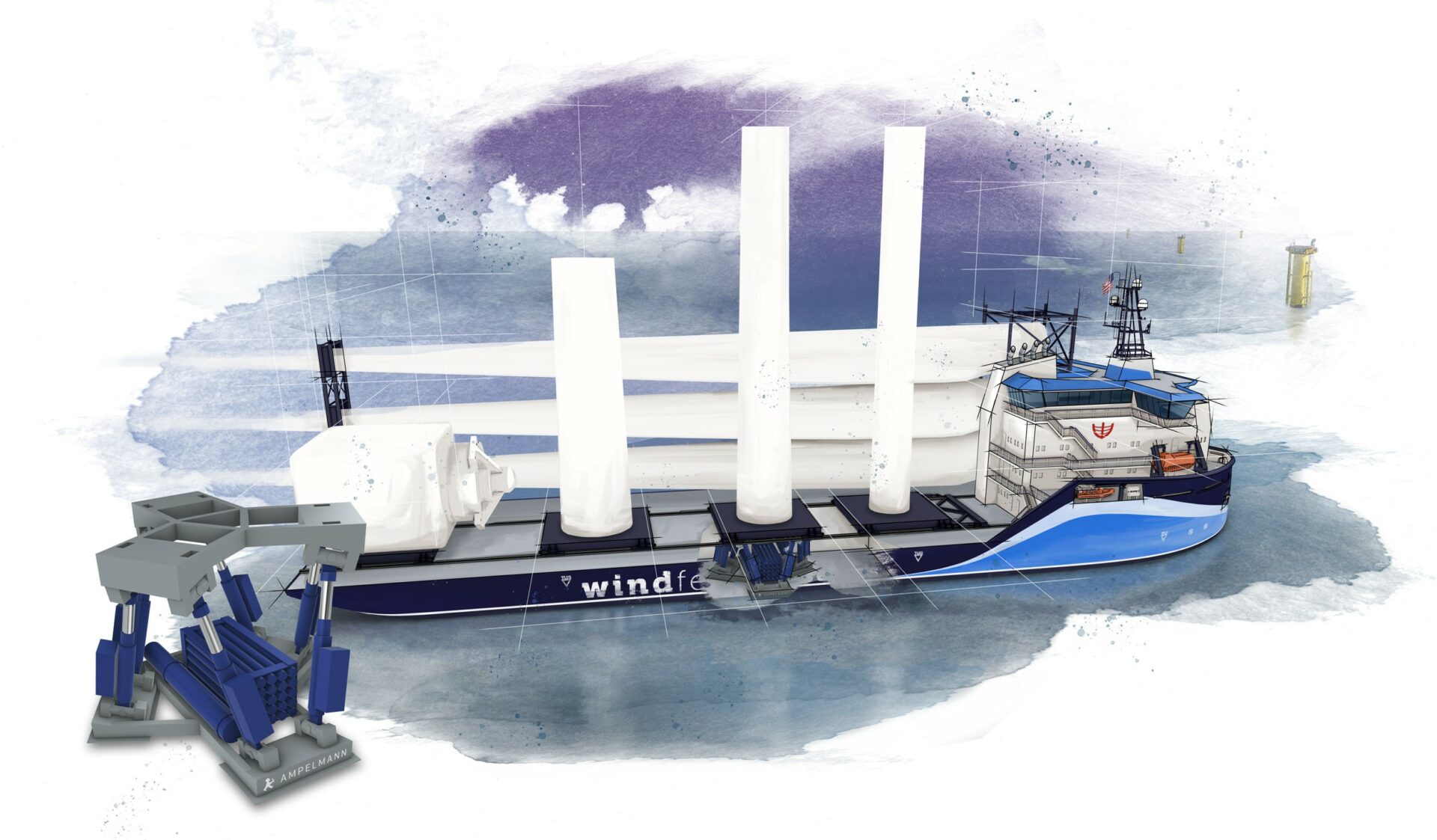



Ampelmann and C-Job Naval Architects have joined forces to develop a one-of-a-kind offshore wind feeder vessel concept with motion compensation technology, specifically suited for the rigorous demands of operating off the east coast of the United States of America.
The concept design combines the knowledge of Ampelmann, the Dutch offshore access provider, and independent ship design company C-Job Naval Architects. Together they have created a viable solution in response to the need to support the construction and logistics of offshore wind farms in the United States under the Jones Act.
US offshore wind
Todd Allen, VP Business Development at C-Job Naval Architects, says: “The United States is ambitious in its plans to grow the installed offshore wind power. The only viable way to realize this goal while complying with the Jones Act is utilizing offshore wind feeder vessels. Together with our strategic partner Ampelmann, the experts in motion compensation, we have created an innovative ship design ready to support construction of US wind farms today and into the future.”


Maximum workability
The state-of-the-art offshore wind feeder vessel has an L-shaped superstructure. This enables the transport of all wind turbine components, including the blades, while keeping the ship itself relatively compact minimizing construction and operational costs. To maximize workability and allow for safe lifting of the components, the feeder vessel features a specially designed motion compensation system by Ampelmann.
The system uses Ampelmann’s core technology to stabilize the components of the wind turbine generator (WTG) in six degrees of freedom and is designed for safe lifting operations in sea states up to 2.5m significant wave height. The compensator is positioned close to the vessel’s center where it can compensate all vessel motions and allows for continued operations – even in adverse weather conditions – throughout the year.
Gus DeOliveira, Ampelmann’s Business Development Area Manager for the Americas, says: “We see a lot of potential for the offshore wind market in the US and believe that we can add some unique value based on our decades long experience in the offshore wind market. Our partnership with C-Job is crucial if we are to design and deliver just the right solution for this growing market.”

Motion compensator
The wind turbine components are arranged on the ship with a quick connect grip- and glide system. Cargo pallets are placed on deck quickly thanks to the quick connect system. Once the feeder vessel is at its destination, the system slides the components into place to connect to the motion compensator. The Ampelmann system then compensates all vessel motions, so the crane operator can lift turbine components in a similar fashion to an onshore lift.
The motion compensated wind feeder vessel is designed to provide maximum efficiency and workability during the construction of an offshore wind park. The conventional way of working is that the installation vessel would transport the components and then do the installation of the turbines. However, this is an inefficient use of the WTIV and in the case of foreign vessels not allowed by the Jones Act.
With this feeder concept – which is envisioned to be a series – the turbine components are brought to the installation site by the feeder vessel. With two or more vessels per project, this allows the WTIV to focus on the installation of the turbines and ensures operations can continue at all times.
For more information, please contact C-Job or go to www.ampelmann.nl.