



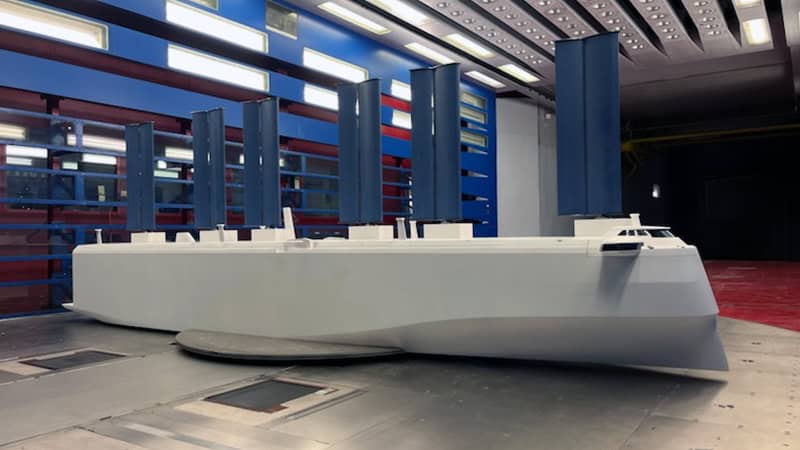
Wallenius Marine is conducting advanced wind tunnel tests aimed at realising the world’s first wind-powered PCTC (Pure Car and Truck Carrier) vessel. The tests are being carried out in Gothenburg, at one of Europe’s most advanced wind tunnels, with wind speeds of up to 250 km/h.
Their vision is to offer zero-emission shipping. Over the years, they have put a lot of effort into research and innovation. Many tests have been carried out, and great collaborations with academia and partners have brought them to where we are today.
In December, Wallenius Marine gathers with experts from RISE, KTH, and Oceanbird in Gothenburg for a series of crucial tests to validate the latest design for wind-powered Pure Car and Truck Carrier vessels, a groundbreaking innovation in maritime transport. These tests will not only confirm the design but also contribute to the development of new data simulation models for wind-powered ships.
“We are currently at a central stage in the design process where we want to ensure that our design meets all technical and operational requirements before we finalise the tender design,” says Carl Fagergren, Senior Project Manager at Wallenius Marine.
The tests are being conducted by RISE Maritime Department (former SSPA), which has also constructed a 5 x 2 meter model using advanced technology. The model weighs 1.2 tons and is used to simulate the full aerodynamic performance of the ship in the wind tunnel. Previously, wing sails have been tested independently without a hull, but this combination of hull and multiple wings in a large tunnel with a full-scale model makes this test unique. This round of tests includes:
The interaction between the vessel’s hull and six high-tech wing sails.
- Testing the optimal distance between hull and wing for maximum performance.
- Testing three different types of command bridges and their impact on the vessel’s performance.
- How “off-design conditions” affect the ship’s operation, such as when a wing sail is positioned at the wrong angle or location.
- Data for the development of wing control systems
The hull and multi-wing wind tunnel tests are a milestone in the development of wind-powered PCTC vessels. A journey that started as a sketch on a paper in 2017. The next important step is during 2025, when the Oceanbird wing sail will be tested live aboard Wallenius Wilhelmsen’s vessel Tiranna. This will give us further input in on the journey towards zero emission shipping and the development of the sh






 vessel is conducting advanced)