


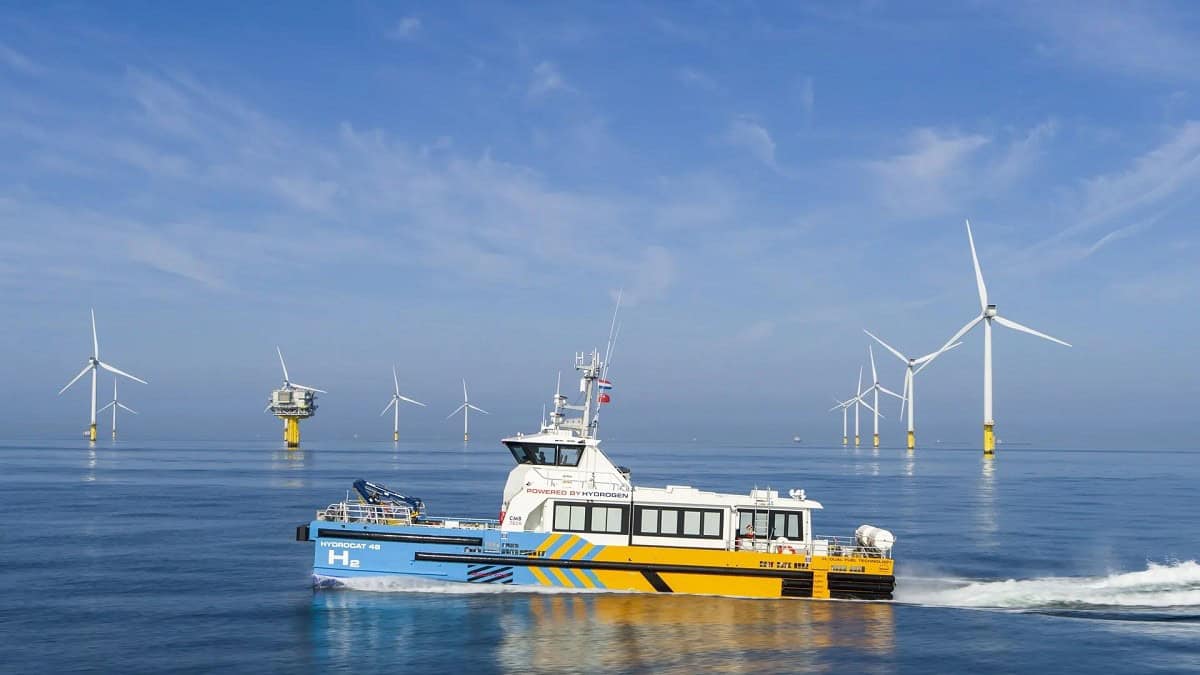
Windcat Workboats and CMB.TECH announced that the first hydrogen-powered CTV is ready for immediate operation after successful completion of trials and bunkering. This ground-breaking development for both the marine and offshore wind industries is the first CTV that uses clean fuels to reduce up to 80% of its traditional fuel usage and associated emissions. The Hydrocat 48 is a further green development, introducing clean fuel technology on the already very fuel efficient and high performing Windcat MK 3.5 design.
Dual fuel technology has been integrated into the MK3.5 series without compromising on performance and retaining the reliability of a traditionally fuelled vessel. It is the first vessel to truly offer a sustainable alternative to diesel fuel.
CMB.TECH was the first to build a hydrogen-powered passenger shuttle in 2017. Based on this proven technology, the Hydrocat 48 is now designed and built.
The base MAN engine is manufactured by MAN Engines for dual fuel use and retrofitted by CMB.TECH with a hydrogen injection system.
This vessel offers the industry a cost-effective solution to significantly reduce emissions from service vessels, which can be applied to any wind farm today. This solution can be seen as a steppingstone to fully hydrogen powered CTVs. By starting with dual fuel combustion engines, we can make hydrogen technology operational in the industry and kick-start further development of the technology, regulation, supply chain, etc.
Willem Van Der Wel – Managing Director of Windcat Workboats
The suitability of this technology for a CTV is mainly because existing diesel engines can be used. No fundamental changes to the main engine are required, which not only means that maintenance and repair remain simple, but also that the engine can easily be switched back to diesel fuel without any modifications. Even if hydrogen is not available, the vessel can continue to run on traditional fuel, making it a very robust and reliable solution for the offshore wind industry.
Roy Campe – CTO of CMB.TECH
Further optimisation: mono-fuel
CMB.TECH and Windcat Workboats are working on the further optimisation of engine capacities and the increased use of the hydrogen percentage. The long-term plan is to develop the technology and infrastructure to be able to eventually use a mono-fuel option via an internal combustion engine (ICE).
Hydrogen supply and mobile refueller
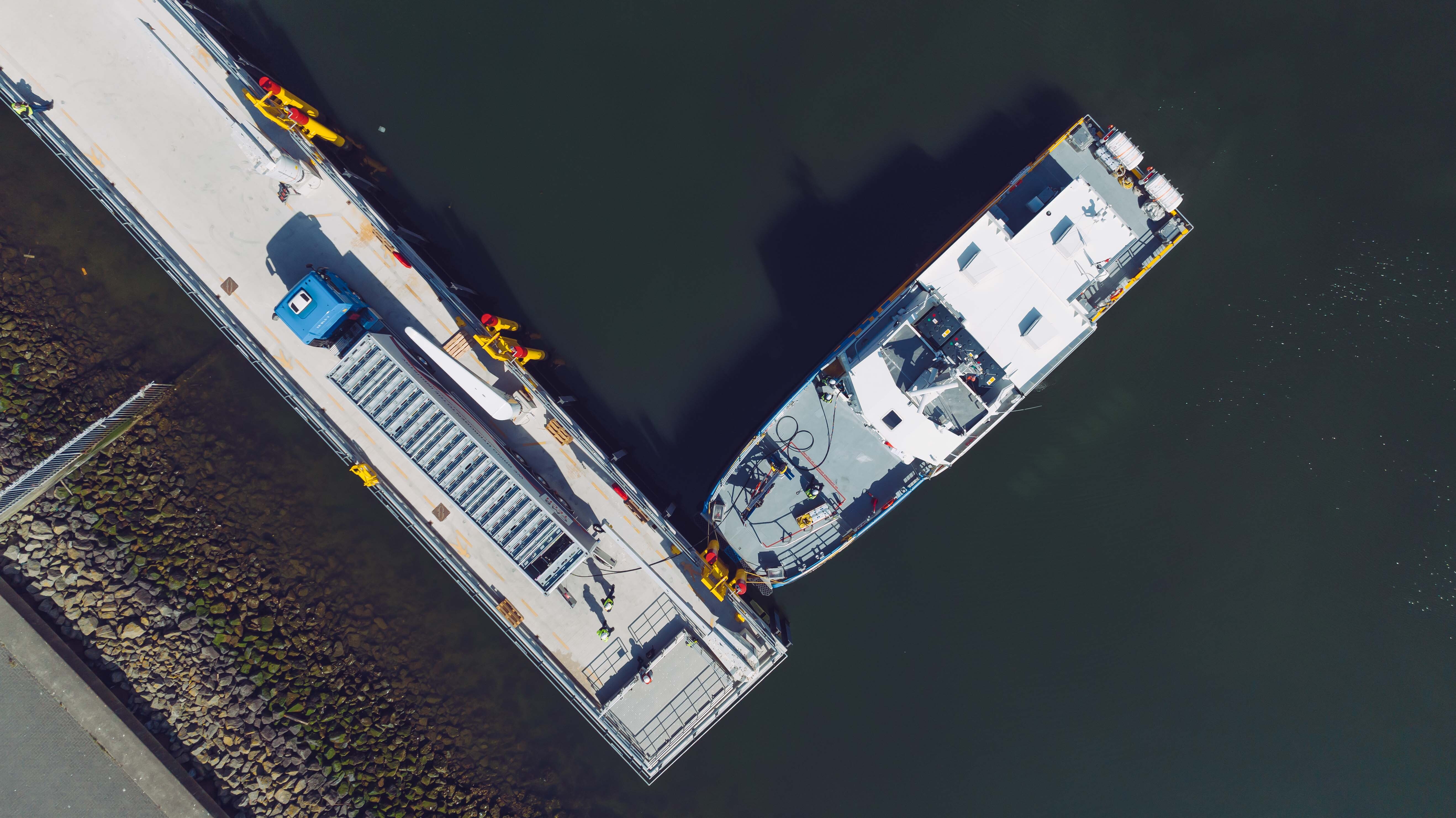
The hydrogen supply chain still needs to grow to become readily accessible in more locations. There is a significant shift towards hydrogen applications, and it is expected that the hydrogen supply chain will develop in the coming years. CMB.TECH and Windcat have also developed solutions for the supply of hydrogen to the vessel in this early phase of hydrogen development. CMB.TECH has designed a 40ft 500bar trailer for remote refuelling of all the various systems applying the technology currently in use. Multiple applications and customers can be served by this one system, which can also support the Hydrocat.
Windcat, together with its joint venture partners TSM and FRS, has three more vessels under construction that can be delivered with the hydrogen technology on board. More CTV designs using this technology are being developed.
MAN engine – how does it work?
The operating behaviour, fuel consumption and all other characteristics correspond exactly to the MAN D2862 LE428 with the same performance. In a form of pre-treatment, a precisely measured quantity of hydrogen is added to the charge air. This mixture of hydrogen and air is then ignited with the injected diesel fuel in the combustion chamber of the cylinders. Depending on the engine’s operating point, only a very small amount of diesel fuel is needed. The diesel injection parameters are optimised in dual fuel mode to achieve the lowest emissions and the best consumption values. Therefore, in dual fuel mode, considerably less CO2 is released in the exhaust gases in circumstances where operating behaviour and full load characteristics remain unchanged. In the event of problems in the hydrogen circuit or a depleted hydrogen supply, a switch back to diesel can be made at any time. This guarantees uninterrupted operation with normal reliability.