



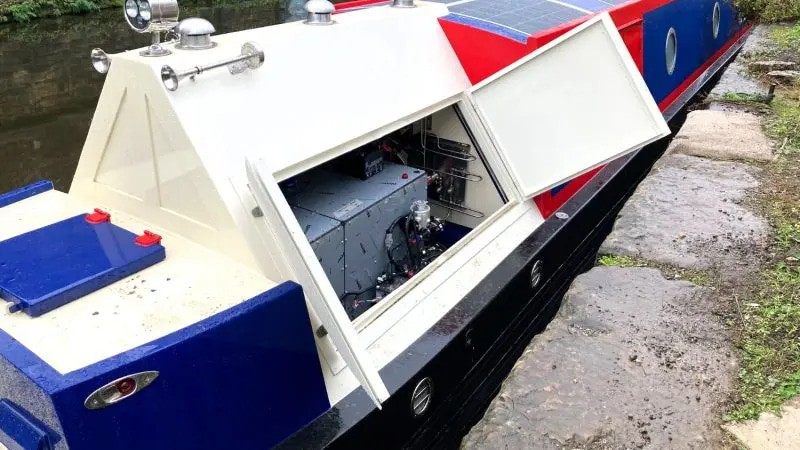
Bramble Energy, an innovator and disrupter in fuel cell technology, has achieved a milestone in marine history by launching the world’s first hydrogen-electric boat powered by a printed circuit board fuel cell (PCBFC™).
As the lead partner in the HyTime project working alongside custom engine builder Barrus, Bramble Energy has created a demonstration vessel that showcases the vast potential of its PCBFC™ technology to quickly and cost-effectively decarbonise the marine sector.
In a maritime first, the 57ft narrowboat was launched onto the water in Sheffield, Yorkshire, where it has successfully completed testing, emissions-free, using a custom marinised fuel cell system. The fuel cell system has the potential to provide the vessel with approximately 600 miles of range using the 14kg of hydrogen stored on-board, as well as additional power being supplied from solar panels on the boat’s roof to the 22kWh battery system.
In 2022, Bramble Energy was awarded Government funding from BEIS, now the Department for Energy Security and Net Zero (DESNZ), of just under £1 million to develop its hydrogen fuel cell technology as a solution to replace diesel engines in boats. The integration and deployment of the technology represents the successful completion of the project between the partners.
The vessel, which has been built from the ground up, has been under construction in Sheffield where Bramble engineers have created a completely new design of a hydrogen system to meet marine requirements, and the boat has the potential to save each boat using this powertrain technology up to 12 tonnes of CO2 per year.
The global maritime sector contributes to 940 million tonnes of CO2 per year, equating to approximately 2.5% of global greenhouse gases. As such, the Clean Maritime Plan requires new vessels to be zero-emission capable from 2025. The project’s goal was to demonstrate how the shift to a hydrogen fuel source could help the transition thanks to providing a range extender to pure battery systems, but also to remove the reliance on a charging base.
Dr Tom Mason, co-founder and CEO of Bramble Energy commented: “While road transportation has arguably had the greatest amount of attention in terms of developing zero-emission solutions, the reality is there is a massive urgency to decarbonise across all transportation sectors – especially marine. CO2 emissions from the marine sector are staggering. It requires a quick, convenient, cost-effective technology that also provides no compromise when it comes to performance.
In a short amount of time we have designed, developed, built and launched a working demonstration of our PCBFC™ technology within a marine application. Our solution has the ability to meet a range of power needs and is easily scalable, which is the exact catalyst the industry needs to make a seamless shift to hydrogen to quickly meet emissions regulations and contribute to greener and cleaner waterways.”
With the fuel cell stack successfully integrated into the narrowboat, it has now completed a comprehensive testing programme on UK inland waterways. Now, at its world-leading Hydrogen Innovation Hub in Crawley, the Bramble Energy team will analyse the boat’s data along with vital information about the fuel cell’s performance under real-world conditions. This analysis will support the future development of PCBFC™ systems for wider maritime applications.








.)