



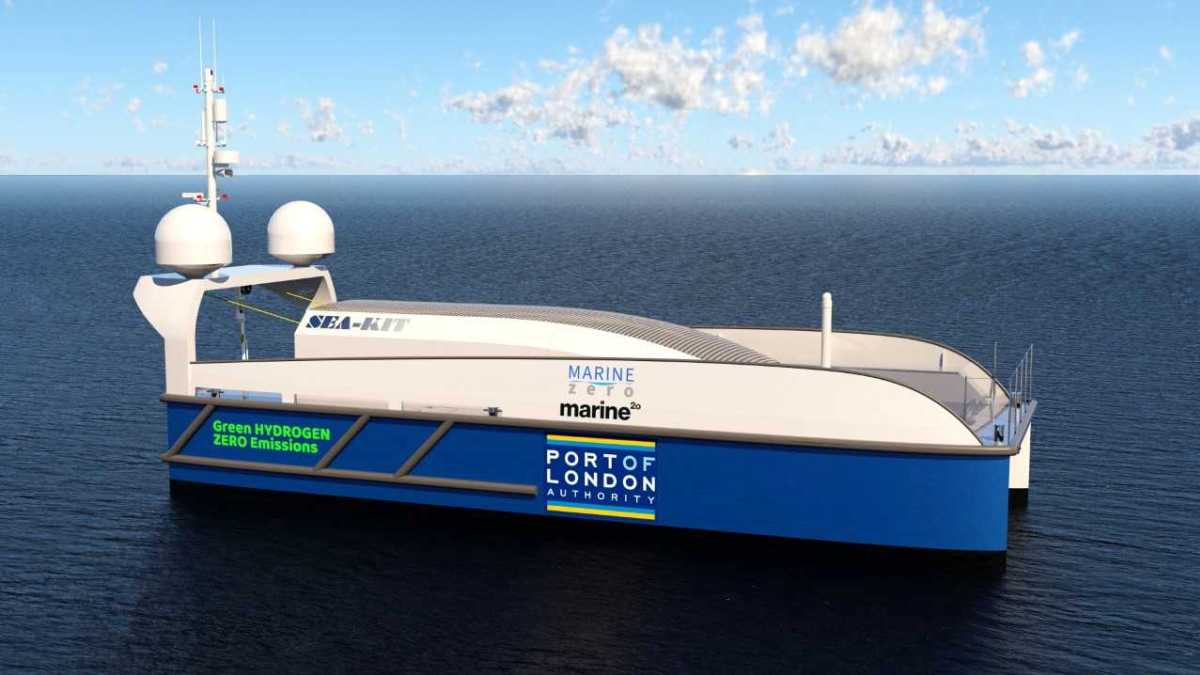
SEA-KIT International has won funding from the Zero Emissions Vessels and Infrastructure (ZEVI) competition to design and manufacture a hydrogen-fuelled Uncrewed Surface Vessel (USV). The company will partner with maritime decarbonisation disruptor, Marine2o, for the build of land-based infrastructure to produce green hydrogen, via renewable energy and the electrolysis of water, as part of the project.
Dubbed ZEPHR – Zero Emissions Ports Hydrogen Refilling Survey Vessel, the project aims to extend vessel operation for port operators and stakeholders through complete energy transferal, from readily accessible green electricity to 100% green hydrogen production, compression, storage and dispensing.
Engineering design and sustainability specialists, Marine Zero, will support Marine2o with regulatory compliance and the design and integration of the dispensing facility. The Port of London Authority (PLA), a consortium partner, will host the hydrogen refilling station on the River Thames in London and subsequently operate the ZEPHR USV.
John Dillon-Leetch, PLA’s port hydrographer, said: “Our support of this exciting project underlines our commitment to creating a Net Zero future on the tidal Thames. Embracing innovation and new fuel technologies utilised on ZEPHR will enable us to be more sustainable and efficient in the production of the essential hydrographic data and products that we provide to all mariners on the Thames.
“The 5-year project will also support environmental monitoring, academic and industry research programs as well as feeding into the Maritime Hydrogen Highway programme – all key elements of the Thames Vision 2050, supporting the PLA, our partners and stakeholders to deliver on their sustainability goals.”
The Thames is Britain’s busiest inland waterway, handling over five million tonnes of goods and materials and millions of passenger journeys each year. The Thames Estuary is therefore well placed to support the development of a hydrogen ecosystem, with significant potential usage demand across several sectors, including ports, marine and river transportation, airports and aviation, construction, distribution and logistics.
As custodians of the UK’s largest port, the PLA has set out ambitious emissions reduction targets and is actively undertaking a range of actions to realise these, including the implementation of new technologies. The ZEPHR USV, with its zero-emission operations capability, will support the PLA in achieving its aims.
SEA-KIT’s remotely operated USVs, many of which are operational on offshore projects around the world, improve safety by having crew located onshore in Remote Operations Centres. Their smaller size also leads to significant cost savings compared to larger, conventional survey vessels.
The configurable ZEPHR USV platform will have a high resolution multibeam echosounder as its primary payload, with the capability to mount additional sensors such as LiDAR, cameras and environmental monitoring and sampling equipment. The vessel will also be able to launch and recover aerial drones for surveying, surveillance, search and rescue. ZEPHR will use two hydrogen fuel cell systems for redundancy.
The vessel’s design will be reviewed with Lloyd’s Register and the Maritime and Coastguard Agency to satisfy regulatory and compliance requirements and to obtain approvals for continuous operations. ZEPHR will be built at SEA-KIT’s recently expanded production facility in Tollesbury, Essex in the UK.







 competition to design and manufacture a hydrogen-fuelled Uncrewed Surface Vessel (USV). The company will partner with maritime decarbonisation disruptor, Marine2o, for the build of land-based infrastructure to produce green hydrogen, via renewable energy and the electrolysis of water, as part of the project.)