



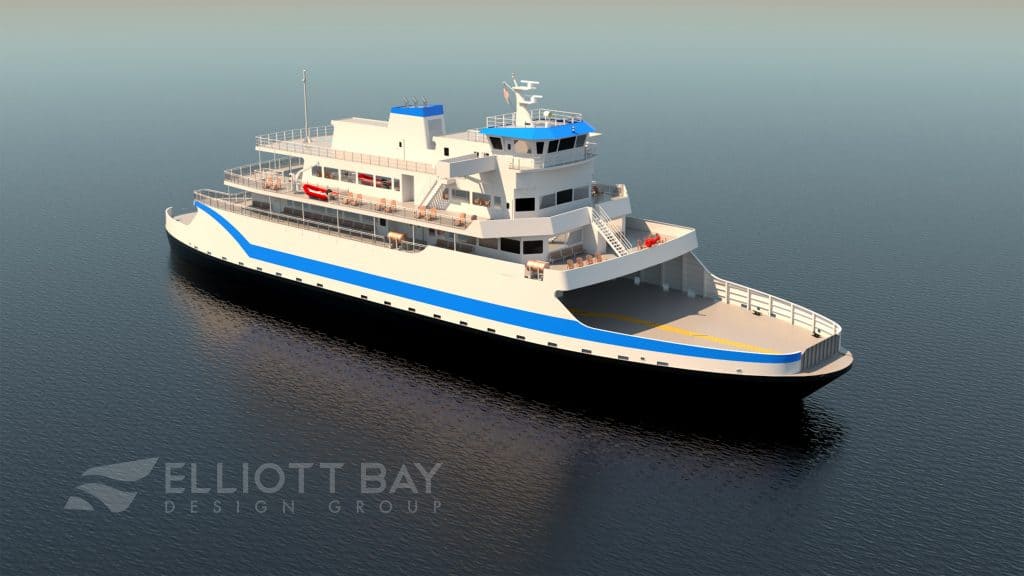
Hybrid-electric system supports Delaware River and Bay Authority ’s push to cut emissions and fuel use on the Lewes–Cape May route
One of North America’s busiest ferry corridors is embracing electrification as U.S. operators increasingly prioritise efficiency and emissions reduction in fleet renewal programs. An integrated hybrid-electric propulsion package from ABB has been selected for a new vessel ordered by the Delaware River and Bay Authority (DRBA).
Shipbuilder Senesco Marine has awarded ABB a contract to supply the complete propulsion and automation system for the new 75-car and passenger ferry. The new ferry will replace the 45-year-old Cape Henlopen, which operates on the Lewes, Delaware–Cape May, New Jersey route. Construction is scheduled to commence at Senesco’s Rhode Island facility in mid-2026.
ABB’s comprehensive scope of supply includes the high redundancy propulsion system comprising flexible Onboard DC Grid™ power platform, and PEMS™ power and energy management system, as well as engineering, acceptance testing, training and commissioning support.
Established in 1964, the Cape May–Lewes Ferry route has served 50+ million passengers and supports 4,000+ regional jobs accounting for hundreds of millions of dollars in economic activity each year. The 17-mile Cape May-Lewes transit offers passengers a car-friendly alternative to spending hours on the highway between New Jersey and Delaware.
Expected to improve efficiency, reliability, and customer experience, the new ferry is due delivery in 2029 as part of Delaware River and Bay Authority’s fleet modernization initiative. Unlocking initial fuel savings of around 35 percent, as well as lower operating and maintenance costs compared to the existing fleet, the ship will enter service as a diesel-electric vessel, but with the capability to install a 7,000 kWh battery pack for an all-electric upgrade.
Developed by Elliott Bay Design Group and classed by American Bureau of Shipping to meet United States Coast Guard requirements, its arrival will signal a major step forward in DRBA’s strategy to cut regional emissions of nitrogen dioxide, particulates, hydrocarbons, carbon monoxide and carbon dioxide. The delivery is one of 18 projects under the 2024 $300 million U.S. Department of Transportation nation-wide funding program supporting hybrid and electric ferry upgrades to advance cleaner, lower emission ferry systems2.
ABB is a leader in ferry electrification worldwide, and in the Americas, where its technical expertise and broad portfolio of products and services support initiatives to improve efficiency and sustainability, and deliver operational cost benefits which only increase over time. With the first phase of the DRBA’s Cape May-Lewes Ferry project leveraging the high redundancy of hybrid-electric propulsion systems, the subsequent upgrade will secure zero-emission operations and port stays, as part of a US-build project featuring strong domestic content that complies with ‘Buy America rolling stock subject to 49 CFR 661’ conditions.
“Senesco Marine is truly excited to have been awarded the DRBA contract for the Cape May Lewes Ferry. We are absolutely thrilled to be working alongside ABB on this project, especially given their remarkable expertise and proven success in the hybrid propulsion space,” said Ted Williams, President, Senesco Marine, LLC.
“ABB is proud to support the modernization of the Cape May–Lewes Ferry with hybrid-electric propulsion technology developed and supported here in the United States,” said Timo Vesala, Head of Sales, Marine Systems, Americas, ABB’s Marine & Ports division. “This project builds on our long-standing commitment to helping American shipyards and coastal communities move toward cleaner, more efficient marine transportation.
Our solutions are entirely scalable, and our ferry projects range from the biggest electrification programs to smaller vessels with very tailored needs. We look forward to working with Senesco Marine and the Delaware River & Bay Authority to deliver the next generation of sustainable ferry operations.”
In December 2025, ABB announced winning an order from Washington State Ferries (WSF) to support the United States’ largest ferry operator’s System Electrification Program by supplying and integrating hybrid-electric propulsion systems for two hybrid-electric 160-auto ferries.









.)