


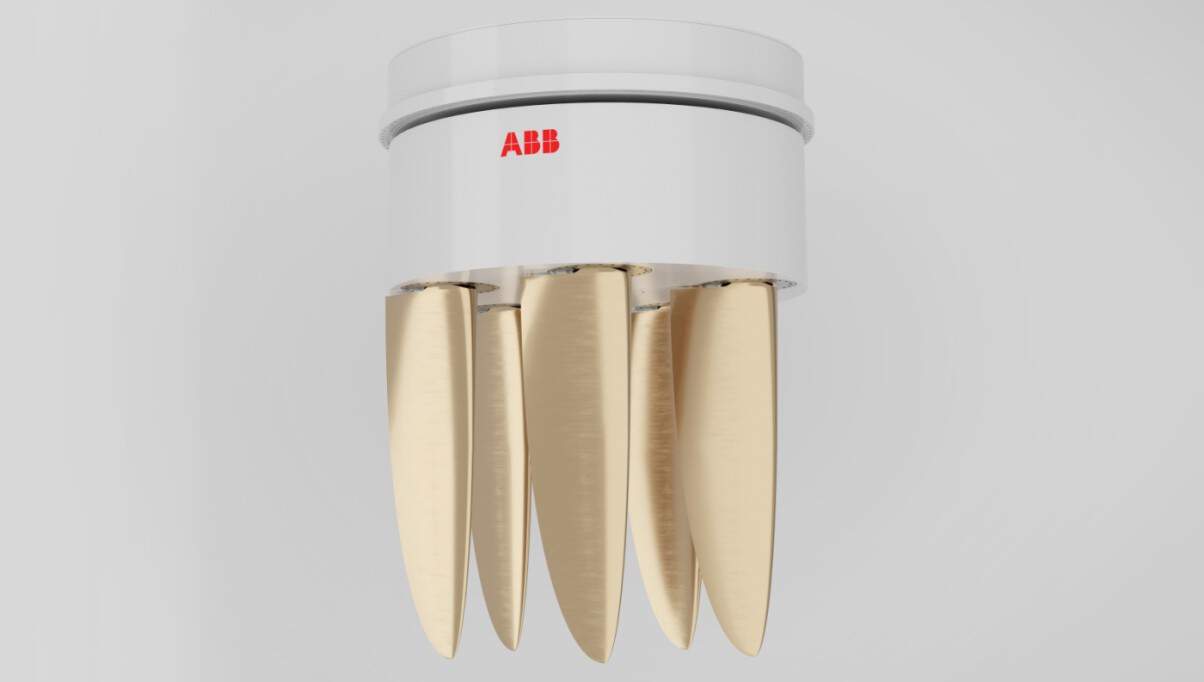
ABB today introduced ABB Dynafin™, a new concept representing a revolutionary propulsion system breaking new ground for efficiency in the marine industry. Inspired by the dynamic motions of a whale’s tail, the innovative concept is the result of over a decade of research, development, and testing. ABB’s combined extensive experience and expertise in the marine industry, along with its innovative heritage, are the driving forces behind this new concept. ABB estimates the first prototype to be available in 2025.
“ABB Dynafin™ shows what is possible when marine engineers pursue radical innovation and progress, inspired by the interplay of evolution and technology,” said Juha Koskela, Division President, ABB Marine & Ports. “This solution is all about operational efficiency and emissions avoidance, leveraging innovations from the brightest minds in marine and propulsion engineering. I want to thank the whole team for their persistence, resilience, innovativeness, and years of hard work.”
The new propulsion concept features a main electric motor that powers a large wheel rotating at a moderate 30-80 rounds per minute. Vertical blades, each controlled by an individual motor and control system, extend from the wheel. The combined motion of the wheel and blades generates propulsion and steering forces simultaneously, enabling ground-breaking operational efficiency and precision for ships. The concept follows ABB’s proven design philosophy in marine propulsion of gearless power transmission.
An independent study of ABB Dynafin™ from OSK-ShipTech A/S of a passenger vessel design equipped with different propulsion solutions has verified savings in propulsion energy consumption of up to 22 percent compared to conventional shaftline configuration. This can deliver significant savings in fuel consumption and help to avoid emissions. As part of an electric propulsion power system, the concept is also fully compatible with zero-emission battery and fuel cell technologies.
Initially available in the power range of 1–4 MW per unit, the new propulsion concept is particularly effective for medium-sized and smaller vessels, including ferries for passengers and vehicles, offshore support vessels operating at wind farms, and yachts. By reducing vibrations and noise levels, the system improves passenger and crew comfort. In addition, the propulsion concept delivers superior maneuverability, and positioning performance, i.e., the capacity of the vessel to maintain the desired position and heading.
The new concept is the latest addition to ABB’s portfolio comprising electric, automated and digital technologies. With its market-leading expertise in electric and hybrid propulsion, the company has been pushing the boundaries of technology, and driving efficiency, performance, and sustainability to new levels through the 30-year plus track record of Azipod® propulsion. The new propulsion concept will complement the existing propulsion portfolio.
The shipping industry contributes to almost 3 percent of global greenhouse gas emissions annually. If it were a country, it would be the sixth largest emitter. However, with about 90 percent of global trade being carried on ships, it is central for the movement of goods. If no action is taken, shipping could be responsible for up to 13 percent of global emissions by 2050. At the same time, the International Maritime Organization has set the goal to cut annual greenhouse gas emissions by at least 50 percent by 2050, against 2008 levels. While there is consensus in the industry that no single solution can provide a ‘silver bullet’, low-carbon fuels, alternative power sources, data analytics and energy-saving devices all have a part to play, and the role of new innovations may become notable.
ABB is a technology leader in electrification and automation, enabling a more sustainable and resource-efficient future. The company’s solutions connect engineering know-how and software to optimize how things are manufactured, moved, powered and operated. Building on more than 130 years of excellence, ABB’s ~105,000 employees are committed to driving innovations that accelerate industrial transformation. www.abb.com