Electronics & CommunicationAIAIRCAT Selects Sea.AI To Enhance Safety Onboard World’s Fastest Crew Transfer Vessels

AIRCAT Selects Sea.AI To Enhance Safety Onboard World’s Fastest Crew Transfer Vessels

Sea.AI, a leader in AI-powered maritime safety solutions, announce the integration of its Sentry system into the first three AIRCAT Crew Transfer Vessels, marking a significant milestone in offshore navigational safety. This collaboration represents a major step forward in leveraging artificial intelligence to enhance maritime safety and operational efficiency.

Designed for crew transfers in offshore industries such as wind farms and oil & gas installations, these vessels use powerful fans to generate an air cushion between the catamaran hulls. This unique vessel design, called a “Surface Effect Ship” or SES, minimizes hull drag and resistance to reduce emissions and enhance speed and efficiency. Now, these innovative vessels come with the added intelligence of Sea.AI’s Sentry system for enhanced situational awareness at sea.

The AIRCAT 35 Crewliner Series are 35-metre and 80-passenger vessels that achieve speeds of up to 53 knots, making them the World’s Fastest Crew Transfer Vessels. With the integration of Sea.AI’s Sentry, these vessels now have an extra layer of safety, security, and operational intelligence.

“From the very start, we saw the immense potential of machine vision technology for maritime safety. It was only natural for us to integrate such innovative and proven technology into our vessels,” said Jérôme Arnold, CEO of AIRCAT Vessels. “With the speeds and operational environments we navigate, having Sea.AI’s Sentry onboard is not just an upgrade—it’s a game-changer for safety and efficiency.”

Sentry provides 24-hour, 360-degree surveillance all the way to the horizon, even in the most adverse conditions. Leveraging high-performance thermal and optical sensors paired with AI-driven object detection, target tracking, and collision avoidance, the system automatically classifies a wide range of objects including floating debris, rafts, buoys, boats not equipped with AIS, and persons overboard.
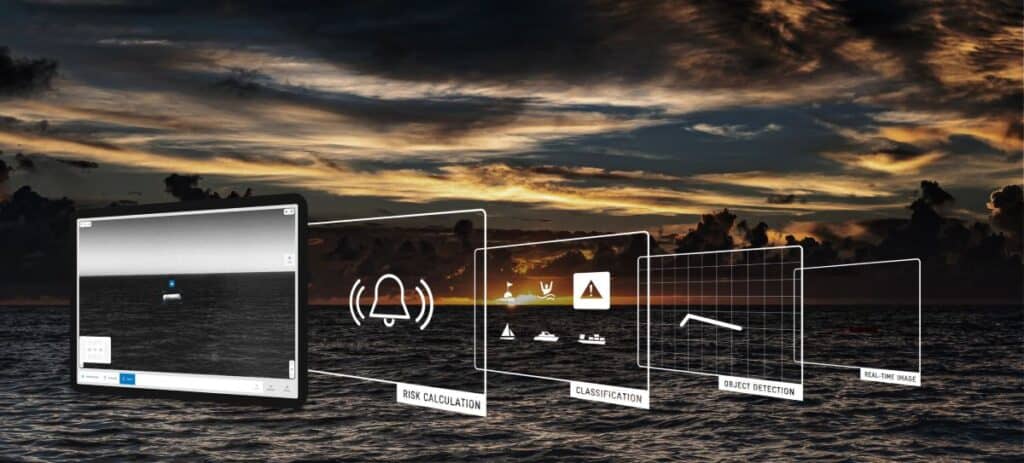
Sea.AI, the leader in AI-powered maritime safety solutions, has announced the integration of its Sentry system into the first three cutting-edge AIRCAT Vessels, marking a major advancement in offshore navigational safety.

“The integration of our Sentry system into AIRCAT vessels underscores our commitment to making maritime operations safer and smarter,” said Marcus Warrelmann, CEO of Sea.AI. “Whether it’s detecting potential hazards, tracking a person overboard, or enhancing situational awareness, our AI-driven technology provides a new level of confidence for operators working in offshore environments.”

“The Sentry system provides additional navigational safety, allowing us to detect thermal differences even in poor visibility conditions. This is crucial for spotting fires, monitoring non-visible heat sources, and even detecting people in the water during search and rescue operations.” said Eduard Ercegovic, Technical Director at Aircat Vessels and Master Mariner.


Latest News

The International Institute of Marine Surveying (IIMS), working in collaboration with the International Marine Contractors Association (IMCA) and the Workboat Association, has announced the publication of the International Workboat Code of Practice, a 122-page guide providing best-practice guidance for the construction, operation and surveying of commercial workboats.

IIMS, IMCA and Workboat Association Launch International Workboat Code of Practice

IIMS, IMCA and the Workboat Association collaborate on a 122-page guide covering vessel safety, operational standards and crew competency for commercial workboats worldwide The International...
The world’s largest battery-electric ship has officially entered commercial passenger service, marking a major milestone for maritime electrification and zero-emission vessel operations. Built by Incat Tasmania for long-standing customer Buquebus, the 130-metre China Zorrilla has completed its maiden commercial voyage between Buenos Aires, Argentina, and Colonia, Uruguay, across the River Plate.

China Zorrilla Begins Electric Ferry Operations

Built for Buquebus to connect Argentina and Uruguay, the China Zorrilla, the world’s largest battery-electric ferry, marks a major milestone in large-scale marine electrification...
Boluda Towage has expanded its Norwegian fleet with the addition of VB NORWEGIAN FALCON, a new tug built by Sanmar Shipyards to support towing, vessel assistance and offshore operations in demanding maritime environments.

Boluda Towage Takes Delivery of VB NORWEGIAN FALCON

Sanmar-built VB NORWEGIAN FALCON features RAstar 3200 SX design, ASD propulsion and more than 6,700 hp Boluda Towage has expanded its Norwegian fleet with the...
SWITCH Maritime has secured a Design Basis Agreement (DBA) from the United States Coast Guard (USCG) for its SWITCH-150 hydrogen fuel cell-electric ferry, marking a key milestone in the development of the 150-passenger vessel. Designed by naval architecture firm Incat Crowther, the SWITCH-150 combines hydrogen fuel cell-electric propulsion with onboard hydrogen storage to support high-frequency ferry operations without compromising service schedules or requiring shoreside charging infrastructure.

SWITCH Hydrogen Ferry Clears Key US Coast Guard Milestone

The US Coast Guard agreement establishes a regulatory framework to guide construction, commissioning and future commercial operation of the hydrogen-powered ferry SWITCH Maritime has secured...

Related news