



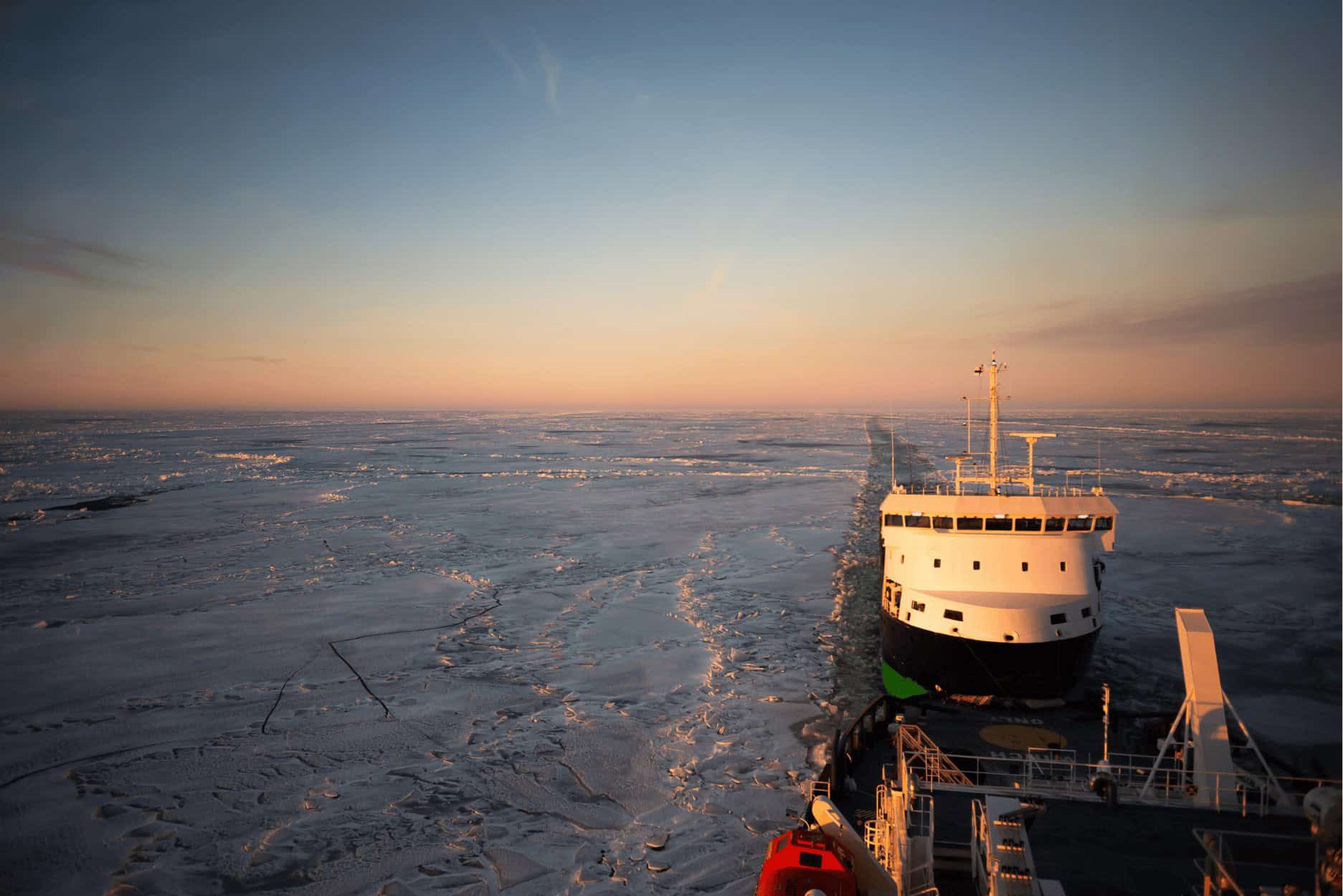
The Finnish Transport Infrastructure Agency (FTIA) has selected Aker Arctic, the global leader in icebreaking technology, to develop the design for a next-generation Baltic Sea assistance icebreaker as part of the Winter Navigation Motorways of the Sea III (WINMOS III) project, co-financed by the European Union. The contract encompasses initial design, technical evaluations, model testing, and final concept development, ensuring the new vessel meets the evolving demands of winter navigation in the Baltic Sea.
Ensuring year-round access to Finnish ports requires maintaining sufficient icebreaking capacity. For example, during the average ice winter of 2023–2024 the first Finnish icebreaker was deployed to the Bothnian Bay already in late November and by the end of January the whole Finnish icebreaker fleet was in operation.
“Tightening energy efficiency requirements will reduce the independent ice-going capability of new commercial vessels and consequently increase the need for icebreaking services also during mild winters. In addition to high operational icebreaking capability, the icebreaker design thus highlights the ability to operate in more dynamic and fragmented ice fields, as well as good seakeeping characteristics and low fuel consumption in open water transit,” says Mika Hovilainen, CEO, Aker Arctic.
The working title of the new icebreaker design, “B+”, describes its classification between the biggest A-class and the mid-tier B-class icebreakers in terms of vessel size and capability. Such icebreaker could be deployed to the Bothnian Bay in the beginning of the icebreaking season when icebreaker assistance is required primarily by smaller commercial vessels. Later in the season, the new icebreaker could be relocated south to the Bothnian Sea or the Gulf of Finland as needed.
Meeting the tightening emission targets of the maritime industry will call for the adoption of new environmentally friendly technical solutions in future icebreakers. The initial design phase will include the evaluation of different fuel alternatives and machinery configurations suitable for icebreakers. In addition, the use of different electric energy storage systems to balance out the load fluctuation will be investigated based on the typical operational profile of a Baltic Sea assistance icebreaker.
The development of the next-generation icebreaker design will begin immediately. In addition to the initial technical evaluations and studies, the first phase will also include the comparison of three concept alternatives in terms of performance and costs for acquisition, service, and maintenance over the lifetime of the vessel. The performance of at least two concepts will be evaluated with model tests. The final concept design package will be completed in early 2026.













 project)