



Kongsberg Maritime is to begin a trial of Eutelsat OneWeb’s low Earth orbit (LEO) satellite internet service on an autonomous barge operation across the Oslo Fjord.
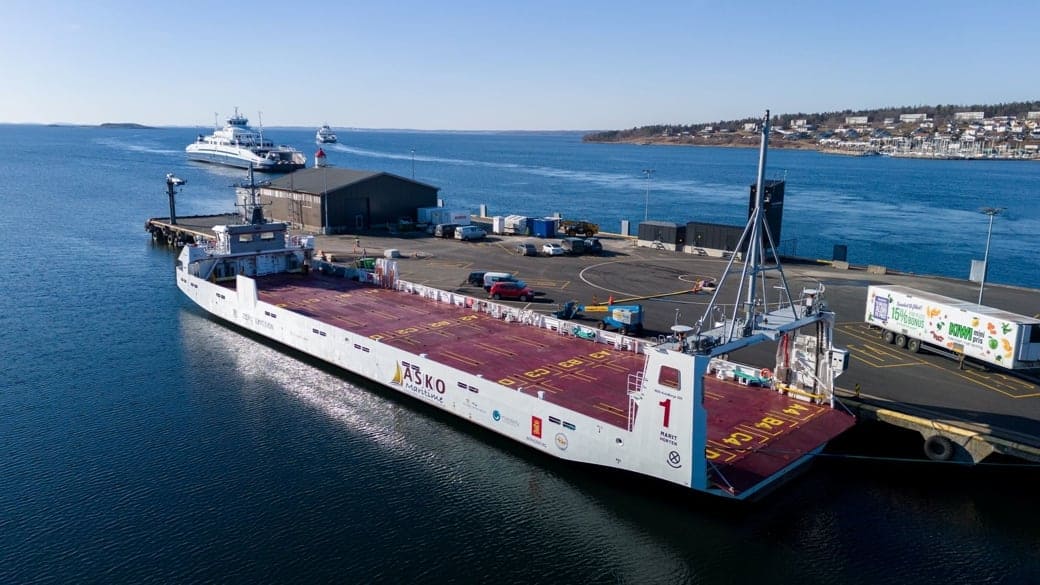
In a collaborative project with the help of Norwegian telecommunications provider Telenor Maritime, a zero-emission, electric barge, owned and operated by grocery distributor ASKO, will be equipped with Eutelsat OneWeb’s latest Kymeta Peregrine u8 flat panel antenna system for the duration of the trial.
The integration of the Eutelsat OneWeb antenna system on the vessel will enable Kongsberg Maritime to experience LEO connectivity and bandwidth for real-time data transfer, ship-to-shore communication, and remote and autonomous vessel control.
The ASKO barge, which is battery-powered, is one of a pair delivered in 2022. They have been operating extensive trials since then, transporting up to 16 trailers of cargo on each journey across the Oslo Fjord. This innovative operation reduces road travel by two million kilometres and cuts carbon emissions by 5000 tons annually.
During the latest trials, the barge will be remotely controlled from a Remote Operations Centre (ROC), located in the Kongsberg Maritime facility in Horten. The ROC is operated by Massterley, a Kongsberg Maritime and Wilhelmsen joint venture company.
Pål André Eriksen, Senior Vice President, Remote & Autonomous solutions, at Kongsberg Maritime, said: “Through the successful demonstrations of our remote and autonomous technologies on several ground-breaking pilot projects, including the ASKO barges, Kongsberg Maritime has already proved that remote and autonomous technologies are applicable to different vessel types.
“Seamless connectivity remains one of the key challenges for remote and autonomous operations, particularly in the open oceans. Overcoming the challenges of global connectivity and available bandwidth will unlock great potential for the deployment to of such technologies in future, and we look forward to working with Eutelsat OneWeb and Telenor Maritime to see how this project can advance the development of autonomous shipping solutions further.
“We’re grateful to ASKO for allowing us to install OneWeb’s latest antenna technology on one of their vessels, which will provide a realistic operating environment to comprehensively demonstrate the low latency, high throughput capabilities of Eutelsat OneWeb’s low Earth orbit satellite service.”
Alexandra Kenworthy, Director Maritime & Energy, Eutelsat OneWeb, said: “Our work with Telenor Maritime and Kongsberg Maritime plays a key role in demonstrating the new, enhanced, and secure capabilities that high-speed low Earth orbit connectivity brings to maritime operators all over the world. This trial is a great example of shared vision; and Eutelsat OneWeb’s collaboration with trusted partners like Telenor Maritime and Kongsberg will continue, as we drive digital transformation across the maritime industry. There is huge demand for resilient low-latency connectivity that will enhance business critical operations as well as improve crew communications, for their customers everywhere.”
Knut Fjellheim, CTIO, Telenor Maritime said: “This project is incredibly important for the future of autonomous vessels, not only in local fjords and rivers, but also in open ocean waters. I am genuinely excited about developing connectivity solutions that will set standards for the global connectivity for autonomous vessels. With OneWeb’s LEO coverage and our advanced connectivity platform, we’re on the cusp of achieving 100% uptime for ship connectivity. It’s thrilling to be at the forefront of such cutting-edge innovation.”
Both of the ASKO autonomous barges, also known as sea drones, have a permanent bridge for manual operation, and can also be controlled from the ROC in Horten. However, once the autonomous concept is proven the bridge will be omitted in future builds.









 satellite internet service on an autonomous barge operation)