






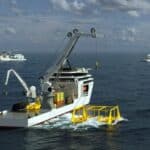
CalWave Power Technologies successfully commissioned its CalWave x1™ on September 16th off the coast of San Diego. This milestone event marks the beginning of California’s first at-sea, long-duration wave energy pilot operating fully submerged. The CalWave x1™ will be tested for six months with the goal of validating the performance and reliability of the system in open ocean.
This project is supported by a US Department of Energy award with the goal to demonstrate CalWave’s scalable and patented xWave™ technology.
“CalWave’s long-duration deployment is a novel open water demonstration of a wave energy technology with active load management features,” said Jennifer Garson, Acting Director of the Department of Energy’s Water Power Technologies Office (WPTO). “WPTO is pleased to recognize this accomplishment as a major milestone for unlocking the potential of wave energy from our oceans and providing access to clean energy for the growing blue economy in the US.”

Several key partners collaborated with CalWave on this project including the Scripps Institution of Oceanography, the National Renewable Energy Laboratory, Sandia National Laboratories, DNV GL, and UC Berkeley.
Operating fully submerged without visual impact, CalWave’s xWave™ architecture is capable of breaking through the fundamental challenges that have held the industry back so far: a technology that achieves high performance while being able to control structural loads in rare but destructive storms on all parts of the system.
The CalWave x1™ is well suited for the needs of end-users of the blue economy with applications in offshore inspection, aquaculture, ocean science, and others that require access to power and data offshore.
Following this demonstration, CalWave plans to prepare for deployment of a larger unit at PacWave, the first commercial-scale, utility grid-connected wave energy test site in the US rated at 20 MW.
Marcus Lehmann, CEO and Co-Founder of CalWave:
“Wave power is the largest unused renewable resource and the third-largest after wind and solar globally. Wave power can provide power at night and during wintertime where other renewables can’t, and so far it is completely unused.
Wave energy devices are no different than wind turbines or other hydro turbines. It’s a kinetic device that captures a renewable resource to produce electricity. At the highest systems engineering level, the functions to make a technology viable are the same. To generate cost-competitive power, technology must be able to use the most of a resource to produce the greatest amount of electricity at minimum capital and operating cost. For us, capital efficiency means that any system must be able to reduce primary loads from storm waves just like pitch and yaw control, a critical feature of our modern wind turbines.
Next to high performance, this is the second fundamental and critical feature of a wave energy device to be able to survive storms without being overdesigned for these rare events that don’t contribute to the annual energy production but drive up the cost.
Our team is excited about this major milestone and wants to express our gratitude to all partners and supporters that helped us along the way.”
Details on the xWave™ Technology
Unlike conventional technologies that extract wave energy at the ocean surface, CalWave’s patented xWave™ architecture operates fully submerged at a range of different water depths and distances to shore, achieving high performance and unlocking the ability to be fully shut down in storm conditions. This unique approach enables several advantageous operating abilities: It survives stormy seas and extreme conditions, causes no visual impact, and allows for unique control of structural loads by eliminating excessive loads during storms that drive up the cost of systems without substantially contributing to annual energy production. Wave farms export power using the same electrical export infrastructure as offshore wind farms.
Status of the Industry
The Department of Energy recently published a study including an updated resource assessment and found that wave power can provide up to 30% of the 2019 energy consumption in the US, representing the technically feasible resource potential and not just the theoretical.
The wave energy industry is at an inflection point and CalWave is taking a leading role in unlocking the vast and steady carbon-free power from ocean waves worldwide. As several governments aim to transition to 100% clean energy, such as California through the passage of Senate Bill 100 in 2018, CalWave’s scalable technology has the potential to complement existing renewable energy forms to provide reliable power when no other renewables are available. Similar to wind turbines, wave energy converters (WECs) are scalable in power rating and CalWave plans to offer product lines with different power ratings in the coming years. Utility-scale units can be co-located with offshore wind farms using the same electrical export infrastructure and achieve a significantly higher joint capacity factor due to the complementary production profile of wind and wave power.
About CalWave Power Technologies Inc.
Founded in 2014, CalWave is a California-based developer of clean energy technology designed to generate electricity and freshwater from ocean waves. Through rigorous research, innovation, and testing, we offer next-generation solutions that protect our planet and unlock the potential of its global citizens.
CalWave’s mission is to unlock the vast and steady carbon-free power from ocean waves, thereby contributing to a healthier, safer, more equitable, and prosperous world. The company is a member of the National Hydropower Association’s Marine Energy Council, which is calling for domestic marine energy deployment targets of at least 50 MW by 2025, 500 MW by 2030, and 1 GW by 2035.











 successfully commissioned its CalWave x1™ on September 16th off the coast of San Diego. This milestone event marks the beginning of California’s first at-sea, long-duration wave energy pilot operating fully submerged. The CalWave x1™ will be tested for six months with the goal of validating the performance and reliability of the system in open ocean.This project is supported by a US Department of Energy award with the goal to demonstrate CalWave’s scalable and patented xWave™ technology. “CalWave’s long-duration deployment is a novel open water demonstration of a wave energy technology with active load management features,” said Jennifer Garson, Acting Director of the Department of Energy’s Water Power Technologies Office (WPTO). “WPTO is pleased to recognize this accomplishment as a major milestone for unlocking the potential of wave energy from our oceans and providing access to clean energy for the growing blue economy in the US.”Several key partners collaborated with CalWave on this project including the Scripps Institution of Oceanography, the National Renewable Energy Laboratory, Sandia National Laboratories, DNV GL, and UC Berkeley.)