



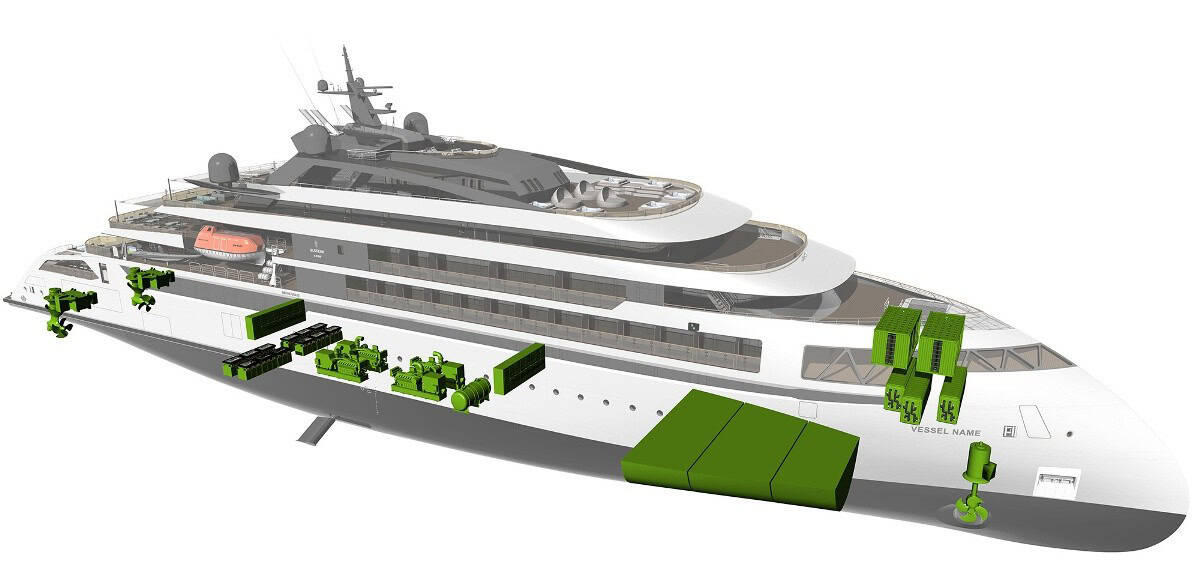
The maritime industry has a goal to reduce emissions, with targets of 40% by 2030 and 70% by 2050, settled by IMO. The cruise vessels need to play a role in the future greener shipping. Ulstein now proposes a cruise concept prepared for a stepwise transition towards zero-emission operations.
Although the cruise industry is not a large contributor to global GHG emissions, with less than 0,1 per cent of the overall emissions, the cruise industry has a commitment to reduce emissions and become more sustainable. The cruise vessels explore protected and vulnerable areas around the world, and the cruising companies and their clients do not wish to harm the environment they are exploring. Low emission solutions and minimal noise and vibrations are requested. In parallel, regulators have drafted a pathway that vessel operators need to comply with. IMO’s Carbon Intensity Factor (CII), will set increasingly stringent energy efficiency requirements.
Operational analysis always comes first
Every design process should start with a better understanding of vessel operations. An analysis of the different operations that are carried out, and how they impact the energy consumption of the vessel, is key. This enables the identification and assessment of how to reduce energy consumption, how to produce the energy and, finally, how to utilise the waste energy. By doing this, some measures have been implemented in the ULSTEIN CX129 cruise vessel design, including the optimised hull lines with the X-BOW®, LED lights, heat pump technology and a waste energy system, and others can be added later as desired.
Fuel availability as a case-by-case study
The selection of alternative, low emission fuels is not an easy one and should be looked at in a case-by-case study. Fuel availability in vulnerable areas is scarce, and to date, alternative fuels are non-existing. Thus, although technology might soon be available, there is still a way to go when it comes to fuel availability. These are remote areas without the necessary infrastructure for all future alternative fuels.
Stepwise approach
Ulstein is committed to enabling such sustainable cruise operations. By implementing technology as it becomes available, we can make today’s vessels prepared for future expectations and requirements.
This has triggered Ulstein to explore innovative solutions and to propose a stepwise implementation of technology for how to reach zero-emission cruise operations.
To fully investigate how cruise vessels can become more sustainable, our design team has carried out a thorough analysis of typical cruise operations. The analysis provided useful insights into how alternative fuel technologies can be combined.
A flexible combination of alternative power sources
The ULSTEIN CX129 has been developed to operate on dual fuel methanol/MGO engines. This technology is already available in the market. If desirable, MGO can already be replaced with HVO, a renewable biofuel produced from waste and residues from e.g. the food industry. This fuel has a cleaner combustion and will reduce greenhouse gas emissions significantly.

Methanol is an available energy source with an advantageous energy density and storage availability, and green methanol results in very low emissions. The power plant is supported by a large battery package enabling periods of zero-emission operations in vulnerable areas that also supports optimization of the power plant by enabling peak-shaving.
Methanol-fuelled, the vessel will meet the expectations of emission reduction from day one. The next step might be to install fuel cells for methanol, and space will be reserved for this upgrade. This will decrease emissions further and allow silent operation of the vessel.
The design also has the flexibility for a later upgrade to hydrogen, preparing the cruise operators for a zero-emission future. An upgrade to carry Liquid Organic Hydrogen Carriers (LOHC) as fuel is possible, in addition to space reserved for hydrogen containers, and hydrogen fuel cells can be installed.

Low emission cruise operations are possible today with the combination of dual-fuel methanol engines and battery energy storage systems. “With a battery capacity of 4 MWh, a total fuel range of 11,000 nautical miles on MGO/HVO, 3,800 nautical miles on Methanol and with the option of a future upgrade to 1,200 nautical miles of Hydrogen range, a typical cruise operation can be decarbonised dramatically,” says Lars Ståle Skoge, commercial director at Ulstein Design & Solutions.






, will set increasingly stringent energy efficiency requirements.)