


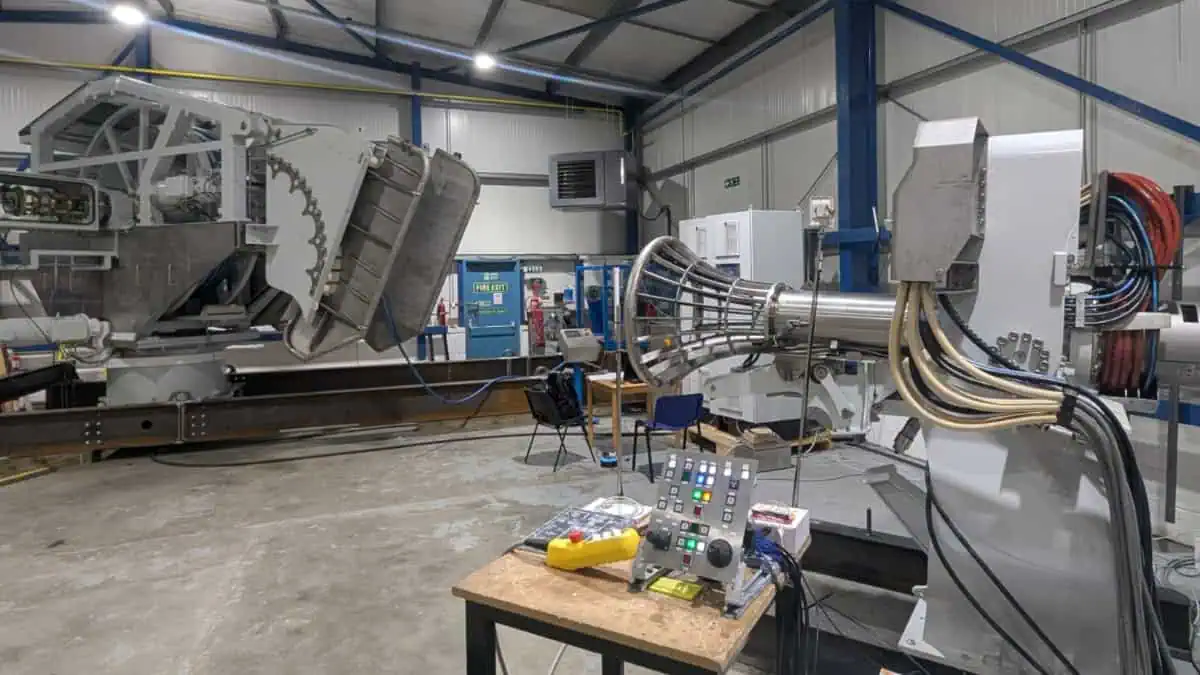
Charge Offshore, a leading specialist in marine electrification has successfully completed factory acceptance tests (FAT) for its 2 MW-enabled offshore charging system, Aquarius Eco. The system is designed to supply emissions-free power generated by offshore wind directly to electric crew transfer vessels while operating at sea.
The successful FAT included rigorous mechanical function checks, stress tests, and electrical and control system verification to ensure the highest standards of operability, safety, durability and reliability in the field. The equipment will power Tidal Transit’s ‘e-Ginny’, a previously diesel-powered crew transfer vessels retrofitted by the company to run on 100% electric power.
Aquarius Eco is made up of two distinct modules: The ‘reeler’, installable on turbines, offshore substations or fixed and floating foundations; and the ‘catcher’, permanently mounted to an electric or hybrid crew transfer vessels. During operations, the reeler actively manages the charge cable, mating the connector and the vessel’s catcher to enable charging in high sea conditions. This unique, fully automated design allows for fast, hands-free connection and disconnection, offering a highly safe and reliable solution for charging vessels on location.
Paul Cairns, CEO of Charge Offshore, commented: “We’re incredibly proud to announce this latest milestone. Crucially, the thorough testing procedures proved that our innovative charging systems go above and beyond the stringent crew safety and technical durability standards required by the industry. The positive results mean that Aquarius Eco is now ready for a wider commercial rollout, and we’re looking forward to installing the system on new and existing offshore sites across the North Sea and beyond.”
Having delivered its first 2MW-capable commercial charging unit, Charge Offshore is now in the process of qualifying and certifying to DNV standards its 8MW Aquarius Plus product range. This larger charging capacity system is designed for the high-power service operation vessels (SOV) market, with units typically requiring between 5MW and 7MW for full electrical field operations with a single daily charge cycle.