


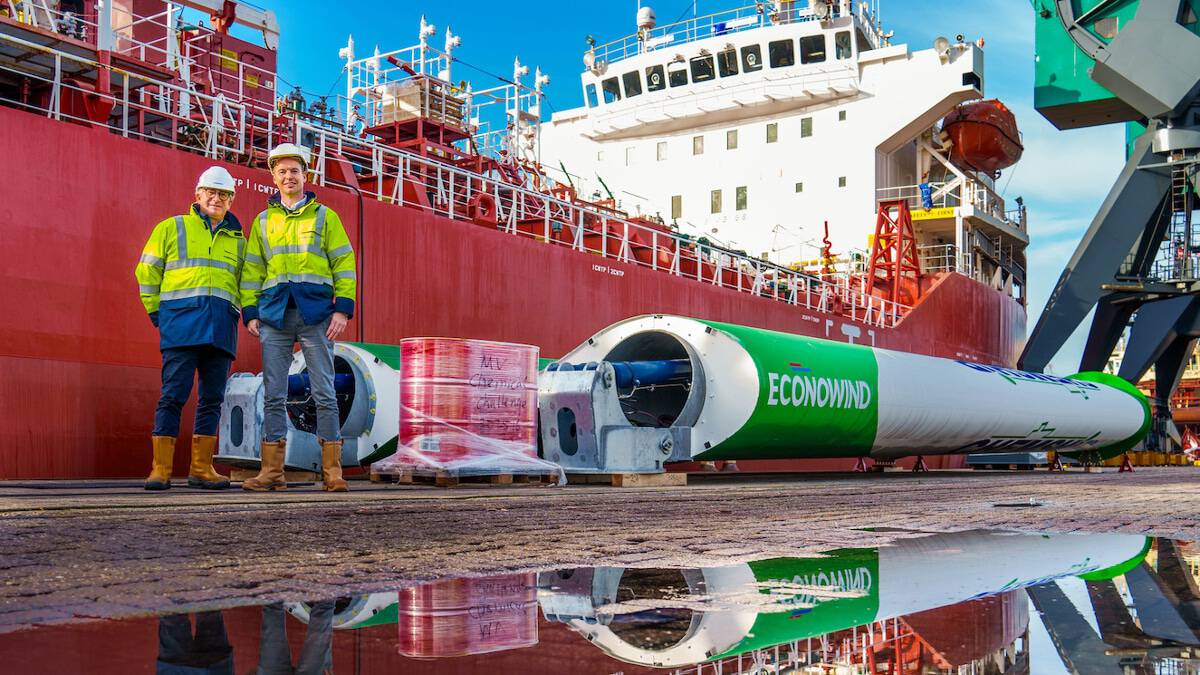
Chemship has commissioned its first ship with wind assisted ship propulsion. This makes the MT Chemical Challenger the first chemical tanker in the world to be equipped with sustainable wind technology. The ship will serve on shipping company Chemship’s Trans-Atlantic route between the East Coast of the United States and the Mediterranean.
This week four 16-metre-high aluminium wind sails were installed on board the 134-metre long vessel. The VentoFoils from Econowind create a direct wind surface of 180 m2. Smart vacuum technology quintuples the force of the wind, creating a gross wind surface of 900 m2. This is equivalent to an imaginary sail of 30 by 30 metres. Chemship expects to achieve an average CO2 reduction of 10% with these turbo sails.
Leading the way in sustainability
Chemship has a relatively young fleet with an average ship age of seven years. With wind assisted ship propulsion, CEO Niels Grotz sees shipping returning to its roots: “As an avid sailor, I know the power of the wind. We will now harness this sustainable and free energy source on MT Chemical Challenger. Despite the fact that shipping already has the lowest carbon footprint of all transport modes, we can use wind to make our existing fleet even more sustainable. With the VentoFoils, we will use less fuel and thus reduce CO2 emissions. For this vessel, we anticipate an annual CO2 reduction of 850 tonnes. This is equivalent to the yearly CO2 emissions of over 500 passenger cars.”
The emergence of wind-assisted sailing coincides exactly with the introduction of the European Emissions Trading System for the shipping industry. Since 1 January, shipowners have been paying for the emissions associated with transporting goods by sea to and from European ports. Niels explains: “Our customers increasingly demand CO2 reports. The better our ships perform, the higher the rating from our customers. Fewer emissions are not only beneficial for the environment, you will also notice it directly in your wallet.”
The wind sails fit well within the existing configuration of Chemship’s tankers. Operations Director Michiel Marelis explains the choice of wind propulsion: “Shipping is evolution: one step at a time. Chemship was looking for a solution that would not interfere with normal operations. These wind sails were easy to install without adding reinforcements to the ship. They are lightweight, have a small deck ‘footprint’ and do not obstruct the crew’s line of sight. At the push of a button, they can fold or set the sails as needed. Above wind force seven, the sails fold automatically, which is much safer. Now it is learning by doing. With positive results, we will also equip the next vessel with VentoFoils.”
Wind propulsion is part of a larger sustainability plan, as Michiel explains: “The beauty of these turbo sails is that you can show it to customers. They immediately capture everyone’s imagination. We hope this will inspire others to choose wind assisted propulsion too. We also focus on less visible aspects such as improved lubricating oils and a coating that enables the ship to glide through the water more efficiently. Cumulatively, this leads to fuel savings of over 15%. This all goes hand in hand with a CO2 reduction. Chemship remains committed to making the fleet more sustainable.”