London-based deep tech innovator Compute Maritime, developer of the world’s first generative AI ship design, NeuralShipper, is leading a £700,000 project awarded under the UK Government’s Clean Maritime Demonstration Competition (CMDC).
Working in partnership with Siemens Digital Industries Software, Rapid Fusion, HP, BYD Naval Architects, and the University of Southampton, the project, called GenDSOM, aims to significantly reduce the design to manufacturing cycle and deliver high performing, innovative solutions.
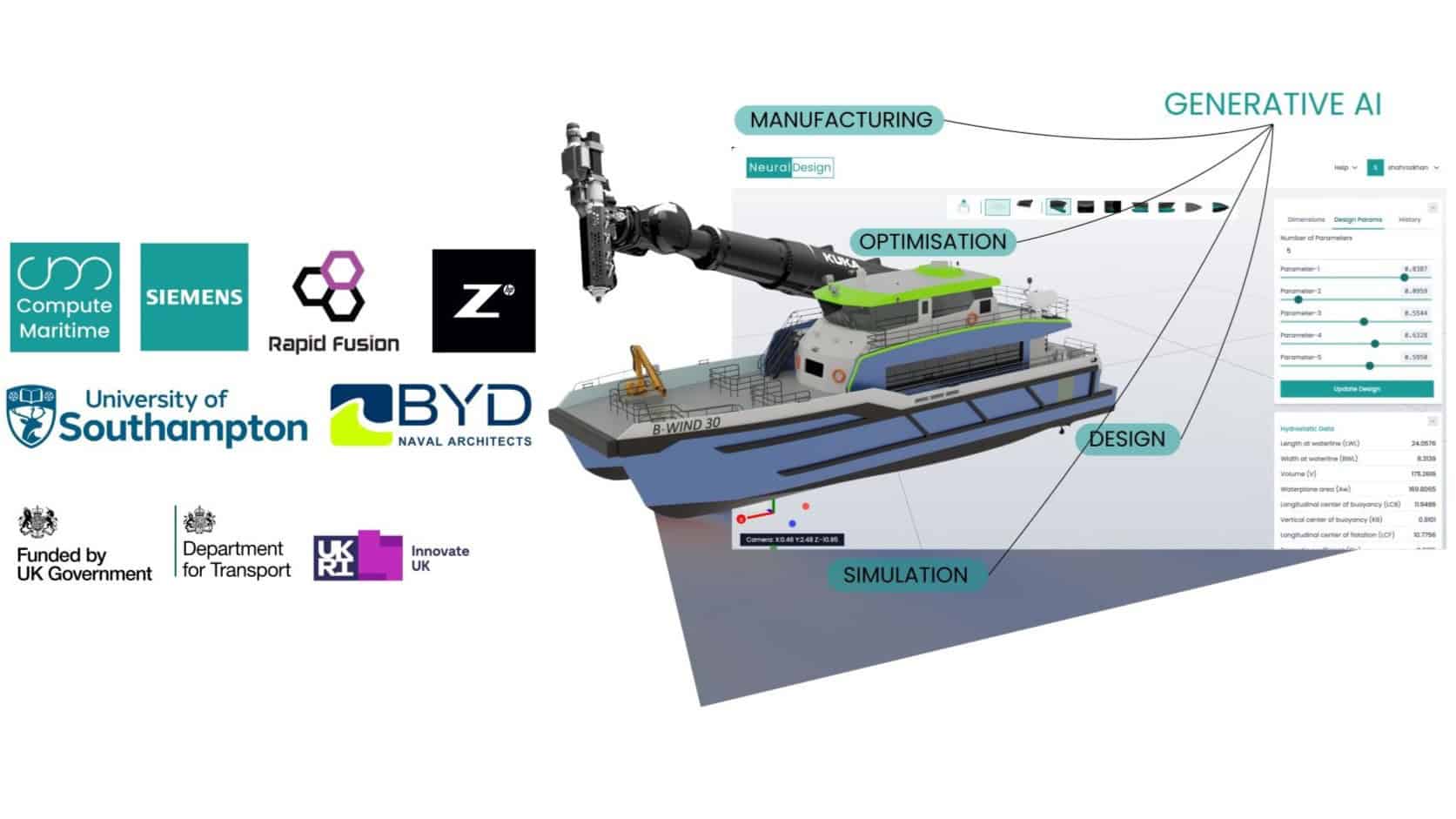
This will be achieved by embedding greater intelligence into modern ship design through the integration of simulation, optimisation, and validation against additive manufacturing constraints and workflows. The approach brings together the complementary expertise of the consortium partners: generative AI (Compute Maritime), design (BYD Naval Architects), simulation (University of Southampton), optimisation (Siemens), and additive manufacturing (Rapid Fusion). The integrated development will be powered by the advanced compute capabilities of HP Z Workstations & Solutions.
A crew transfer vessel (CTV) provided by BYD Naval Architects, critical to supplying staff to the offshore wind sector, will serve as the test case. The focus will be on optimising hull design with hydrofoils produced in large format additive manufacturing using Rapid Fusion’s Apollo robot system.
“Confronted by multifaceted challenges, the maritime industry urgently requires truly evolved, smart design frameworks that balance sustainability with operational and economic viability.” said Shahroz Khan, CEO of Compute Maritime, “The transformation of ship design is no longer optional; it is a critical survival strategy in an industry historically anchored in tradition. That is why this project is so important, and we firmly believe that through the power of NeuralShipper and the expertise of our consortium partners we can achieve a 10% reduction in design costs, 20% faster design cycles, and a 50% increase in overall design efficiency.”
He added: “GenDSOM responds directly to the UK’s 2025 Maritime Decarbonisation Strategy, which targets emissions reductions of 30% by 2030 and 80% by 2040 for domestic maritime. As highlighted in the Call for Evidence, decarbonising smaller vessels such as CTVs is critical to achieving these targets.”
Rapid Fusion has been chosen for its expertise in Large Format Additive Manufacturing (LFAM) and will be using Apollo, a full turnkey 3D printing solution that utilises the power of robotics to support the production of large components and moulds.
“Additive manufacturing has expanded design freedoms and is rapidly gaining traction for both small components and large structures, including hull forms, in the world of maritime,” – Martin Jewell, Chief Technical Officer at Rapid Fusion, “Yet scalability remains constrained. GenDSOM will adopt a modular strategy, breaking designs into manufacturable subcomponents compatible with both traditional and AM processes.
“Our manufacturing aware approach ensures designs remain manufacturable while integrating constraints such as building envelope limits, support structures, tolerance stacking, and material compatibility. All of this will ensure innovative, efficient, and production ready solutions while enabling decarbonisation across the design to manufacturing lifecycle.”
Set to take place over the next seven months, the Innovate UK backed project combines the expertise of Siemens Digital Industries Software, the research of the University of Southampton, and the team of BYD Naval Architects.
“This project represents a new leap within maritime design. Bringing all the digital elements within one loop will unlock a new paradigm of convergence, where design, performance, and manufacturability evolve simultaneously rather than sequentially.” – Dmitri Ponkratov, Marine Director at Siemens Digital Industries Software
GenDSOM will have a unique ability to generate solutions that would otherwise be difficult, if not impossible, for designers relying solely on domain expertise or incomplete problem definitions. Such scenarios often arise in specialised projects adopting next generation propulsion technologies or alternative fuels.” – Jami Buckley, CEO of BYD Naval Architects
Compute Maritime will also tap into the compute power of HP Z Workstations to train AI models locally rather than in the cloud, giving it more control over energy consumption and sourcing.
While retrofitting with emission reduction technologies provides incremental benefits, the largest fuel savings come from optimising vessel form and components. Historically, vessel design progress was constrained by limited tools and evaluation methods. Today, intelligent tools like NeuralShipper can generate highly efficient, unconventional hull shapes, supported by advanced simulations that accurately assess performance. GenDSOM therefore aims to address the core challenge of designing more efficient vessels.” – Professor Tahsin Tezdogan, University of Southampton
GenDSOM is funded by the UK Government through the UK Shipping Office for Reducing Emissions (UK SHORE) programme in the Department for Transport. Innovate UK, part of UK Research and Innovation, is the main delivery partner for UK SHORE interventions.