


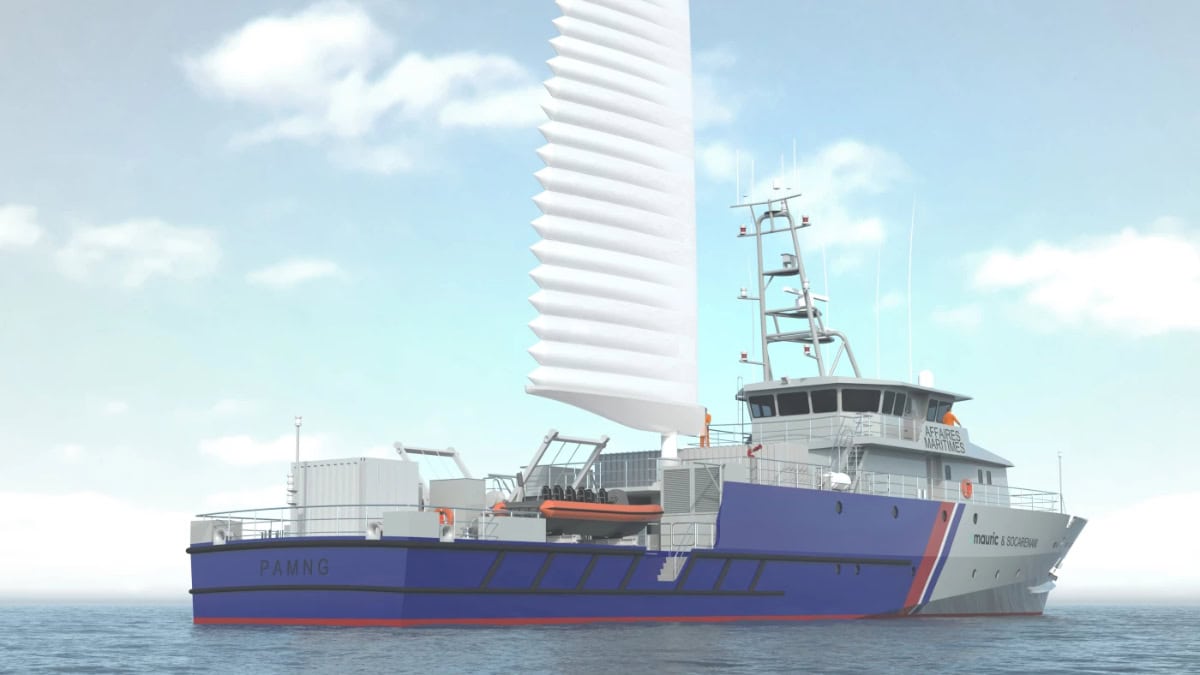
The New Generation Maritime Affairs Wind-Assisted Patrol Vessel project, integrating wind-assisted propulsion, has reached a key milestone. Following the tender win in December 2024 and the formal launch in January 2025, the project advanced to the construction phase with the first steel cutting on 18 September, marking the shift from design to build of this innovative vessel.
MAURIC’s team of naval architects and marine engineers has completed the detailed arrangement study of the vessel, including an optimisation loop for optimal sail positioning. This phase also enabled the finalisation of active and passive stabilisation systems development, through seakeeping calculations carried out to optimise the anti-roll tank with free surface effects and active fin stabilisers.
Computational fluid dynamics (CFD) optimisation of the bulbous bow has refined the hull’s hydrodynamic performance. These CFD studies have optimised resistance through the water and defined the vessel’s active trim control system underway, confirming a hybrid cruising speed of 10 knots and maximum speed exceeding 18 knots. This configuration ensures the energy efficiency sought for this vessel with reduced environmental footprint.
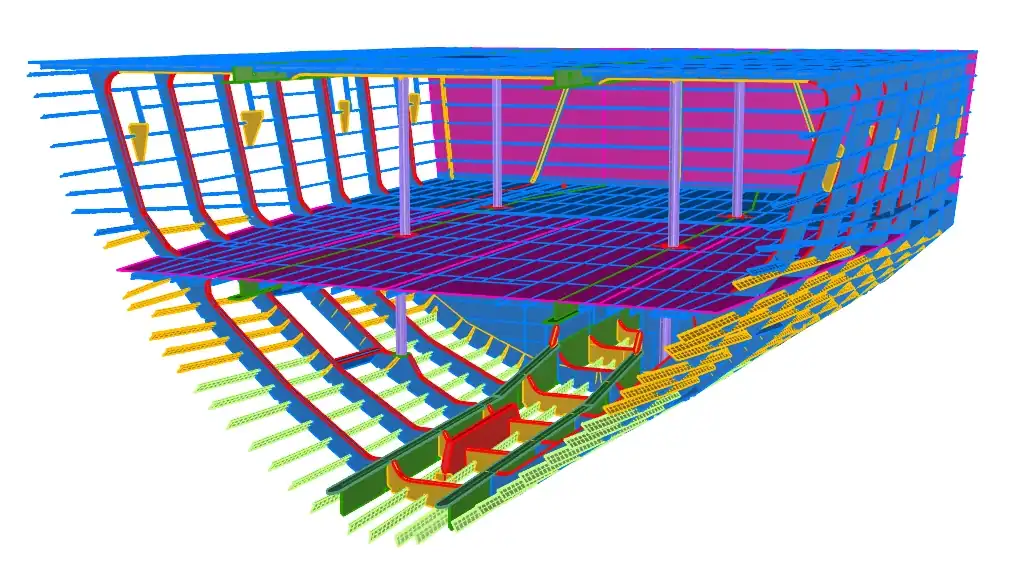
The Wind-Assisted Patrol Vessel design phase has established the assembly sequence in eight modular blocks. The image below illustrates the detailed structure of the first block, located in the forward third of the vessel’s hull. Its preparation for cutting is being completed at Socarenam in Boulogne-sur-Mer. The commencement of first steel cutting marks the concrete beginning of fabrication, thereby maintaining the construction schedule for delivery planned in the second half of 2027.
This major project demonstrates the excellence of French naval engineering in developing bespoke maritime solutions, combining operational performance with environmental innovation.
Key features
Crew and Capacity
- Crew : 16 persons
- Special Forces : 4 persons
- Autonomy : 12 days
- Activity : Up to 200 days at sea per year
Technical Specifications
- Length: 53.70 m
- Construction: Steel hull, aluminium superstructure
- Propulsion: Diesel-electric hybrid system with wind-assisted propulsion
- Maximum speed: 17 kts at 85% MCR, electric : 10 kts
- Endurance: 3,600 nm at 12 kts
- Nautical equipment: 2 semi-rigid boats of 6.50 m (speed: 35 kts)