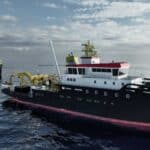
The Panama Canal Authority has ordered ten hybrid electric tractor tugs from European shipbuilder, Astilleros Armón, with options for another 10 similar vessels, and Corvus Energy will supply the battery systems for the hybrid electric vessels.
The contract between the Panama Canal Authority and Astilleros Armón for the first ten vessels, each 30-meter tugboats with 70-tonnes bollard pull, was signed in October 2023 and valued at US$150M.
Hybrid Electric Propulsion
The tugboats will be equipped with hybrid-electric propulsion systems to reduce emissions during ship towage through the Panama Canal and while docking in Panamanian ports. Corvus Energy will provide battery energy storage systems, 450 kWh of Corvus Orca ESS, for each vessel.
“Corvus Energy is pleased to have been selected to supply the battery systems for this landmark project for the Panama Canal Authority and Astilleros Armón,” says Corvus Energy CEO, Fredrik Witte. “The Panama Canal is a world-renowned, high-traffic waterway, and battery systems in hybrid-electric tugs have been proven to significantly decrease vessel emissions. The new fleet represents an important step in supporting the Panama Canal Authority’s sustainability strategy and ambition to reach net-zero GHG emissions by or around 2050.”(source)
Expanding Shiphandling Capabilities in the Panama Canal
The Panama Canal expansion has resulted in larger container ships, LNG carriers, cruise ships, tankers and dry bulk carriers using the shipping shortcut between the Pacific and Caribbean – requiring the services of more powerful tugboats and pilot vessels. With the acquisition of these new vessels, the Panama Canal Authority is seeking to enhance its shiphandling capabilities, modernise its fleet and replace tugs it charters from other owners.
Tugboats leading the way in marine electrification
Worldwide, tugboats were among the first maritime vessels to adopt battery technology due to their near shore operations and ability to recharge regularly, with the first hybrid tugboats entering operation as early as 2011 followed by fully electric, zero emission tugboats in 2019.
In North America, the first all-electric tugboats are entering the market now. In Western Canada, both HaiSea Marine and SAAM Towage recently launched their respective fleets of all-electric tugboats. In the United States, the first fully electric tugboat, the Crowley eWolf, will soon begin operations in the Port of San Diego, and several other U.S. ports are applying for federal funding under the “Green Ports Program” to invest in electric tugboats and onshore charging infrastructure.
The HaiSea Marine, SAAM Towage and Crowley eWolf electric tugs are all equipped with a Corvus Energy system, as are more than fifty percent of hybrid-electric and fully electric tugboats worldwide. As the maritime sector increasingly pursues carbon reduction initiatives, the number of hybrid-electric and fully electric tugboats worldwide is projected to grow exponentially.