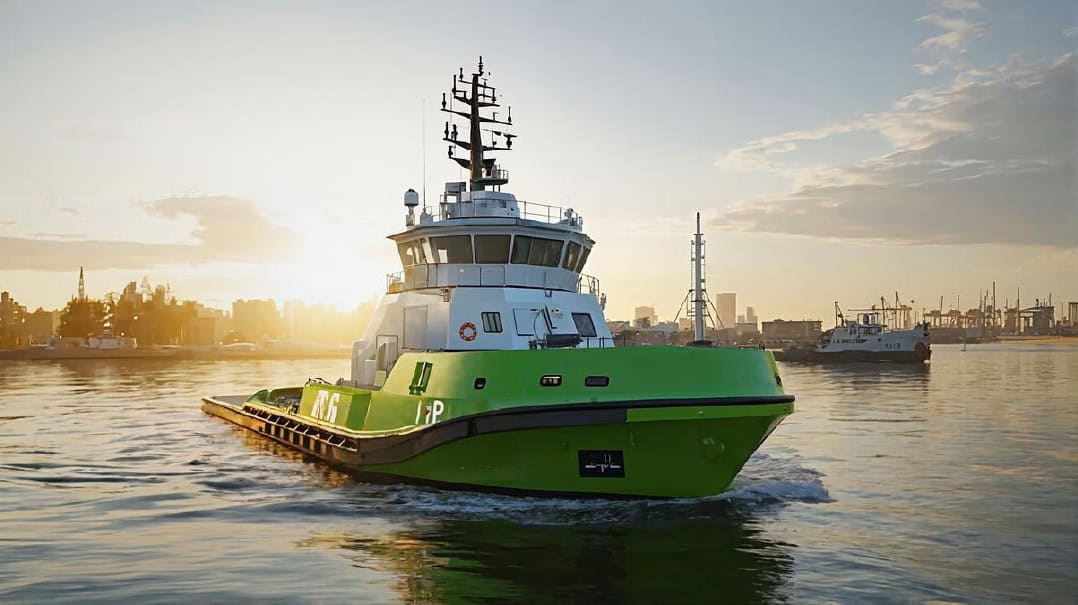
Corvus Energy, a global leader in zero-emission maritime energy solutions, has been selected to supply the battery systems for a new electric tug that will be built by Japanese shipyard Keihin Dock for Nippon Yusen Kabushiki Kaisha (NYK Line).
The environmentally friendly harbour tug will be equipped with Corvus Energy’s Orca Energy battery systems, delivering a total capacity of 2,712 kWh to enable fully electric propulsion with reduced noise and zero operational emissions.
The concept design for the vessel was developed by NYK Line’s Project Engineering Team, with detailed engineering to be completed by Keihin Dock.
The new electric tugboat represents a major advancement in Japan’s efforts to achieve carbon-neutral ports. Equipped with batteries and Japan’s first domestically manufactured large-capacity motor drive system supplied by TMEIC Corporation, as well as a Dynamic Positioning System (DPS), the vessel will combine powerful zero-emission propulsion with enhanced crew comfort and safety.
As part of NYK’s “Co-Creating the Future” initiative, the electric tugboat symbolizes Japan’s transition toward greener and smarter maritime operations. The project has been selected under the Ministry of Land, Infrastructure, Transport and Tourism’s Support Project for the Development of Technologies to Promote Transformation in Coastal Shipping, reflecting its importance in advancing maritime innovation and sustainability.
“This vessel is the result of our collective innovation—a ‘Tugboat of the Future’ that cares for both people and the planet. It will lead the way in Japan’s next-generation maritime industry,” said Satohiko Kodama, Manager of Project Engineering Team at NYK Line. “By integrating advanced electric propulsion from our domestic partners and state-of-the-art energy storage technology from Corvus Energy, we are taking an important step toward realizing zero-emission ports.”
From concept design to construction and operation, this project unites expertise across the NYK Group to advance domestic know-how in electric propulsion vessels. The full-scale adoption of battery-based power systems represents a significant contribution to Japan’s maritime decarbonization goals and highlights Corvus Energy’s growing role in enabling zero-emission solutions worldwide.
“We are proud to collaborate with NYK and Keihin Dock on this innovative electric tug project,” said Ole Jacob Irgens, EVP and Head of Regional Sales for Europe and Asia at Corvus Energy. “This project further strengthens Corvus Energy’s position as the leading provider of zero-emission battery technology in Japan, where more than ten vessels are already sailing with Corvus battery systems.”
He added: “Batteries are ideally suited for tugboats because they enable zero-emission operations during idling and low-power manoeuvres, with diesel engines only needed when maximum thrust is required. This hybrid approach significantly reduces fuel consumption, emissions, noise, and maintenance—while enhancing efficiency and responsiveness. We strongly believe energy storage will become the standard for all tugs going forward.”
The battery system will be supplied in partnership with Sumisho Marine, Tokyo, Japan and is scheduled for delivery in June 2026 and the tugboat is expected to begin operation by the end of 2026 under NAIKAI TUG BOAT SERVICE CO.,LTD., part of the NYK Group company.