




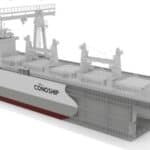
Corvus Energy, the leading provider of marine battery and fuel cell systems, is pleased to announce that they have been selected by HAF Power Solutions (HPS) to supply Energy Storage Systems (ESS) for the innovative Energy Subsea Construction Vessel (ESCV) to be built for shipowner REM Offshore.
REM Offshore is one of the main players in the maritime cluster in Norway with a modern fleet of 19 vessels for offshore, offshore wind, and subsea operations.
The new ESCV is of ST-245 design and will be the first vessel to perform heavy construction work in both offshore wind and subsea with net zero emissions. The vessel will be equipped with dual-fuel methanol engines and a 1.7 MW battery system. The batteries will be used for spinning reserve and peak shaving as well as to regenerate power from the operation of offshore lifting equipment onboard the vessel.
Increased battery capacity helps optimize energy consumption
“This project showcases that we are ready to take zero-emission offshore operations one step further. The vessel will not only be methanol ready – it will run on green fuels. The way it is designed, and its innovative technology will provide us with flexibility and efficiency as well as high redundancy. We anticipate significant improvements in energy consumption as well as a reduction in operational costs, while also contributing to a greener future for the maritime sector. Increased battery capacity is needed to optimize the system. When using an alternative fuel such as methanol, batteries play an even more important role as the response time for dual-fuel engines is slow. Increased energy storage capacity will allow us to more fully leverage the energy efficiency benefits of battery power, including the ability to regenerate energy from mission equipment onboard,” says Ronny Pål Kvalsvik, Chief Commercial Officer, Rem Offshore.
He continues; “Our selection of the integrator HPS along with Corvus batteries, reflects REM Offshore’s vision to use local suppliers for a more sustainable and efficient maritime industry.”
All main partners in the project are located on the west coast of Norway. Both the design company, Skipsteknisk and the integrator HPS are located in Ålesund, and the vessel will be built at Myklebust Verft in Gursken. This proximity facilitated close collaboration throughout the entire project planning phase for the vessel.
New standard for offshore vessels
Pål Ove Husøy, VP of Sales at Corvus Energy states “This project proves the value of collaboration. The innovative vessel will set a new standard for offshore vessels due to its groundbreaking energy system design. Up until now, battery packs have often been sized to a minimum to enable spinning reserve for 10 minutes. Adding more battery capacity unlocks the potential to gain increased value from the battery system.
By adding additional battery capacity, you can increase the value of the batteries by utilizing them in all operational modes as well as improve the balancing of the entire power management system to reduce fuel as much as possible. In this case, when the vessel will be running on Methanol, the more you can utilize the batteries, the more cost-efficient it gets.
The Corvus Energy supplied energy storage system is scheduled for delivery during the first half of 2026 and the vessel will go in into operation in the second half of the same year.
The contract also includes an option for equipment deliveries for a second vessel.











 for the innovative Energy Subsea Construction Vessel)