Corvus Energy, the world’s leading provider of zero-emission solutions for the maritime industry, is pleased to announce that the Company has been selected by Hvide Sande Shipyard in Denmark to supply a complete hydrogen fuel cell system for the training vessel “MS Skulebas.” This marks a historic milestone for Corvus Energy.
One-of-a-kind training vessel for the fishing industry
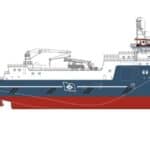
The 35-meter fishing and training vessel has the latest technology and commercial fishing systems installed and sets an example of innovation and cooperation within the maritime and education sectors. The vessel, which is owned by Vestland County and operated by Måløy Upper Secondary School, will be the first of its kind, combining both fuel cells and batteries in a fishing vessel.
The Pelican Fuel Cell System, developed by Corvus through the three-year H2NOR project, builds upon well-proven technology from global fuel cell leader, Toyota. It is the only marine fuel cell that is designed to fully comply with the well-known inherently gas-safe principle, meaning it can be placed anywhere onboard a ship without additional safety systems.
Corvus will deliver a 340-kW PEM fuel cell system for Skulebas and Hexagon Purus will deliver the Hydrogen storage solutions. The hydrogen fuel cell system is scheduled for delivery in Q2 2024 and will be in full operation from Q3 2024.
Another historic milestone
Geir Bjørkeli, CEO of Corvus Energy, is thrilled about the new contract: “We need to thank the Hvide Sande Shipyard for choosing us as the supplier for MS Skulebas. This installation will be another big milestone for Corvus. Adding the Pelican fuel cell to the energy system onboard will make this the first zero-emission fishing vessel in the world. Skulebas will play a pivotal role in showcasing the feasibility, efficiency, and environmental benefits of fuel cells within the maritime industry, furthering the transition to decarbonize all vessels.”
Bjørkeli also praises Vestland County in Norway for its forward-thinking: “Vestland County was the first to invest in all-electric ferries back in 2014, and since then it has become a pioneer and global example with 19 out of 25 ferry routes being all-electric. This demonstrates that policy works, and we believe that today´s milestone will be the start of the same journey for hydrogen fuel cells as it was for batteries.”
Fuel Cells + Batteries = Next step in zero-emission sailing
MS Skulebas is already equipped with Orca batteries from Corvus Energy which will work together with the Pelican Fuel Cell System. By combining these two technologies you get the best of both worlds and significantly extend the range of zero-emission operations.
Kristian Holmefjord – EVP and Project Director of Fuel Cells in Corvus explains: “Adding our inherently gas-safe Pelican Fuel Cell System will enable the vessel to conduct the majority of its operations fully-electric, producing zero emissions, supplemented by clean hydrogen-powered energy when needed.”
Benefits beyond zero emissions
MS Skulebas is owned by Vestland County, and the county mayor, Jon Askeland, is excited that the first hydrogen/electric hybrid fishing and training vessel will be operated by Måløy Upper Secondary School:
“A unanimous county council decision supported the need for this vessel. It will play a vital role in attracting and educating the future workforce. Investing in this project is one of the most forward-thinking uses of our funds, and it equips us to advance the fishing industry into a new era with evolving demands for more sustainable fishing methods, environmentally friendly propulsion, high flexibility, and above all, a high level of safety for all on board. Therefore, it is very gratifying to also introduce a cutting-edge hydrogen installation on the vessel.”

Photo caption: With Hydrogen fuel cells on board, MS Skulebas will be the world`s first zero-emission fishing vessel. Picture: Hvide Sande Shipyard