


South Korean seaweed operators provide positive feedback on Cox Marine’s commercial diesel propulsion technology
Cox Marine is reporting strong market feedback from South Korea, where its diesel outboard technology is delivering greater fuel-efficiency benefits than initially expected in the country’s expanding seaweed harvesting sector.
Commercial vessel operators are reporting fuel savings of up to 50% compared with gasoline-powered alternatives, highlighting the potential for diesel outboards to reduce operating costs across the demanding aquaculture and marine harvesting sector.
Sungho Hong of Soungjin Marine, Cox Marine’s distributor in South Korea, who works closely with commercial vessel operators serving the expanding seaweed harvesting sector said: “Fuel economy is number one. Compared to gasoline engines, the biggest improvement we’ve seen is around 50%.”
“Commercial operators often work with heavily loaded vessels,” he explained. “Fuel consumption increases significantly with gasoline engines under load, whereas diesel engines consume much less fuel. They are working less hard for the same payload.”
Hugh Hudleston, Global Business Development Director at Cox Marine said: “We typically cite fuel savings of around 30% compared with equivalent gasoline outboards. It’s encouraging to see feedback from South Korea suggesting even greater gains in demanding commercial applications where vessels are heavily loaded and fuel costs are a key consideration.”
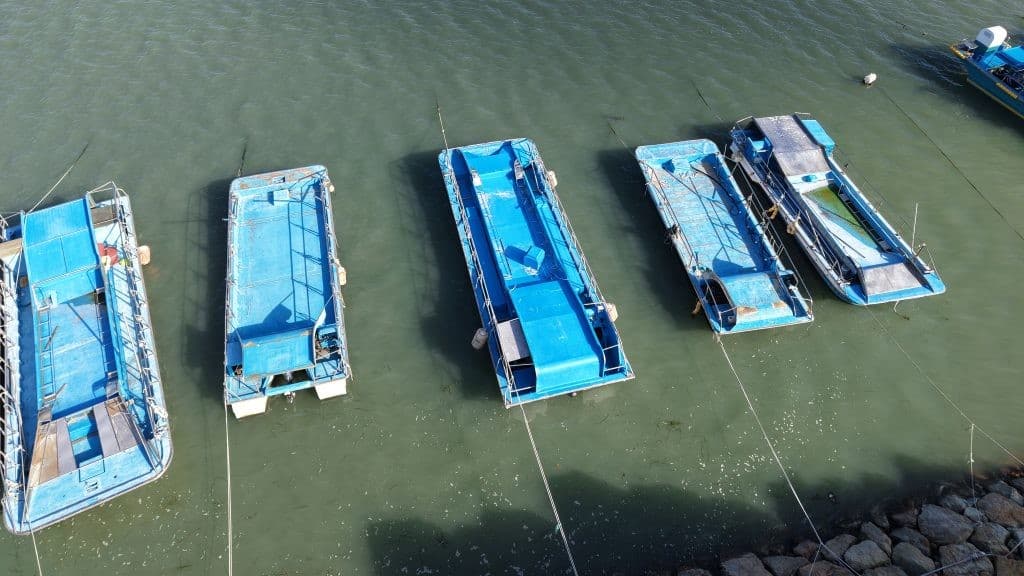
The fuel savings are particularly valuable for South Korea’s seaweed harvesting industry, which is experiencing increased demand as products such as kimbap continue to gain popularity both domestically and internationally.
According to Hong, vessels are also becoming larger and more powerful as operators travel further offshore in search of seaweed.
“There is growing demand for power because the vessels are getting bigger,” he said. “The largest are around 28 tonnes and typically have one inboard engine.”
With some commercial vessels operating with engine outputs of up to 1,800hp, operators require propulsion systems that can deliver the torque needed to move heavy loads efficiently.
The market feedback highlights the growing advantages of diesel outboard technology in demanding commercial applications, where fuel costs have a direct impact on profitability. By combining high torque with exceptional fuel economy, Cox Marine’s diesel outboards are helping operators reduce running costs while maintaining the performance needed for productive offshore operations.