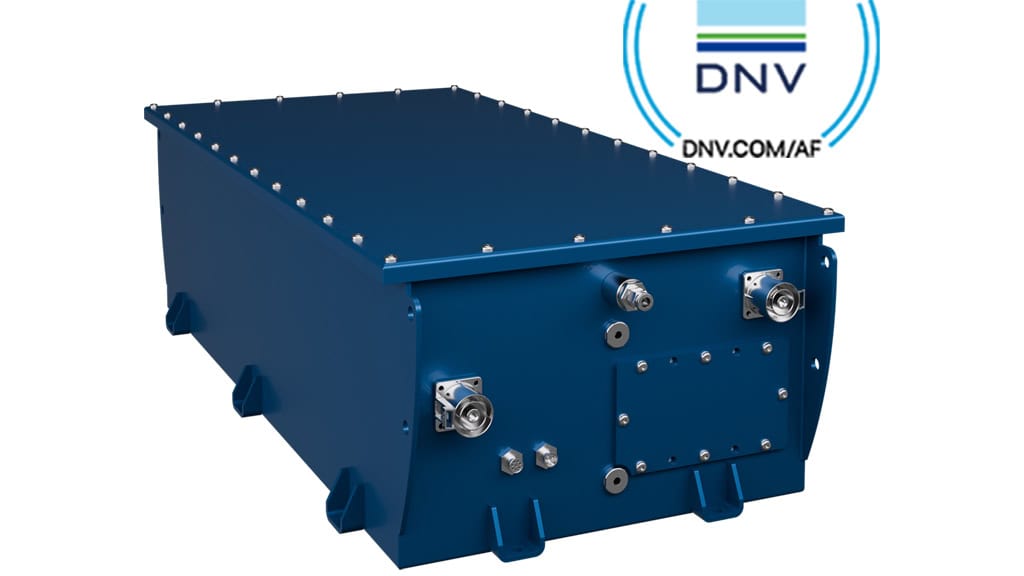
EPTechnologies, a complete marine propulsion provider for electric and hybrid vessels, announced the launch of SVENNER, its next-generation solid-state battery pack, which has now received full DNV type approval. This certification marks a major milestone in the advancement of marine propulsion electrification, delivering superior safety, cycle life and performance for vessel builders, retrofit projects and OEM system integrators.
At the heart of the Svenner Battery lies the solid-state cell technology, replacing most liquid electrolytes with advanced solid materials.
SVENNER Marine Battery Key Features & Benefits
- Withstands 6x overcharge & 8 mm nail puncture: no thermic reaction. This demonstrates safety. Even under extreme electrical or mechanical stress, the cells remain stable with no fire.
- 10’000+ life cycles easily achievable maximizing material efficiency and reducing lifecycle costs.
- Dual-core lockstep CPU BMS ensures redundancy and continuous monitoring HIVIL interlock & internal water-leak detection for module-level protection. In other words two synchronized processors constantly monitor system safety for uninterrupted operation, while integrated interlocks and leak sensors add an extra layer of protection within each battery module.
- DNV Design Option 1: No propagation – no module gas ducting needed; any fire fully contained within the module. This means the battery can contain any thermal incident within a single module — only one cell will be affected. And because no gas-ducting system is required for each individual module, installation complexity is greatly reduced.
- Heat resistant: stable operation under elevated temperatures. Solid-state chemistry maintains safety and efficiency even in high-temperature environments or heavy-duty maritime operation.
- Hardware override switch allows manual override of some protections in critical emergencies. A dedicated safety switch allows personnel to override certain protections and operate the system in a semi-manual mode.
With increasing regulatory and insurance demands on battery-based propulsion systems for vessels, classification approval is no longer optional — it’s essential. The DNV type-certification of EPTechnologies’ solid-state tech battery provides vessel manufacturers, shipyards and system integrators with a trusted, ready-for-class solution that reduces integration risk and supports simplified certification.
At the same time, operators gain tangible benefits: the long lifecycle lowers total cost of ownership, the enhanced safety lowers risk and insurance burden, and the compact/high-density format enables lighter battery banks and thus more usable range or payload.
The solid-state tech battery pack is now available for order and will feature in upcoming retrofit and new-build projects across recreational, commercial and industrial marine segments. It is ideally suited for high-duty applications such as ferries, work-boats, performance yachts and hybrid systems.
The Level 2 model is expected to launch in January, offering a 12% performance increase while maintaining the same dimensions and weight.
Achieving DNV type-approval for our solid-state tech battery is a breakthrough for marine electrification,” said Marco Ottiker COO & Co-Owner of EPTechnologies. “We’re now offering vessel designers and operators a turnkey energy-storage solution that combines the highest levels of safety, durability and performance, enabling the next generation of electric propulsion systems.”