



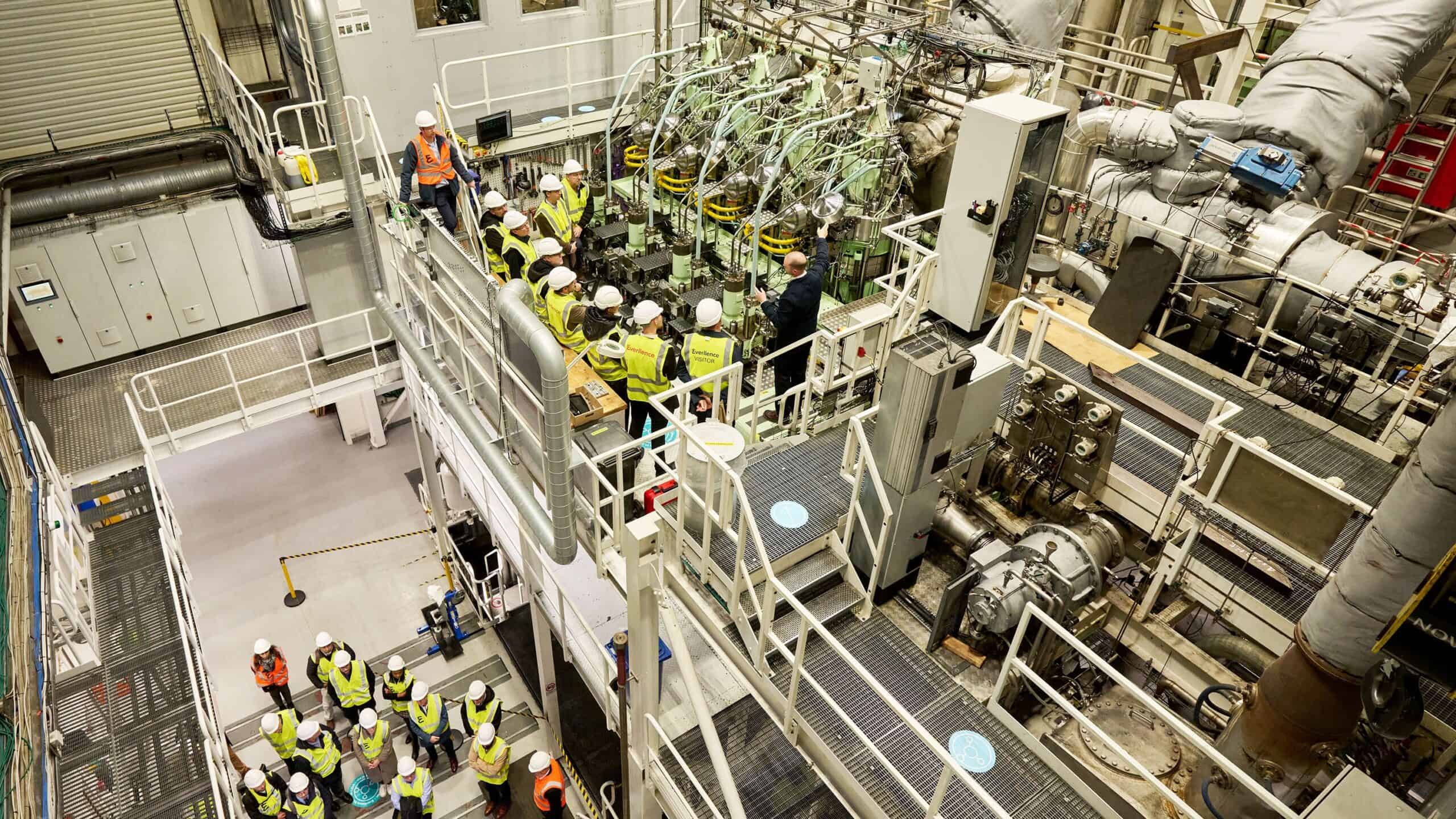
Everllence has officially introduced its latest innovation in sustainable marine propulsion: the dual-fuel ME-LGIA (Liquid Gas Injection Ammonia) engine. The unveiling took place during a two-day event in Copenhagen, which brought together more than 300 participants from across the global maritime sector, including shipowners, operators, and industry leaders.
Using the Diesel principle and the well-known, dual-fuel Liquid Gas Injection concept, the ME-LGIA engine has many of the same merits as Everllence’s existing ME-LGIM and ME-LGIP units that, respectively, run on methanol and LPG. However, in light of ammonia’s particular characteristics, the new engine also has additional safety features such as containment systems, sensors, system ventilation and double-walled piping developed especially for ammonia as a fuel.
Dr Uwe Lauber, CEO Everllence, said: “As the maritime industry’s leading engine designer, we are in a unique position to advance the green transition and know that bringing new fuels to market is not just innovation – it’s imperative for zero-carbon shipping. In this context, ammonia is a vital piece of the puzzle. The development of this engine is not just a technical achievement; it is another concrete step towards a climate-neutral future where the time to act is now.”
Everllence reports that the first ME-LGIA engine is due for delivery in Q1, 2026 with bedding-in set for Q4, 2025. The company is currently engaged in several pilot-projects, including 2 × Very Large Ammonia Carriers for Eastern Pacific Shipping; a further four engines for Höegh Autoliner Pure Car and Truck Carriers; and another for a bulk carrier in Japan where the engine is currently on the MITSUI E&S testbed.
Bjarne Foldager, Head of Two-Stroke Business, Everllence said: “This ammonia engine is truly a technological milestone. It is the result of over 150,000 hours of collective work and represents a significant financial investment on our part. Since two-stroke engine testing on ammonia started in July 2023, we have carried out over 800 tests – both here in Copenhagen and at MITSUI E&S in Japan. All the way through, safety has been our first consideration and we have worked closely with the relevant authorities and classification societies to ensure that the technology meets all demands. Combined with the knowledge we will gather from the pilot-projects, we are confident that this responsible approach will ultimately deliver the market gold-standard in ammonia engines with a final design based on operational experience. Furthermore, these engines will be digitally connected to optimise operational performance.”
In relation to digital connectivity, the ME-LGIA enables a secure and reliable data flow from vessels to Everllence shore-based monitoring. This allows the leveraging of real-time engine and operational data to improve performance, provide remote assistance, and help shipowners operate more efficiently and sustainably. As such, data-driven insights have a significant role to play in supporting decarbonisation as new fuels like ammonia enter the market.
Everllence states that the full sales release of the ME-LGIA will initially feature G50, S50, S60, G60, G70 and G80 bore sizes; retrofit options will also, eventually, be made available.
Ammonia as future-fuel
Ammonia has several characteristics that mark it out as eminently suitable for deep-sea shipping decarbonisation:
- its emissions profile makes it a promising carbon-free alternative to traditional fossil fuels with zero CO2, and low sulphur-oxide and particulate emissions. When produced from renewable sources like green hydrogen, it is carbon-neutral;
- ammonia’s relatively high volumetric energy-density allows for more compact fuel storage – especially compared to hydrogen – critical for large ocean-going vessels. Furthermore, it can be stored as a liquid at moderate pressures, simplifying bunkering compared to cryogenic fuels;
- its high thermal-efficiency reduces operational costs while maintaining power output;
- as a widely produced chemical, ammonia benefits from established global supply-chains, lowering long-term costs compared to other e-fuels. Green ammonia production is also currently scaling up via electrolysis, while several blue-ammonia production facilities are already in operation;
- ammonia is especially suitable for two-stroke marine engines because of its inherently slow combustion rate that aligns well with the low piston speeds of these engines.






 during a two-day event in Copenhagen,)