


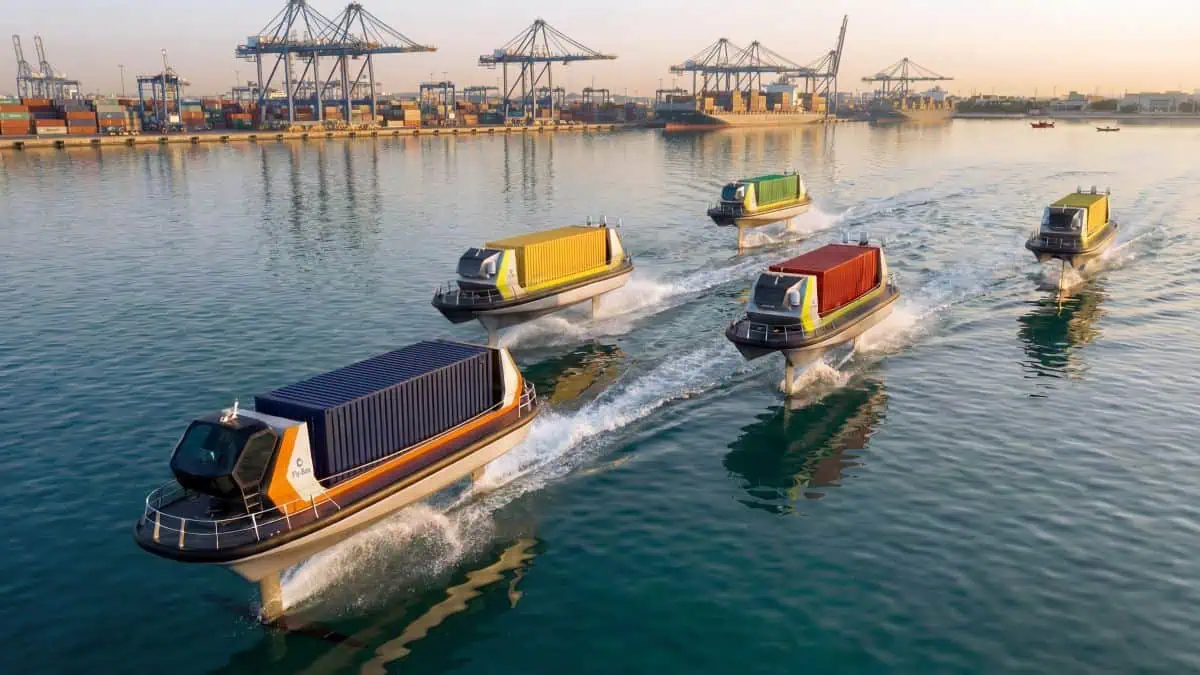
Fly-Box, a Franco-Swiss maritime deeptech startup developing next-generation foil-borne container platforms, is entering an exciting new phase. Following the establishment of key Gulf-region partnerships this spring to prepare pilot routes and the successful flight of its prototype over the summer, the company has now launched a comprehensive techno-economic assessment with a global leader in shipping and terminal operations. Fly-Box’s platforms will be benchmarked against trucks and feeder vessels through real-world user cases.
Across operators and logistics players, two structural pressures are converging: operational efficiency and decarbonisation. Today, flows between primary hubs and secondary ports are served at sea by feeder vessels designed for high volumes, with low sailing frequency and loading cycles that can take several days. On land, diesel trucks still handle the majority of port-to-customer moves, sometimes over very long distances. This default reliance on trucking contributes to port congestion, compounded by negative externalities inherent to road transport (air pollution, traffic, accident risk, nuisance for local communities, and driver shortages).
Fly-Box offers a fast-to-deploy answer. Its 20-metre platforms can carry a 40-foot container on foils at a 25-knot cruising speed (around 45 km/h), enabling entirely new port-to-port flows while leveraging existing infrastructure. A Fly-Box line can operate from a small, shallow-draft berth, and a single reach stacker is sufficient to handle container loading.
For operators equipped with Fly-Box platforms, freight forwarders will be able to sell shippers an “express” sea service that removes cargo from the terminal immediately. Containers can then be transferred to trucks much closer to the end customer, departing from secondary ports and inland ports that are far less congested.
“With Fly-Box, the sea regains its role in port-to-port transport. On a vast number of routes, our next-gen coastal shipping pushes trucking back to where it truly adds value: the last miles. Hyper-concentration has made global supply chains highly efficient in terms of volume and cost but their lack of agility and responsiveness is a key weakness. Fly-Box addresses that while actively decarbonising,” said Admiral Antoine de Roquefeuil, COO of Fly-Box.
This assessment with a major industry player will enable detailed modelling of CAPEX, OPEX and ESG implications for the operator, its customers and key stakeholders. It will examine integration with digital systems (TOS, PCS, planning and vessel-tracking tools) as well as with terminal physical infrastructure (navigation, handling, energy, safety and maintenance). It will also help calibrate how the solution fits within the broader ecosystem: shippers, freight forwarders, 3/4PLs, operators (shipping, terminals, inland logistics) and public authorities (customs, maritime affairs, port authorities).
Fly-Box is designed as a standard, complementary component of the multimodal chain, without disruption or major changes to established operating practices. By multiplying coastal maritime connections, this innovation could help revitalise thousands of small ports that have been cut off from container flows. Until the 1970s, local ports enabled goods to arrive in break-bulk close to demand, served by a multitude of coastal vessels. That model faded with the widespread adoption of the standard container, which drove the ultra-concentration of flows seen today. Thanks to its size, speed, low emissions and automation potential, Fly-Box aims to reopen container distribution by sea, bringing it closer to end customers along coastlines everywhere.
With a “software-defined” approach, Fly-Box ultimately aims to operate its flying platforms as autonomous swarms. On roads, each truck is likely to require a driver for a long time, given the risks for the many road users and nearby communities. The maritime environment is better suited to the ramp-up from remote operation to autonomy. Foils are Fly-Box’s second decisive advantage: they deliver both speed and efficiency (with energy consumption reduced by 30% to 40%). For an equivalent size at sea, conventional barge hulls are slowed and battered by chop, whereas Fly-Box platforms ride above the surface with stability, preserving cruising speed and, therefore, schedule reliability. Fly-Box also benefits from the current maritime-tech momentum, as supply-chain costs are falling rapidly (batteries, lidar, compute). The potential for rapid scaling is significant.
For naval architecture, foils and flight control, Fly-Box has built a team of experts notably from the America’s Cup and l’Hydroptère. For energy and systems, its experts have come through Venturi and EPFL. Officers from the French Navy contribute maritime and port-operations expertise. This summer, the startup successfully flew its prototype on Lake Geneva: an 8-metre scaled demonstrator validating key programme choices. Six patents have already been filed. The demonstrator will return to Lake Geneva in spring in an A-26 configuration, paving the way for drone-ready operations.
“Two years after the initial intuition, the idea has moved off the page: the prototype is flying, the business models are sharpening, and discussions with industry players are multiplying, from the Gulf’s shores to European ports. A new, fully automated building block on the water is emerging, mirroring the automation already visible on land in terminals,” said Alain Thébault, founder of Fly-Box.