



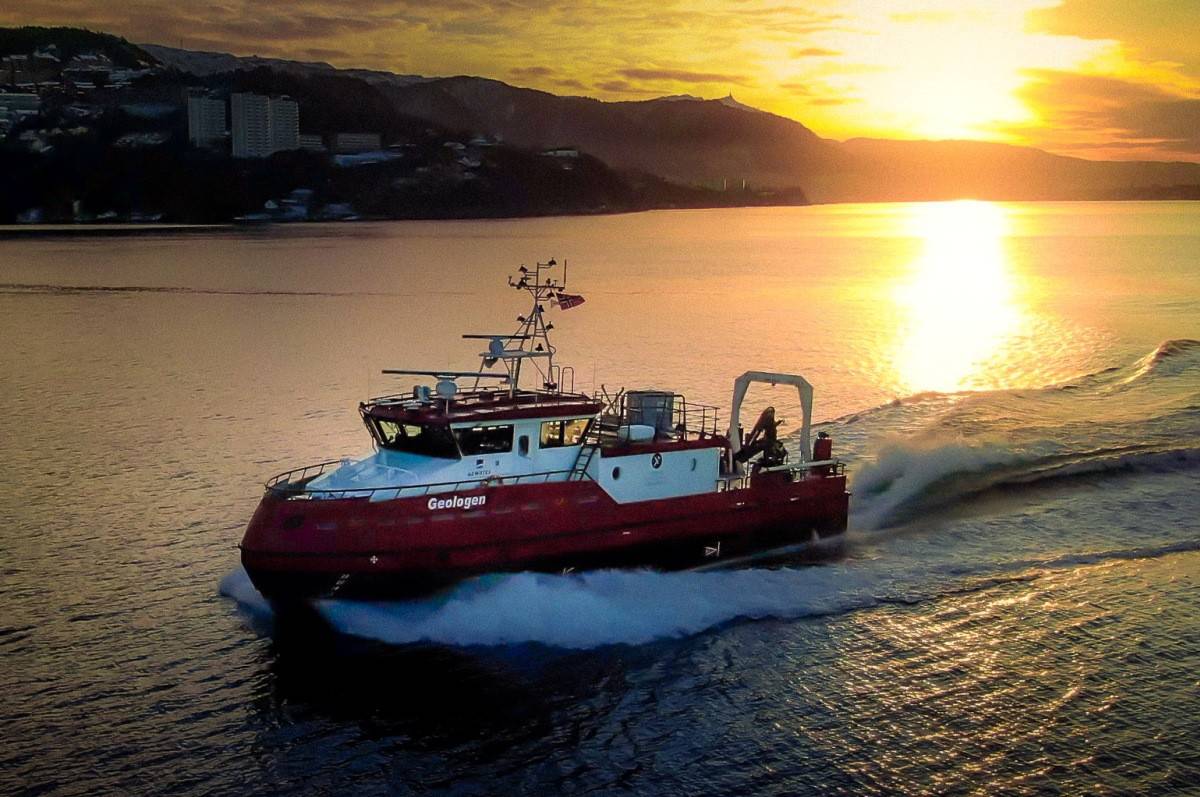
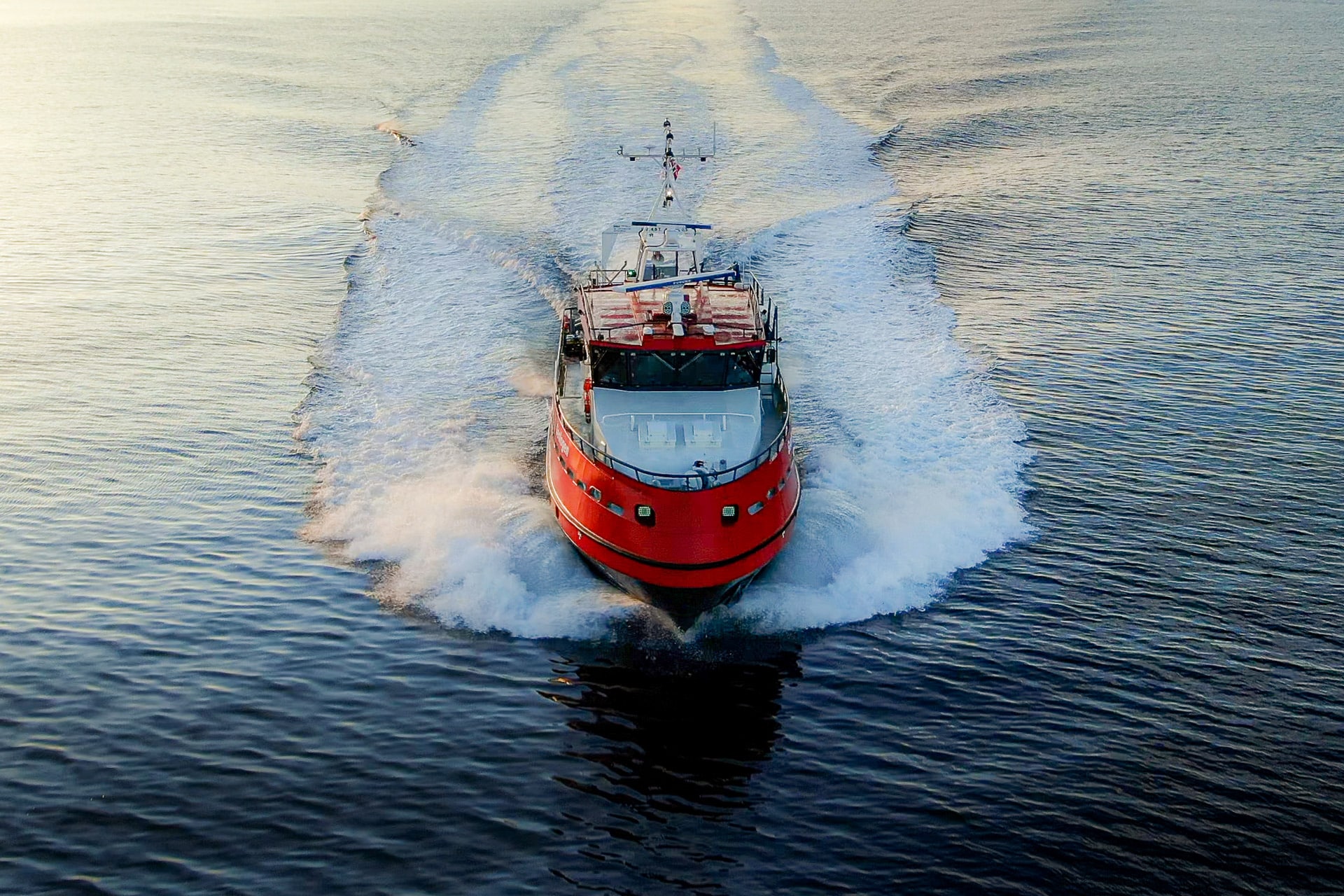
The unique hybrid system combines Yanmar engines with electrics and a controllable pitch propeller. The research vessel e-Work 2390 Survey has gone into service studying the seabed and fjords around Norway. She was handed over in March to the Geological Survey of Norway (NGU) in a ceremony in Trondheim where the NGU’s director May Britt Myhr threw sea water over her and christened her Geologen.
The drivetrain is extremely interesting
Gisle Johnsen is General Manager of Martec AS, Kewatec Aluboats Norwegian subsidiary. He explains, “The brief from the client was to devise a propulsion system with very low vibrations and noise because of all the sensitive scientific instruments on-board.”
This equipment includes two multi-beam echo sounders, a sub-bottom profiler, and seismic technology to examine the geology under the seabed. These can operate at depths of up to 1,300m. There is also a remotely operated vehicle which is lowered from an A-frame crane on deck.
Johnsen continues, “I believe the propulsion system is the first hybrid system consisting of Yanmar IMO Tier III engines in combination with a controllable pitch propeller and an electric motor PTI (power take in) mounted on the gearbox. What’s more, the propeller tunnel design integrated in the hull is unique.”
The process began with the construction of a 3D model which was rigorously tested by computational fluid dynamics. When this had been refined to the designer’s satisfaction, the physical ship was created and sea trials began. Johnsen notes, “The system was tested properly according to the yard and regulation SAT (sea acceptance test) program, including a 4-hour 100% load test. The tests were successful, everything worked according to plan and no additional adjustments or adaptions were necessary. It just goes to show that with proper planning, modelling and virtual testing you can get a vessel right first time.”
Yanmar engines and electric motors generate the right power
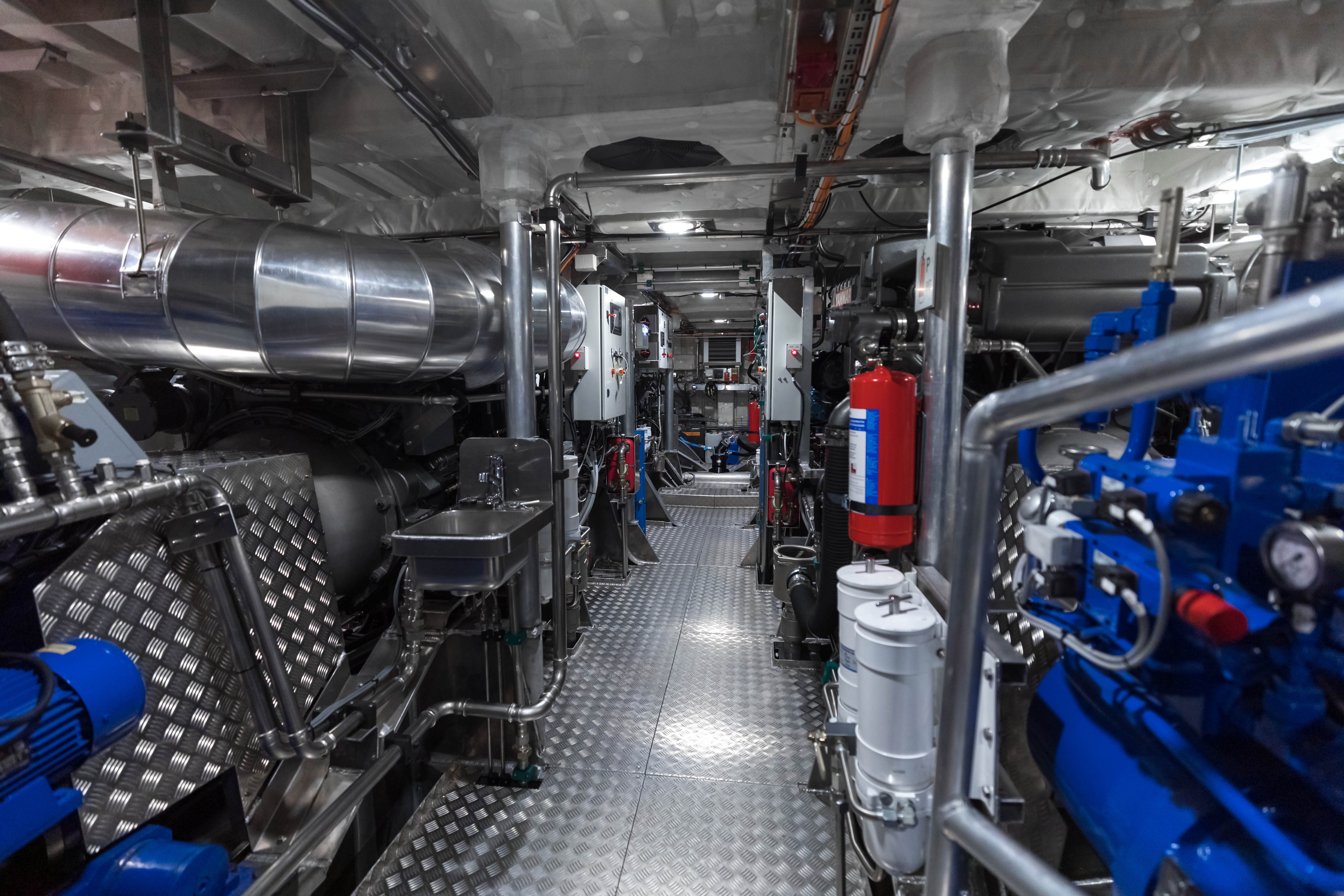
The drive train consists of two 670kW 6AYEM-GTWS engines and a total of 200kW electric motors, which is capable of propelling the vessel along at 20 knots. In electric-only mode, she can run at 5 knots for 4 hours.
When considering the choice of engine, Johnsen says, “We chose Yanmar because the company has such a good reputation, and we know these units have low vibrations, low emissions and the ability to deliver a complete IMO Tier III package. This is a hybrid system of course, which does present challenges. For example, batteries are heavy which can affect fuel consumption in diesel-only mode, and the fire protection regulations mean we have to have a cooling system in place for the batteries. However, we consider this ship a great success, and we’re having a lot of interest in hybrid systems from our governmental clientele. It’s not quite the same for our private customers because of the cost, here we are seeing more clients asking about alternative fuels such as methanol for future projects.”
Hybrid solution works well when research is underway
In her working life, the vessel will use the diesel system to get to and from the target sites, switching to the electric drive when the research is underway. In addition to the instruments on board there is a dry laboratory, a wet laboratory and creature comforts like a galley and cabins for the crew.










 in a ceremony in Trondheim where the NGU's director May Britt Myhr threw sea water over her and christened her Geologen. The drivetrain is extremely interesting Gisle Johnsen is General Manager of Martec AS, Kewatec Aluboats Norwegian subsidiary. He explains, “The brief from the client was to devise a propulsion system with very low vibrations and noise because of all the sensitive scientific instruments on-board. ”This equipment includes two multi-beam echo sounders, a sub-bottom profiler, and seismic technology to examine the geology under the seabed. These can operate at depths of up to 1,300m. There is also a remotely operated vehicle which is lowered from an A-frame crane on deck. Johnsen continues, “I believe the propulsion system is the first hybrid system consisting of Yanmar IMO Tier III engines in combination with a controllable pitch propeller and an electric motor PTI (power take in) mounted on the gearbox. What’s more, the propeller tunnel design integrated in the hull is unique. ”The process began with the construction of a 3D model which was rigorously tested by computational fluid dynamics. When this had been refined to the designer’s satisfaction, the physical ship was created and sea trials began. Johnsen notes, “The system was tested properly according to the yard and regulation SAT (sea acceptance test) program, including a 4-hour 100% load test. The tests were successful, everything worked according to plan and no additional adjustments or adaptions were necessary. It just goes to show that with proper planning, modelling and virtual testing you can get a vessel right first time.”)