



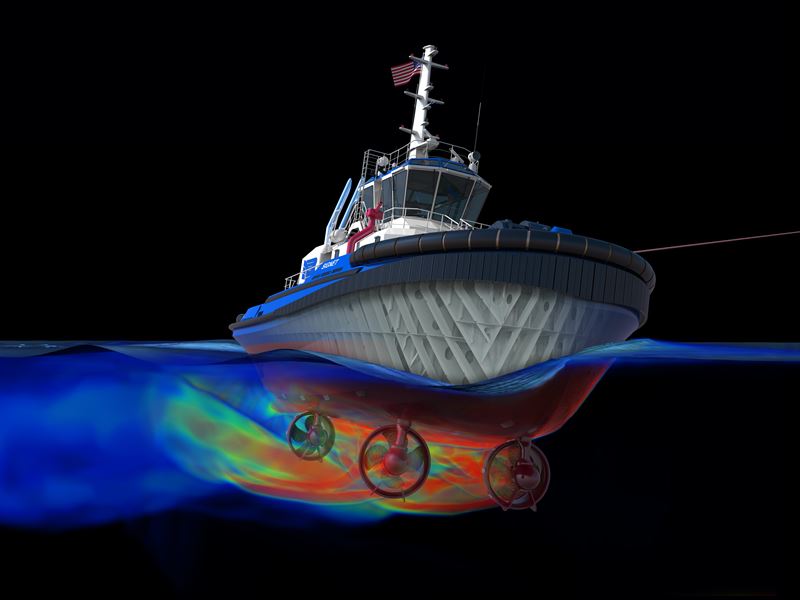
The first commercial U.S. vessel designed, built and verified using an end-to-end 3D design process is now under construction in a pioneering project by ABS, Robert Allan Ltd. (RAL), Signet Maritime Corporation (Signet) and the United States Coast Guard (USCG).
Designed by RAL, the Advanced Rotortug® (ART), which is designed to escort vessels and offshore assets at the Port of Corpus Christi, will receive its Certificate of Inspection from the USCG and will now be built and operated by Signet to ABS Class, making it the first commercial vessel in U.S. history to be produced using only 3D models in design and construction for all structures.
A purely 3D process reduces costs and time investment, while streamlining interaction between all stakeholders throughout the design, verification and construction phases, without compromising safety.
“This landmark achievement sets the bar for future projects both in the U.S. and internationally. Together with our forward-looking partners, we have realized a long-held dream of the industry to leave behind 2D paper plans and move to the next generation of vessel production. ABS is proud to help unlock this capability and to be genuinely leading the industry in this area, once again delivering the advantages of digital classification today. The advantages are significant, and we are confident that once the industry develops the infrastructure to handle 3D models in shipyards, a pure 3D process will become the default approach,” said Christopher J. Wiernicki, ABS Chairman, President and CEO.
“As Naval Architects, we find ourselves developing ship structure in 3D more than ever, even at the basic design stage for new vessels. We believe that delivering 3D models instead of traditional 2D drawings benefits all stakeholders – us as the designer, Class societies, clients, shipyards, and equipment suppliers. ‘Direct Design’ of structure in 3D not only streamlines the transition to production design modeling for the shipyard, but also gives us as naval architects earlier estimates of weights and centers, steel quantities as well as the means to check for structural interferences.
“We are very pleased that ABS has taken the initiative to work with us on a process to review and approve 3D structural models on our project with Signet Maritime Corp. Not only has it become easier to exchange complex structural design information this way, but the time from the basic design stage to the production design stage is shortened, allowing the shipyard to start cutting steel earlier,” said Mike Fitzpatrick, CEO of Robert Allan Ltd.
“The understanding and fidelity of this construction model represents a major milestone in the history of the U.S. maritime industry. 3D design review ensures the designer, engineer, production manager, fitter, welder, and surveyor all work from the same complete model. Each individual has access to both the micro (component) and macro (complete assembly) with which they are working to better understand the bracket, frame, or bulkhead as it relates to the module, section, and ship. Providing that level of awareness to all participants in the process will give ABS, Robert Allan, and Signet a superior finished product and contribute to an overall safer waterway through technological advancement,” said Timothy S. McCallum, Signet Vice President, Engineering and Dynamics.
The milestone is just the latest in a succession of ABS firsts in 3D Model-based Class. ABS was the first to develop a process for ingesting 3D models into class software to allow 3D model-based reviews in 2018. ABS then became the first classification organization to accept 3D models for class surveys in April 2020.
More information about ABS 3D Model-based Class services is available here.











, Signet Maritime Corporation (Signet) and the United States Coast Guard (USCG).Designed by RAL, the Advanced Rotortug® (ART), which is designed to escort vessels and offshore assets at the Port of Corpus Christi, will receive its Certificate of Inspection from the USCG and will now be built and operated by Signet to ABS Class, making it the first commercial vessel in U.S. history to be produced using only 3D models in design and construction for all structures. A purely 3D process reduces costs and time investment, while streamlining interaction between all stakeholders throughout the design, verification and construction phases, without compromising safety.)