Huisman has announced the launch of a newly developed system that empowers crane operators with the ability to anticipate and react to approaching wind speeds, gusts, and direction during the installation process of turbine blades.
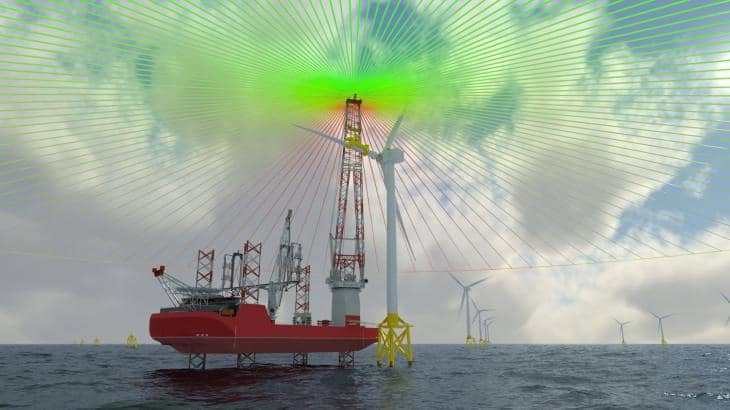
The system, called Wind Gust Buster assists crane operators and lifting supervisors when working with the installation of large objects at considerable height, by providing information on the incoming wind 360° around the boom tip.
Measurement of the incoming wind is done by application of a LiDAR system on the crane’s boom tip, scanning the horizontal area. The measurement data is post-processed by the crane’s automation system and can be shown to both the crane operator as well as to other people involved, such as on the crane vessel’s bridge. A typical prediction window is five to eight minutes ahead of the wind gust coming in, which allows sufficient time to make the “go or no-go” decision for mating a blade to a nacelle.
The system can be installed on newly built Huisman cranes as well as retrofitted to existing ones.
Cees van Veluw, Product Director Cranes of Huisman: “We are constantly looking for new developments to further improve safety in turbine installation operations. Right now, sudden wind gusts acting on turbine blades can pose a safety risk to the people in the wind turbine, as well as an integrity risk to the blade and nacelle. While we all get used to checking the rain radar prior to taking a hike outside, we haven’t seen this used the same way in turbine installation before. The Wind Gust Buster improves the crane operator’s ability to mate the blade in a controlled manner and thus contributes to safety of the whole lifting operation. Furthermore, this can lead to less damage to components like the blade’s stud bolts, and thus can lead to a cost reduction and installation speed improvement.”
The development of this system contributes to Huisman’s ambition to improve the installation of offshore wind turbines. Another recently introduced solution for controlled installation of blades is the Travelling Load Stabilising System that the company has developed in cooperation with Siemens Gamesa.
Features of the Huisman Wind Gust Buster
- Measurement of approaching wind speed and direction up to 10km distance.
- Sudden changes in the wind speed are detected in advance allowing crew member, like the person guiding the blade into the nacelle, to be informed.
- Unobstructed measurement of the wind speed as the sensor is placed on the top of the boom avoiding unnecessary downtime by inaccurate wind speed measurement due to sensor blockage.