Challenging sea conditions prompt Hydrex to adopt an alternative repair method for damaged sections of a barge hull
Hydrex carried out temporary hull repairs on a 67-metre shallow-water barge during June, adapting its original repair plan to overcome challenging weather and sea conditions while maintaining safe working practices. The work was undertaken while the barge was in the Norderney and Delfzijl areas, with damage identified in void tanks 4 and 6.
The initial repair plan called for three steel doubler plates to be installed externally over the damaged sections. However, rough sea conditions prevented the safe transfer of diving equipment on board, making the planned external repair approach unfeasible.
In response, Hydrex’s technical team developed an alternative solution that allowed the work to proceed without waiting for improved weather conditions. The revised method involved carrying out the repairs internally, with three reinforced steel cofferdams installed over the damaged areas.
The adapted approach enabled Hydrex to address the hull damage while responding to the operational challenges posed by the conditions at sea.
Internal repair in void tank 4
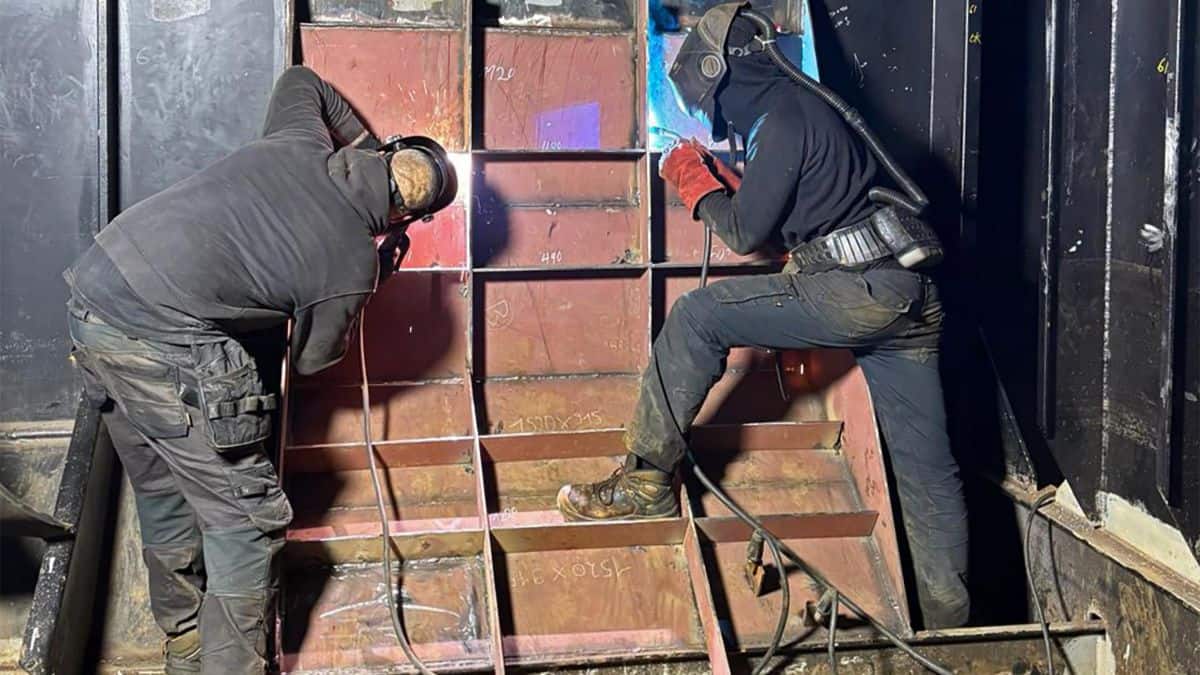
The vessel’s crew had already installed a concrete box over the damaged area. The Hydrex technicians used this as the basis for the temporary repair and constructed a steel cofferdam on the inside of the tank, directly over the concrete box.
The cofferdam, measuring 1550 x 1915 mm, was fabricated from 8 mm steel plating. Reinforcing steel frames were welded to its outside to provide additional structural strength. All mouseholes were closed with small steel plates to make the repair completely watertight.
Once the welding had been completed, all welds were examined and approved by an independent third-party inspector using Magnetic Particle Inspection (MPI).
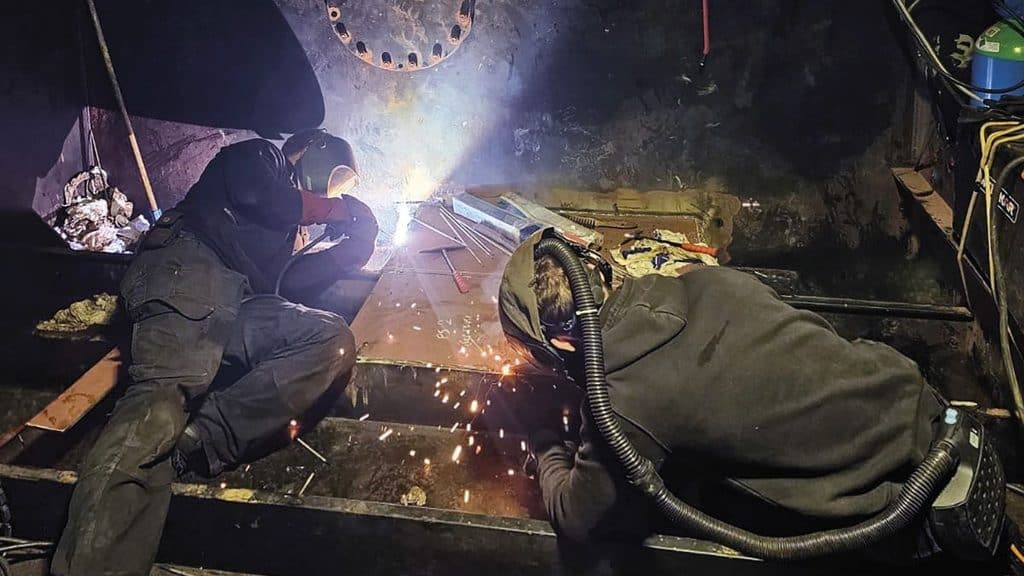
Two cofferdams installed in void tank 6
A similar solution was used for the two damaged areas in void tank 6. Prior to the team’s arrival, the vessel’s crew had installed two concrete boxes over these areas.
The technicians fabricated two separate steel cofferdams around the existing concrete boxes. As with the repair in void tank 4, both cofferdams were constructed using 8 mm steel plating.
The cofferdams measured 1000 x 1000 mm and 1000 x 980 mm respectively. Additional steel stiffening frames were welded onto the cofferdams to increase their strength and rigidity.
After the welding work was finished, the welds on both cofferdams were subjected to MPI and approved by an independent third-party inspector.
Adapting to the circumstances
Flexibility is essential during repair operations, especially when weather conditions make the original approach impossible to carry out safely.
For the barge, the initial plan for an external repair had to be changed because of the severe sea conditions. By switching to internally installed steel cofferdams, the team was able to provide a suitable temporary solution as a viable workaround to the planned underwater operation.
All three cofferdams were reinforced to provide a strong, watertight repair and the completed welds successfully passed independent inspection.