


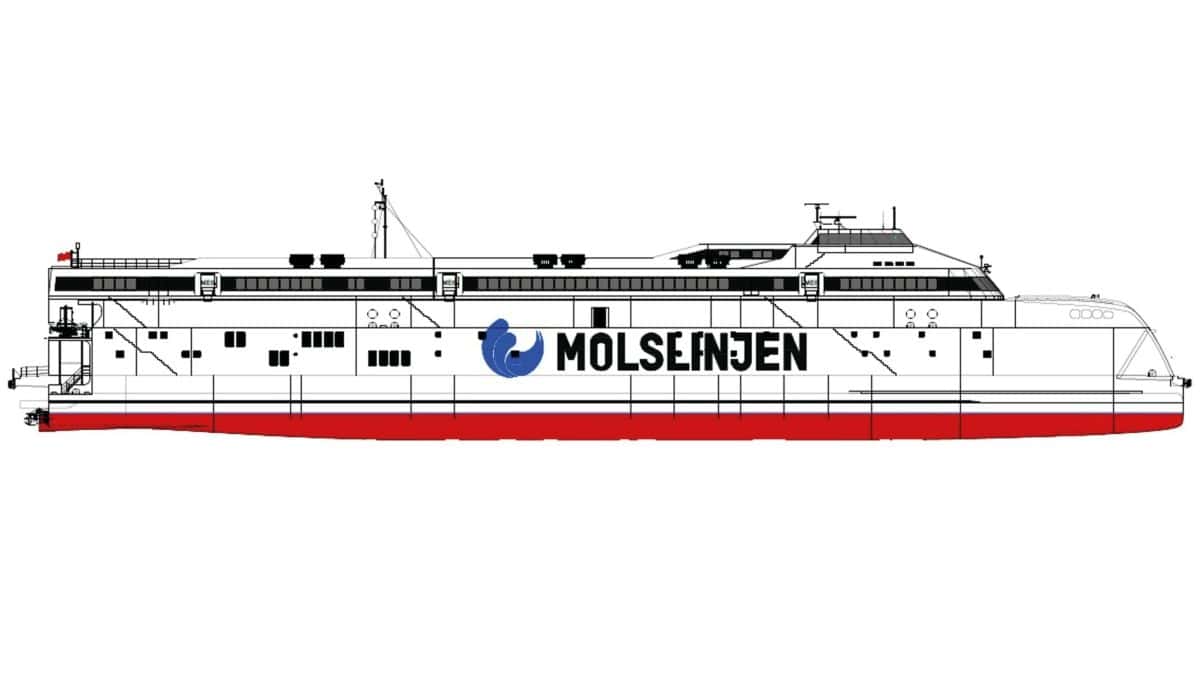
Shipbuilder Incat Tasmania has been awarded a landmark contract to design and construct two 129-metre battery-electric ferries for Danish operator Molslinjen, marking a major milestone in global maritime decarbonization. The vessels, featuring 45,000 kWh battery systems – among the largest ever installed on ships – will service the high-traffic Kattegat route between Jutland and Zealand, becoming flagship projects in what will be the world’s largest maritime electrification initiative.
This significant international order further cements Incat’s position as the world leader in sustainable shipbuilding, with construction already well advanced on Hull 096, the world’s largest battery-electric ferry, and Hull 100, a 78-metre next-generation hybrid ferry.
“These new vessels for Molslinjen mark a turning point not just for Incat but for the global maritime industry,” said Incat Chairman Robert Clifford. “They are part of a new class of high-speed, low-emission ships that are redefining what’s possible at sea. We’re honoured to again partner with Molslinjen, and proud to help them deliver real environmental change on one of Europe’s busiest ferry routes.”
The construction of these vessels commence as Incat prepares to expand its production facilities at Prince of Wales Bay in Tasmania. The expansion will allow the shipbuilder to double its capacity and workforce over the next three years and significantly increase the number of large ships it can deliver annually.
“This project aligns perfectly with our strategic vision,” Clifford added. “As global demand for sustainable ferries accelerates, our expanded facilities will ensure we’re ready to lead the way in both innovation and volume.”
The project also represents a strengthening of ties between Australia and Denmark. Incat Tasmania Managing Director Craig Clifford, who also serves as the Honorary Consul for Denmark in Tasmania, said the partnership reflects a shared commitment to the green transition.
“Incat has a long and trusted relationship with Denmark through our work with Molslinjen, and I’m particularly proud to see this next chapter unfold,” said Craig Clifford. “These vessels will connect communities across the Kattegat with high-speed, clean energy technology, and they’ll be built right here in Tasmania.”
“For many years, Molslinjen has been critical infrastructure, creating cohesion by forming a floating bridge between Jutland and Zealand. Now, we’re making that floating bridge significantly greener – setting a milestone in the green transition for ferry operations and for Denmark,” says Carsten Jensen, CEO of Nordic Ferry Infrastructure, which owns Molslinjen and the Norwegian ferry operator Torghatten
“This is a massive undertaking, involving not just the three ferries but also extensive land-based infrastructure projects and energy storage systems for the new ships,” says Kristian Durhuus, CEO of Molslinjen.
“We now have two and a half years to get ready for full electric operation on the Kattegat. It’s a fantastic milestone for our company. We are among Denmark’s five largest CO₂ emitters, and with support from the fund, we and the government now have a chance to remove 132,000 tons of CO₂ emissions from Denmark’s climate footprint each year,” says Kristian Durhuus.
Early-stage construction of the vessels will begin in the coming months, with delivery of the first vessel scheduled in late 2027. Once operational, the ferries will each carry up to 1,483 passengers and 500 cars, operating at speeds over 40 knots, and eliminating thousands of tonnes of CO₂ emissions annually.