


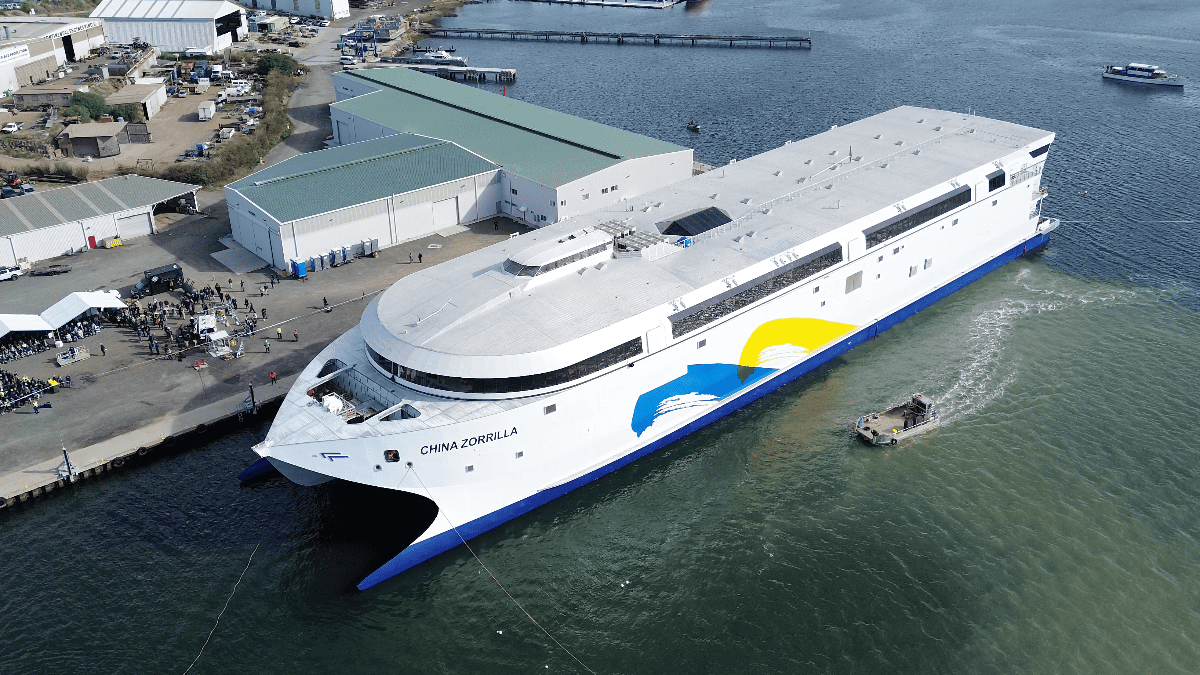
In a historic moment for sustainable shipping, Incat Tasmania today launched Hull 096 – the world’s largest battery-electric ferry – during a ceremony attended by industry leaders and government officials. The 130-meter ferry, built for Uruguayan operator Buquebús, will operate entirely on battery-electric power, on the Buenos Aires-Montevideo route when it enters service carrying up to 2,100 passengers and 225 vehicles.
Constructed for South American ferry operator Buquebus, Hull 096 is the most significant vessel ever built by Incat and represents a giant leap forward in sustainable shipping. When it enters service between Buenos Aires and Uruguay, it will operate entirely on battery-electric power,
“This is a historic day – not just for Incat, but for the future of maritime transport,” said Incat Chairman Robert Clifford. “We’ve been building world-leading vessels here in Tasmania for more than four decades, and Hull 096 is the most ambitious, most complex, and most important project we’ve ever delivered. This ship changes the game.”
The ship is the ninth Incat-built vessel for Buquebus, continuing a proud and long-standing partnership between the two companies.
“For me, it’s a true source of pride to see Buquebus’ vision come to life,” said Buquebus President Juan Carlos López Mena.”When we were evaluating this new vessel, Robert Clifford told me, ‘The next ship I deliver to you will be 100% electric.’ I replied, ‘Then the next one must be the one we’re commissioning today.’ And with great courage, he said, ‘Together, we’re going to make history.’ That’s how we began reconfiguring the China Zorrilla – originally planned to run on LNG – into a fully electric vessel. It’s a true milestone achieved between private companies, driven by our commitment to sustainability and our ongoing pursuit of service excellence.”
Tasmanian Premier Jeremy Rockliff congratulated Mr Clifford and the team at Incat for the extraordinary craftsmanship and innovation that went into building the largest battery-electric ferry in the world.
“Through hard work, determination, and ingenuity, Incat has built a globally significant battery-electric ferry from their yard in Tasmania,” Premier Rockliff said “Incat epitomises what it means to be Tasmanian as they quietly pursue the extraordinary, strengthen Tasmania’s brand on the global stage, and continue to support Tasmanian jobs and our economy. Tasmania has long been a leader in maritime innovation, and Incat’s latest achievement is a testament to our state’s world-class shipbuilding capabilities and proud seafaring heritage.”
The ship is equipped with over 250 tonnes of batteries and an Energy Storage System (ESS) boasting more than 40 megawatt-hours of installed capacity. The ESS, which is four times larger than any previous maritime installation in the world, is connected to eight electric driven waterjets and supplied by leading technology partner Wärtsilä. This combination of technology sets a new global benchmark for the shipping industry.
“We are proud to have collaborated with Incat and Buquebus in launching the world’s largest battery-electric ferry,” says Roger Holm, President of Wärtsilä Marine and Executive Vice President at Wärtsilä Corporation. “Ferries play a vital role in meeting the growing demand for environmentally sustainable transport options, with ship electrification a key solution for enabling the sector to transition towards net-zero emissions.”
“We’re not just building a ship – we’re building the future,” said Incat CEO Stephen Casey. “Hull 096 proves that large-scale, low-emission transport solutions are not only possible, they are ready now. This is a proud day for Tasmania and for Australian manufacturing.”
Work will now continue completing the vessel’s interior, which includes a 2,300 square metre duty-free retail deck – the largest shopping space on any ferry in the world. Final fit-out, battery installation, and energy system integration will take place ahead of sea trials later this year on the River Derwent.
At 130 metres in length, Hull 096 is not only the largest electric ship in the world, but also the largest electric vehicle of its kind ever built – and one of the most significant single export items in Australia’s manufacturing history.
“This ship puts Tasmania and Australia firmly on the world stage,” Clifford added. “We’re incredibly proud of what our team has achieved – and this is only the beginning.”