Incat Tasmania is excited to announce a new partnership with Danish Shipping and Logistics Company DFDS to complete a design study for the construction of a cutting-edge electric-hybrid ferry.
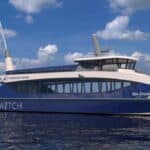
The 72-metre ferry, which will have the option to convert to fully electric, is suited to a number of ferry routes across Europe.
Incat CEO Stephen Casey says the Tasmanian shipbuilder is ideally placed to design and build this next generation of electric-hybrid ferry for the world market.
“Since launching the design of our series produced electric ships last November there has been significant interest from many ferry operators, and we’re excited to work with DFDS on their projects,” Mr Casey said.
“The Incat 72-metre series is offered in a fully electric model that is suited to many ferry networks around the world.”
“Incat’s industry leading design and construction capabilities, and our commitment to sustainability, make us the logical choice for ferry operators who want a vessel of the highest quality whilst minimising their environmental footprint.”
“We know that battery electric or electric-hybrid propulsion coupled with lightweight aluminium on shorter sea routes will be the ideal choice to cut emissions, and it’s great to see major operators such as DFDS sharing in our goal to shape the future of decarbonisation in maritime transport.”
“Incat pioneered the development of large vehicle carrying catamarans in the 1990’s and now we’re ready to work with ferry operators around the world to showcase what the future of maritime transport looks like.”
“Incat has specialised in lightweight aluminum vessel design and construction for the past four decades. Aluminum ferries, being approximately half the weight of their steel counterparts, require less power when operated at similar speeds and deadweights. This results in significant energy savings and emissions reductions.”
Incat is based in Tasmania where the State generates 100 per cent of its energy needs from renewables, and the energy consumed in the construction of Incat vessels comes from 100 per cent renewable sources – a combination of hydro, wind and solar. Tasmania has achieved Net Zero emissions for the past 7 years in a row, making Incat the only shipyard in Australia, and part of only a handful in the world, able to produce zero-emission ships in a State that has already achieved net-zero.
Incat is world renowned for its quality shipbuilding, undertaking all its manufacturing on shore in Australia and servicing a global market. Incat was recently announced as one of Australia’s Best Managed Companies for 2023 as part of Deloitte Private’s Best Managed Companies Program.