



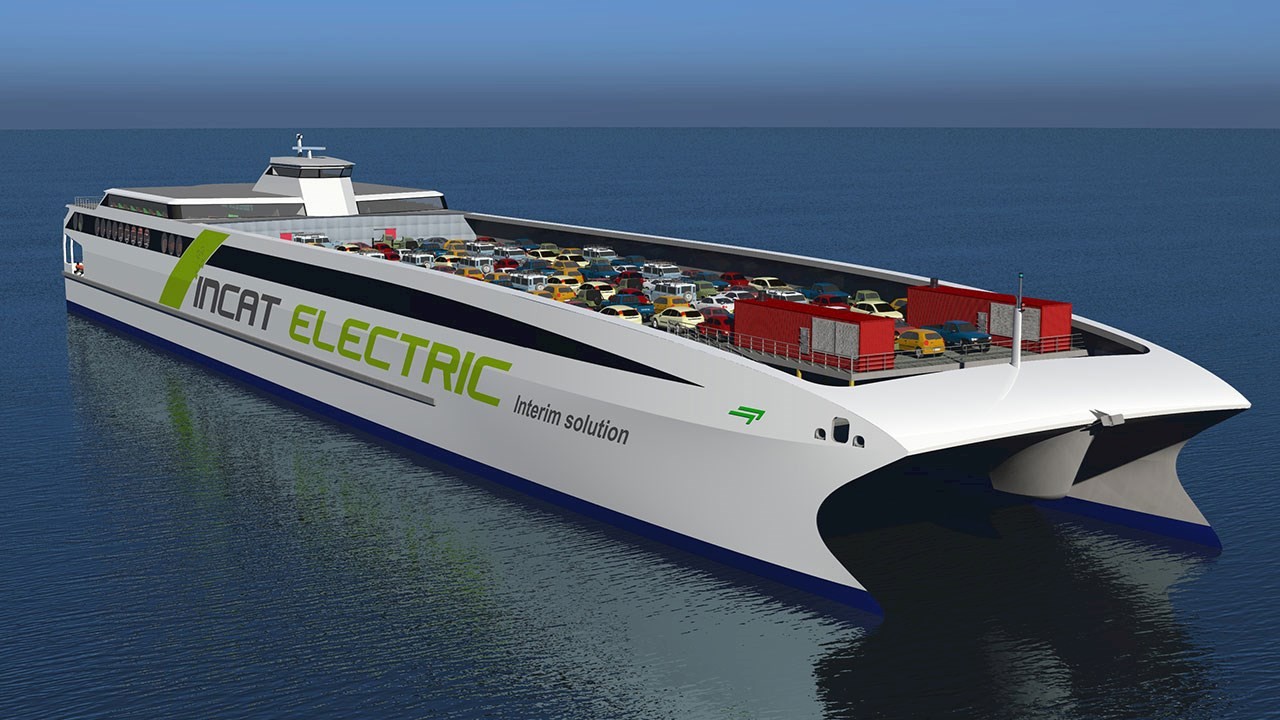
ABB and Incat Tasmania will explore building an electric ferry with hybrid-electric propulsion which could transition to battery power as shore charging becomes available. In a groundbreaking collaboration between the two companies, the announcement paves the way for ABB to supply zero-emission power and propulsion solutions and evaluate a future commercial arrangement for the 148-meter long ferry and similar vessels.
Seeking a transitional route to zero-emission operations for the ferry segment, two leaders in ferry design and maritime technology, Incat and ABB will evaluate the suitability of the ‘Incat 148E’ – a roll-on roll-off passenger (RoPax) catamaran for operating in hybrid mode as well as adapting to full battery operation at a later stage.
“All at Incat are extremely excited at having the opportunity to work alongside ABB. This collaboration combines the world’s leading global technology company and the world’s leading lightweight ship builder into a partnership that is 100 percent focused on completely green energy transportation solution of future,” said Robert Clifford, Founder and Chairman of the Board, Incat Group of Companies. “Lightweight Incat ships use up to 40 percent less power than an equivalent steel ship, which means up to 40 percent less emissions. We’ve done extensive work in applying our excellence in ferry design to the specifics of electric propulsion. ABB is the ideal partner to help Incat realize our ambition to lead the shortsea shipping industry into a more sustainable future.”
Conceived by Revolution Design, Incat’s in house design office, the 148E would be built in Australia to DNV class, operating at speeds of up to 21 knots. It would feature ABB’s Onboard DC Grid™ power distribution, ABB Ability™ Power and Energy Management System™ (PEMS), 800xA distributed control systems, a remote diagnostic system, and two Azipod® propulsion units enabling highly precise control and maneuverability maximizing efficiencies across the operational range of the vessel.
With its proven Azipod® propulsion, ABB has vast experience in delivering hybrid-electric propulsion solutions. The company has also established a strong position as an integrator of marine battery systems for ferries, a ship type which carries approximately 4.27 billion passengers plus 373 million vehicles worldwide per year*.
“There is no single solution where shipping’s emission challenges are concerned and we have to be imaginative in this transition to more sustainable ferry operations,” said Palemia Field, Global Segment Manager, Ferries, ABB Marine & Ports. “Considerations of what a future ferry could or should look like and how it would operate are bringing bold thinking to market. ABB’s innovative electric solutions are an enabler for forward-looking companies like Incat.”
In the first instance, the hybrid-electric propulsion solution envisioned for the Incat 148E will involve the vessel’s diesel engine charging a shipboard battery, whose output provides the flexibility in power management to improve fuel efficiency and cut emissions. When shore charging facilities are available, Incat-built electric ferries would make greater use of batteries, with project goals envisaging installed battery power of up to 30MWh.









 catamaran for operating in hybrid mode as well as adapting to full battery operation at a later stage. “All at Incat are extremely excited at having the opportunity to work alongside ABB. This collaboration combines the world’s leading global technology company and the world’s leading lightweight ship builder into a partnership that is 100 percent focused on completely green energy transportation solution of future,” said Robert Clifford, Founder and Chairman of the Board, Incat Group of Companies. “Lightweight Incat ships use up to 40 percent less power than an equivalent steel ship, which means up to 40 percent less emissions. We’ve done extensive work in applying our excellence in ferry design to the specifics of electric propulsion. ABB is the ideal partner to help Incat realize our ambition to lead the shortsea shipping industry into a more sustainable future.”)