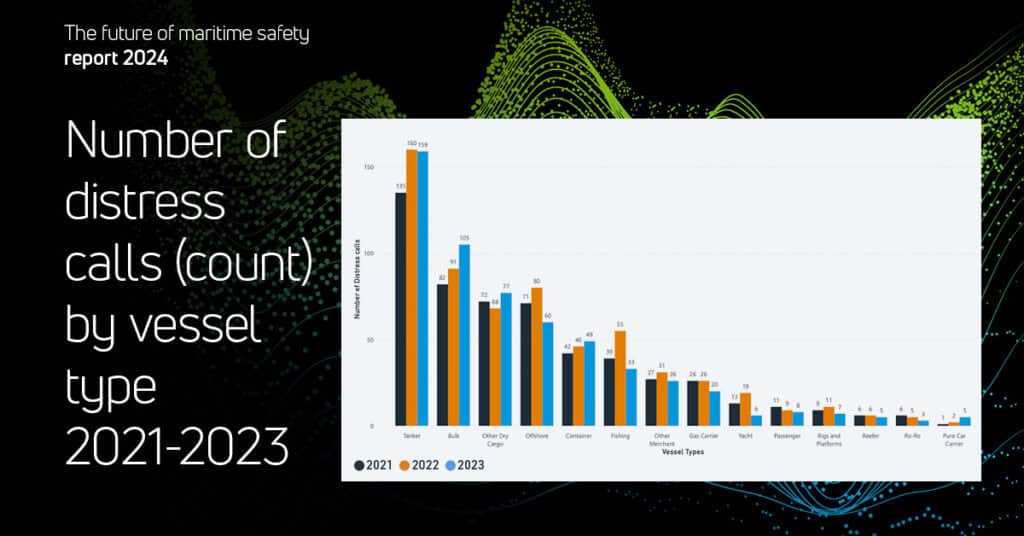



The 2024 edition of The Future of Maritime Safety Report from Inmarsat Maritime, a Viasat company, reveals that Global Maritime Distress and Safety System (GMDSS) distress calls decreased by 7.6% in 2023 over the previous year. Despite this decline, the service was still triggered on 788 occasions and remains close to the six-year average of 799 calls per year. This statistic underscores the ongoing challenges in maritime safety and the need for real improvements.
The report suggests that the maritime industry is beginning to overcome some operational challenges linked to the Covid-19 pandemic, such as limited inspections and disrupted maintenance schedules. However, with the emergence of potential new safety risks associated with future fuels – particularly in the context of the industry’s transition to more sustainable practices – and escalating geopolitical tensions, the industry must intensify its efforts to mitigate preventable safety issues.
The Future of Maritime Safety report not only provides a snapshot of current safety metrics but also serves as a call to action for the maritime industry to embrace data sharing and collaborative problem-solving as the industry strives to navigate through significant changes, including the transition to greener propulsion technologies.
The report goes on to suggest that any concerns regarding data pooling related to confidentiality or reputational damage could be addressed by anonymising casualty and incident data. It recommends that the shipping industry establishes a list of standard data points to monitor and report, including casualties and incidents, injuries or deaths at sea, and near misses. It also endorses trend analysis to support the development of safety measures, with a particular emphasis on developing risk treatments for well-known and recurring issues.
Peter Broadhurst, Senior Vice President, Safety and Regulatory, Inmarsat Maritime, said: “By harnessing the power of anonymised safety data, we can identify trends, develop specific mitigation measures, and enhance the overall safety of our ships and crews.” He also highlighted the critical role of technology in supporting these efforts, noting that “modern technology offers unprecedented opportunities to improve safety through better data analysis and sharing.
“Although progress has been made, shipping continues to experience significant casualty rates,” commented Broadhurst. “We collect vast amounts of safety data, yet the current siloed-working model hinders our ability to fully leverage the actionable insights available to us. By pooling data, we can create a more holistic and objective view of maritime safety to inform performance improvements and ultimately reduce the occurrence of preventable safety incidents to save lives at sea.”
Inmarsat invites maritime professionals, policymakers, and stakeholders to read the full report to better understand the dynamics of maritime safety and to join in the collective effort to safeguard our seas.
The Inmarsat Maritime Safety Report can be accessed here.