



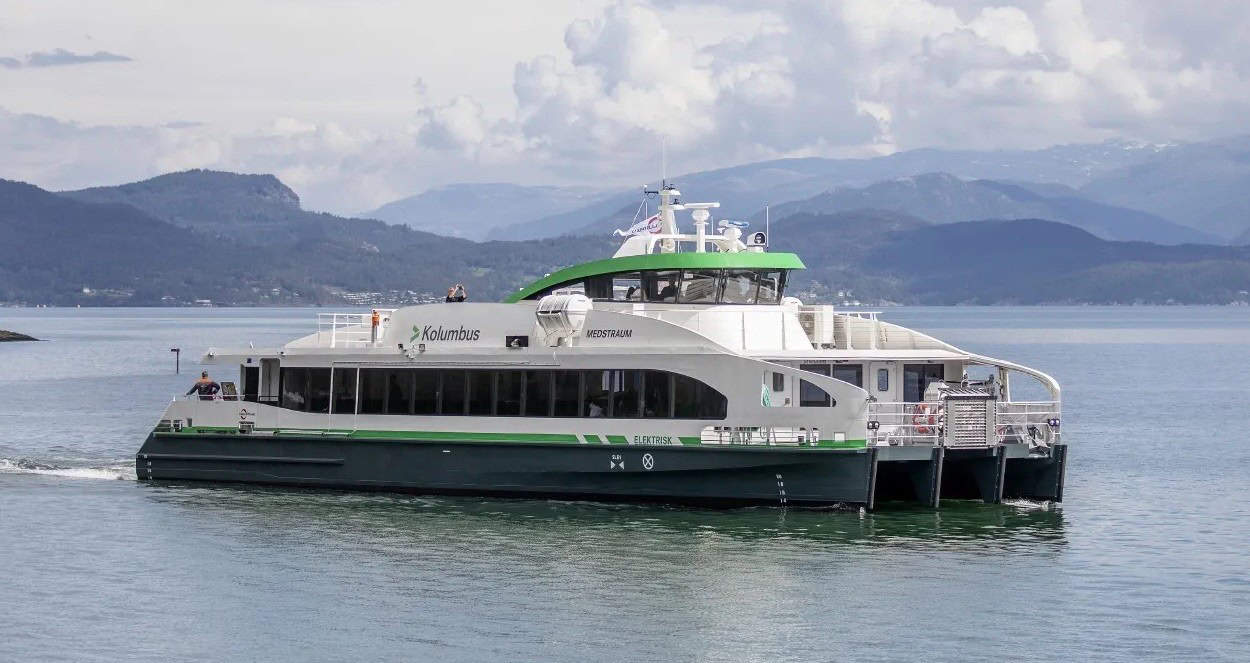
As part of the EU-funded TrAM project, Wärtsilä and partners have delivered a zero-emission fully electric fast ferry that operates on a commuter route in Norway. This ferry not only serves passengers between Stavanger and Hommersåk without releasing emissions to air or sea – it also demonstrates that fully electric passenger fast ferries are a viable concept with great promise.
The TrAM (Transport: Advanced and Modular) project, funded by the European Union’s Horizon2020 Research and Innovation programme and facilitated by the Norwegian cluster organisation Maritime Clean Tech, aims to create a zero-emission fast ferry concept through advanced modular production. It is expected that modular manufacturing methods will reduce production costs by 25% and engineering costs by 70%. The first vessel resulting from the project, the MS Medstraum, is now fully operational.
MS Medstraum operates all day, every day on a multi-stop commuter route and is capable of carrying 147 passengers at a typical cruising speed of 23 knots. Though the route between Stavanger and Hommersåk is fixed, there are 12 potential stops along the way depending on whether any passengers are waiting, so the actual route can vary considerably.
Charging ahead towards zero-emission operations
As a project partner, Wärtsilä’s job was to deliver the PMS/EMS control system, propulsion motors, power converters, batteries, onboard and shore-based battery charging equipment, and various electrical systems. “The project demanded lightweight materials for all components including batteries, converters and motors,” says Ingve Sørfonn, Technical Manager at Wärtsilä. “For example, cabinets were changed from steel to aluminium, and we had to develop a new, weight-optimised charging concept.”
Wärtsilä’s job was to deliver the PMS/EMS control system, propulsion motors, power converters, batteries, onboard and shore-based battery charging equipment, and various electrical systems.
“The charging system was a real challenge,” explains Frode Jenset, Technical Specialist at Wärtsilä. “At over 1000 kg the existing systems were all too heavy, so we developed a new lightweight shore-charging concept that uses standard CCS2 chargers – the same type used in electric cars.” Standardising the charging system will be crucial if electric vessels are to be developed on a broader scale – there are too many dedicated charging concepts on the market today which is a barrier for charging different vessel types. The newly developed CCS2 concept will be a major contributor to accelerating this process. “The charging system is charging the MS Medstraum around a dozen times a day and is looking very good so far,” continues Jenset.
The need for modularisation
One of the key goals of the TrAM project is to support a modular, scalable approach to building vessels. For that reason, the project is developing a toolkit of methods and software for use when designing and constructing inshore vessels. The idea is to combine modular production with ship design and construction methods – making it possible to reuse designs and components while customising each vessel as necessary. For example, depending on whether you’re building a passenger ferry or a different type of vessel you would choose the appropriate hull, superstructure and propulsion module. “The goal is to copy what the car and aviation industries do, with different partners sending their parts to the yard for assembly; this makes the whole production process more flexible, less costly and much faster,” explains Sørfonn.
One of the key goals of the project is to support a modular, scalable approach to building vessels that makes it possible to reuse designs and components while customising as necessary.
Wärtsilä’s approach to supplying the electrical systems supported this goal. “We always use a modular approach,” says Jenset. “We supply the correct size of motor and the rest of the electrical systems – the control system, converters, motors, energy management system and auxiliary supply – are supplied as modules as needed for each vessel.”
Weighing up efficiency
Project partners at the University of Strathclyde in Scotland and the Ship Design Lab of the National Technical University of Athens in Greece were invaluable in calculating the weight efficiency ratio and hull design of the vessel. An interesting finding was that for fast ferries there is an almost 1:1 ratio between changes in vessel weight and losses in the propulsion system. This means that if we can reduce losses by 1% we can afford a vessel that is 1% heavier or, conversely, if we reduce the weight by 1% we can tolerate a 1% reduction in propulsive efficiency.
A sustainable concept with a bright future
But why create a fully electric fast ferry in the first place? The answer lies in the amount of emissions ferries are responsible for. The ratio of passenger kilometres travelled to CO2 emissions is very high for ferries compared to buses, for example. Indeed, fast ferries can even be worse than planes in some cases from an emissions perspective. “This is what makes zero-emission ferries so attractive,” explains Jenset.
The fully electric ferry concept is expected to spread.
Written by
Amanda Thurman






 project, funded by the European Union’s Horizon2020 Research and Innovation programme and facilitated by the Norwegian cluster organisation Maritime Clean Tech, aims to create a zero-emission fast ferry concept through advanced modular production. It is expected that modular manufacturing methods will reduce production costs by 25% and engineering costs by 70%. The first vessel resulting from the project, the MS Medstraum, is now fully operational. MS Medstraum operates all day, every day on a multi-stop commuter route and is capable of carrying 147 passengers at a typical cruising speed of 23 knots. Though the route between Stavanger and Hommersåk is fixed, there are 12 potential stops along the way depending on whether any passengers are waiting, so the actual route can vary considerably.)