
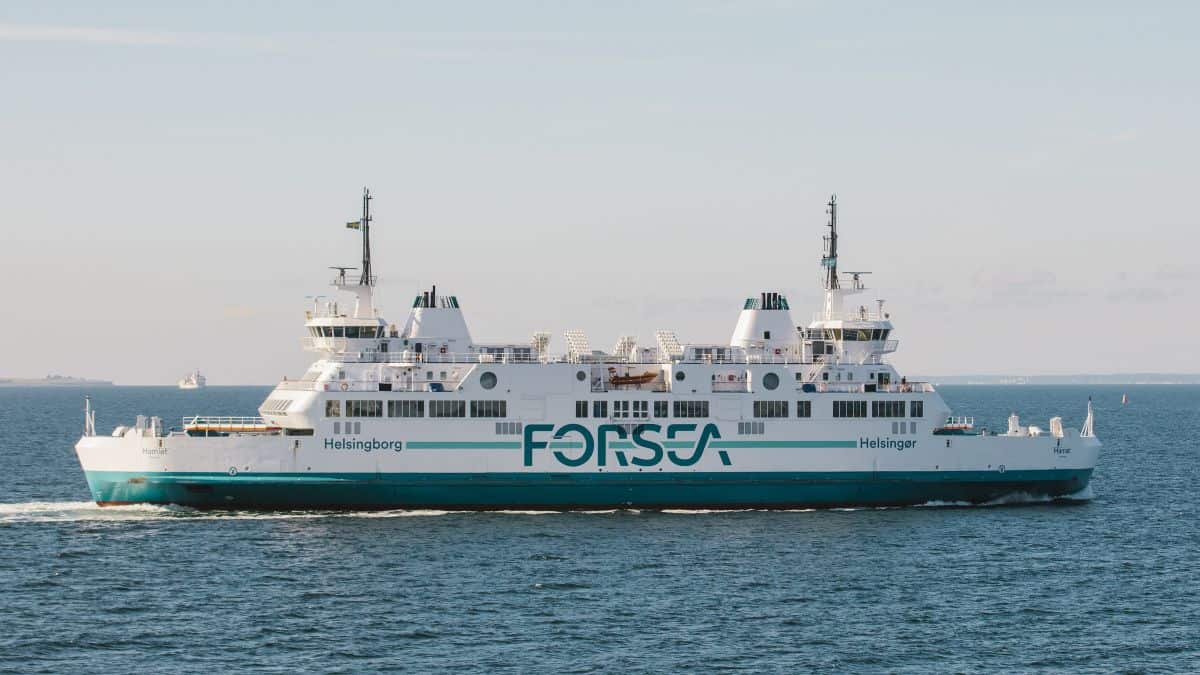
Kongsberg Maritime has secured a significant upgrade project to convert the double-ended car ferry “MF Hamlet” to fully emission-free, battery-powered operation. Operated by Öresundlinjen, MF Hamlet serves the busy route between Helsingør, Denmark, and Helsingborg, Sweden, providing an essential link for passengers and vehicles crossing the Öresund Strait.
The primary goals of the project include achieving zero emissions, enabling full electric operation with batteries, and having mechanical propulsion redundancy. The ferry will utilise high-voltage charging in port, taking only 8-12 minutes, and low-voltage charging via gensets as an alternative.
Kongsberg Maritime will be responsible for rebuilding the existing thrusters to electric operation, installing new Permanent Magnet (PM) motors for each of the four main azimuth thrusters, each rated at 1530 kW. Additionally, Kongsberg Maritime will provide a comprehensive energy, automation, and control package, which includes interface to the main switchboard, retrofitting the K-Chief 600 to the new K-Chief system with an Energy Management System, and implementing Mcon thruster control with control chairs on the two bridges.
Energy storage systems will be supplied by Echandia directly to the owner, while Oresund Drydocks will handle the mechanical conversion. Installation company SH-Group will produce and install deck houses and ensure that cabling is routed the right way and that the new equipment will be installed and wired.
The rapid conversion job is scheduled to start in November 2025 at Oresund Drydocks, but the vessel will be visiting the yard in March during scheduled maintenance docking for preparation work before operating the summer season and then undergoing conversion.
The conversion will enable emission-free operation with powerful battery packs for each of the four thruster motors. The thrusters will be powered by the electric motors, with the existing diesel engines as a backup. The ferry route between Helsingør, and Helsingborg across the northern and narrowest part of the Øresund strait, is one of the world’s busiest international car ferry routes. With the MF Hamlet’s conversion, the entire route will be fully electric.
Kongsberg Maritime’s scope will include the conversion of the top gear on the four US 3001 Controllable Pitch thrusters, rebuilt to have twin input, where the primary input is driven by the new electric permanent magnet motors and the secondary is connected to the existing diesel engines. The ferry will charge its batteries shoreside connecting to the existing charging robots (10.6 MW/10.4 kV).
The ferry will also be prepared to install Kongsberg Maritime’s Auto-Crossing and Auto-Docking technology to automate transit and harbour manoeuvres.
The MF Hamlet will have completely new deckhouses installed on the top deck, with Kongsberg Maritime energy equipment and the Echandia batteries being key features. The two bridges will get new console layouts to improve visibility and new control chairs for the pilot and co-pilot for enhanced ergonomic operation.
Kristian Durhuus, CEO, Molslinjen, said: “We have the strategic vision to electrify our entire fleet to secure the complete green transition and become carbon-neutral in 2040. Hamlet is an important step for us, and we look forward to welcoming our passengers to yet another fully electric ferry on Øresundslinjen.”
Speaking today at the Martime Battery Forum conference WattsUp 2025 in Helsingborg, Martin Kjøraas, Head of Aftermarket Sales Seaborne, Integration and Energy, at Kongsberg Maritime, said, “We are proud to lead the electrification of the MF Hamlet ferry. This project demonstrates our dedication to sustainable maritime solutions and our expertise in hybrid and electric upgrades.
“The continuous collaboration between Öresundlinjen, the yard, and all sub-suppliers has been exceptional in the project preparation phase, and we look forward to seeing the positive impact this conversion will have on the environment and the efficiency of this busy ferry route.”